


Why drawing points is not yet generating space
A list of events supplies a sequence. A spatial description additionally says which events are related as neighbours, how separation is compared, and how these relations persist. The coordinates used on this page are a representation of an explicitly chosen structure. Their appearance on a screen does not derive their physical meaning. [B01] [B08]
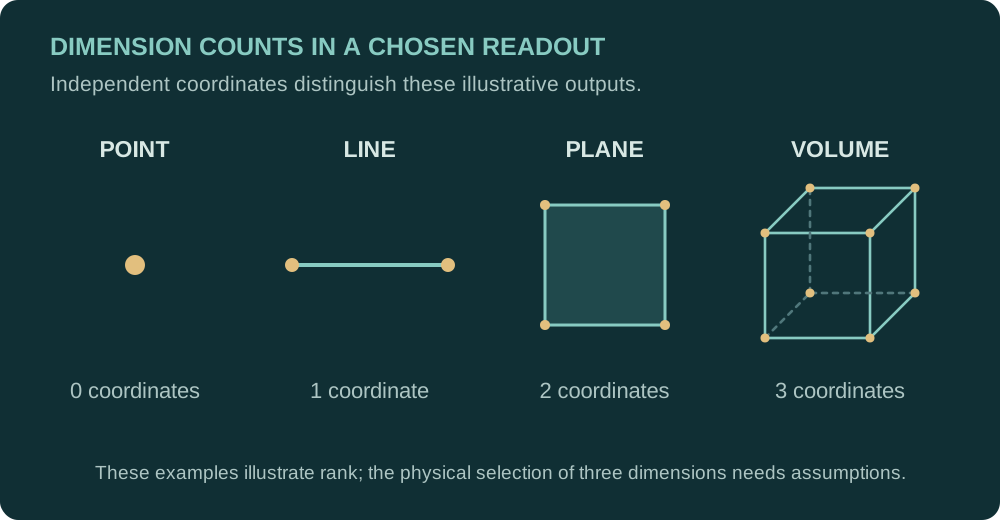
There are at least three tasks. First, obtain independent distinguishable directions. Second, organize records into neighbourhoods with controlled propagation. Third, connect those relations to physical rulers, clocks, and a continuum description when one is appropriate. A successful result at the first task is useful without silently claiming the other two.
A fully specified six-role construction
Let six binary roles be b₁,…,b₆, with each bᵢ equal to 0 or 1. Pair them into signed coordinate differences, with a supplied length scale ℓ. This is an explicit realization of three paired directions in the expanded DoT reader. [B06]
Six roles, three coordinate pairs
Choose how many binary roles are active. The points are the distinct outputs of the supplied paired-coordinate rule; a repeated output may have more than one generating address.
With all six roles active there are 2⁶ = 64 generating addresses. Each difference takes the values −1, 0, or +1, giving 3³ = 27 distinct sites. Zero has two binary realizations, (0,0) and (1,1), while each nonzero difference has one. The centre therefore has eight addresses and a corner has one. Equal address weights are not equal site weights.
After one role the readout varies along one coordinate. Its partner extends the same coordinate. The third and fourth roles open and extend a second, and the fifth and sixth do the same for a third. The rank sequence 1,1,2,2,3,3 follows from the chosen pairing. The animation displays this rule rather than claiming that the pairing has been uniquely selected by the mere existence of one source.
A different route: quaternionic readout
The published quaternionic reconstruction addresses a more specific selection problem. Within a stated finite-dimensional class with associativity and a positive multiplicative norm, incompatible circular phases select a quaternionic carrier. A scalar-insensitive, covariant readout then accesses the three-dimensional imaginary part. [P01] [B07]
The scalar direction represents the part to which this detector is insensitive. The remaining directions transform together under the specified rotation action. Within the theorem’s class, a nonzero covariant detector cannot keep only one or two of those intrinsic directions while discarding the others in an invariant way.
This is a conditional rank-three result, distinct from the paired-bit illustration. The two constructions should not be merged into a single proof. The paired-bit example demonstrates how six assigned roles can encode a three-component output; the quaternionic theorem uses algebra and covariance to constrain an admissible readout. Neither alone constructs a metric manifold filled with matter.
Locality requires a rule for neighbours
Once completed sites have an adjacency relation, a local update can be defined. If each step can transfer influence only across one edge, a disturbance reaches at most n edges after n steps. The proof is an induction: one update extends support by at most one neighbourhood layer. [B08]
The statement is exact for the supplied graph and update rule. If a distant-looking pair is connected by an additional edge, it becomes adjacent in that graph and the propagation possibilities change. Thus locality is a property of the relational structure together with the dynamics, not a property of the drawing’s apparent distance alone.
In a physical reconstruction, the source must explain why the relevant neighbourhoods arise and why interactions respect them. The internal order that visits generating addresses should also be distinguished from observable transport. A carry operation in an address counter can jump between plotted positions without representing a particle crossing that distance.
Different meanings of “dimension”
| Dimension | What it measures | Why it matters |
|---|---|---|
| Readout rank | Independent components resolved by a detector. | A local three-component output need not already be a three-dimensional space. |
| Volume-growth dimension | How the number or measure of sites grows with radius. | The scaling depends on the distance and counting rule. |
| Spectral dimension | How diffusion or spectral probes scale. | It depends on the operator and can vary with scale. |
| Manifold dimension | Coordinates needed in local smooth charts. | It presupposes a suitable continuum organization. |
These notions coincide in familiar ideal Euclidean examples under appropriate conditions. They need not coincide on an arbitrary graph, a fractal structure, or a scale-dependent effective model. Stating which dimension has been obtained prevents a rank count from carrying more physical meaning than its proof supplies. [B08]
Vacuum geometry and matter patterns
The book account treats space itself as generated, rather than as a substance or container assumed before generation. Matter must then be described through structured activity or stable distinctions within that generated setting. This shifts the explanatory burden: a single source law should ultimately account for geometry, persistent matter patterns, and their interaction together. [B15]
A useful next model would identify a vacuum record, define perturbations of it, and calculate how those perturbations evolve. It would need to explain which excitations persist, what observable quantities identify them, how they propagate, and why different measuring devices agree on their geometry. Naming a localized bright patch “a particle” in an animation would not supply those dynamics.
The bridge to the next chapter is phase. Spatial orientation, circular recurrence, and hyperbolic temporal pairing all have mathematical descriptions, but they are not interchangeable. Understanding their differences helps make the proposed origin of space more precise.