


What does a clock measure?
An outer record index says which completion follows which. A clock adds an operational measure of duration. Repeated cycles, transitions, or other reproducible changes can be counted and compared with a reference. A regular teaching model may use tₙ = nΔt, but constancy of Δt and its physical value are assumptions until the source and clock dynamics justify them. [B03]
Two clocks made from different physical processes should agree after calibration in the regime where the proposed theory claims universality. Producing one counter with the desired rate is therefore insufficient. The deeper task is to explain why material clocks, signal propagation, and matter dynamics use compatible temporal and spatial scales.
Inner generative order also must not become an observable preferred frame without an explicit physical prediction. If a hidden order is meant to be unobservable, the completed tests must actually be insensitive to it. Merely asserting that the operations occur “inside” time does not prove that their effects respect relativistic observations.
A conditional bridge to a propagation cone
The published reconstruction gives a useful conditional inequality. Suppose a completed history has additive budget N, displacement x, and measured duration T. Supply a displacement scale ℓᵢₙ per budget unit and a completion-rate calibration ν. If the model satisfies the following bounds, it has a finite propagation cone. [P01] [P02]
The derivation is direct: the duration inequality gives N ≤ νT; insert that in the displacement bound. This makes clear where the speed scale comes from and which premises carry it. The source must still select or calibrate ℓᵢₙ and ν and explain which physical excitations attain the bound.
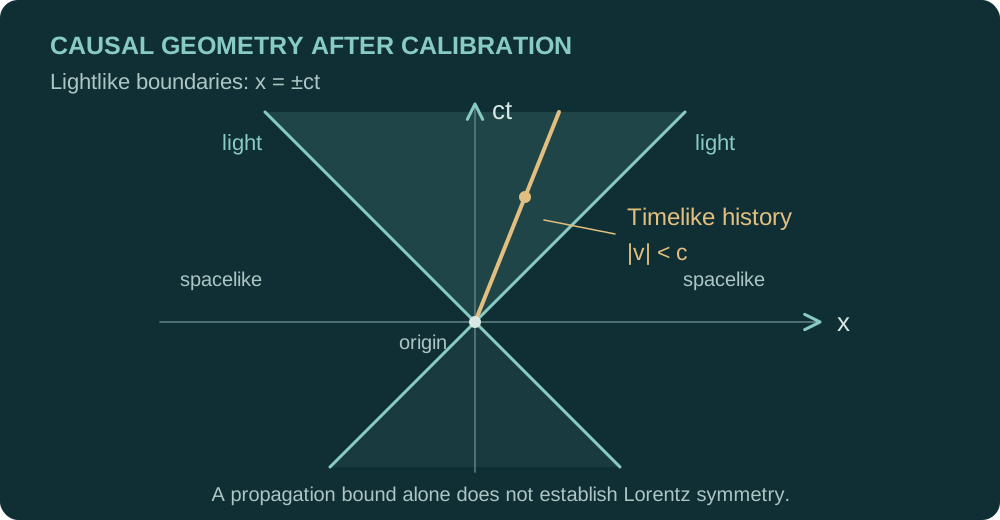
Equality with an isotropic Lorentz cone requires an additional sharpness condition: accessible histories must approach the boundary in every direction. The relevant cone structure constrains a Lorentzian form up to scale; further normalization and volume or orientation conditions identify the usual transformation group. A finite speed on an arbitrary lattice does not by itself establish all of special relativity.
Compare the readings of inertial clocks
Compare coordinate time and proper time
A special-relativistic benchmark for uniform inertial motion. The slider sets v/c. The clock comparison uses dτ/dt = √(1 − β²), after the Lorentzian structure is supplied.
Here t is coordinate time in one inertial frame and τ is the proper time of a uniformly moving clock. At β = 0.6, γ = 1.25 and dτ/dt = 0.8. A coordinate interval of 10 units corresponds to 8 proper-time units for that inertial worldline. The example holds the selected speed constant throughout each displayed run.
This is a benchmark the reconstructed physics should reproduce. It is not a new derivation of time dilation from the animation. The interpretation of the worldline, the invariant interval, and the behaviour of actual clocks must come from the physical model.
The interval and proper time
Once a Lorentzian metric has been identified, an inertial segment in flat spacetime satisfies c²dτ² = c²dt² − dx² − dy² − dz² for a timelike trajectory. Dividing by dt² yields the clock rate used above. The elapsed proper time along a general timelike path is obtained by integrating the local rate.
Three spatial readout directions plus one clock variable do not uniquely determine this metric. The same number of coordinates can be used with Euclidean, Galilean, or other structures. The physical content lies in the admissible transformations, propagation, metric signature, calibration, and agreement of matter clocks. [B10] [P01]
What remains beyond the flat benchmark
A local cone structure alone is not Einstein’s field equations. A gravitational theory also needs a law for how geometry varies, how matter couples to it, and how the resulting dynamics reproduces tested gravitational phenomena. A conformal cone fixes less than a fully calibrated metric, and a metric alone fixes less than a dynamical theory.
Within SMM/DTT, this directs attention to a common generative rule for vacuum geometry, matter, and clocks. The goal is not only to place them in one interpretation, but to calculate compatible equations and identify observations that test the underlying mechanism. The conditional cone construction is a concrete bridge toward that goal, with its premises visible. [P01] [P02]