


Two units, two invariant geometries
The original Duality of Time presentation uses hyperbolic, or split-complex, conventions in its complex-time discussion. Ordinary quantum amplitudes use the ordinary complex unit. The distinction is algebraic: one unit squares to +1, the other to −1. They cannot be exchanged merely because both extend real coordinates. [B18] [B10]
| Structure | Algebra | Transformation | Invariant |
|---|---|---|---|
| Ordinary complex | i² = −1 | eⁱˢ = cos s + i sin s | x² + y² |
| Split-complex | j² = +1 | eʲˢ = cosh s + j sinh s | x² − y² |
The second invariant is indefinite: it can be positive, negative, or zero for a nonzero vector. In particular, split-complex numbers have nonzero zero divisors. It is therefore not a positive norm like the ordinary complex modulus. This difference matters when describing physical positivity, phase recurrence, or a Lorentzian interval.
Explore the difference directly
Circular phase and hyperbolic pairing
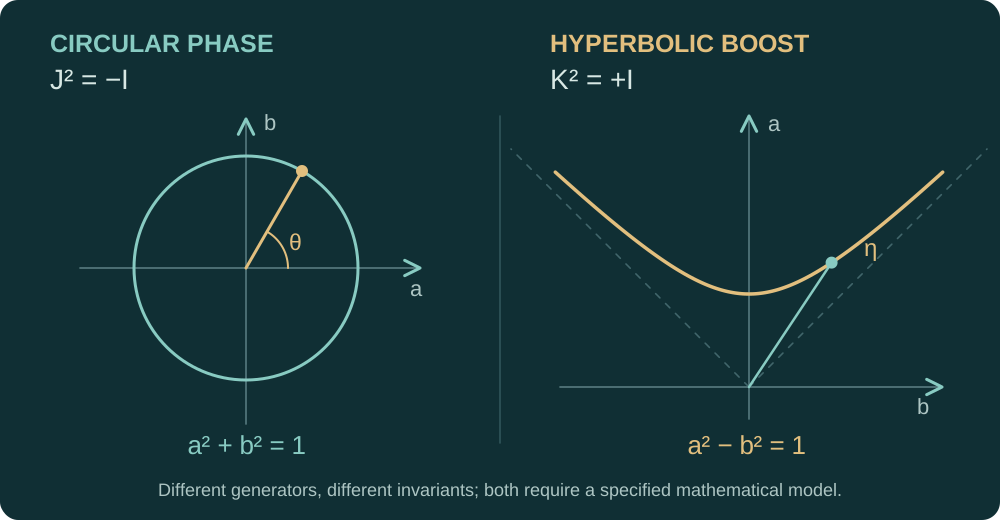
Move the parameter to compare a circular rotation with a hyperbolic boost. Each transformation preserves a different quadratic form.
For the circular transformation, the initial vector (1,0) moves to (cos s, sin s). The sum of the squared coordinates stays equal to one. For the hyperbolic transformation it moves to (cosh s, sinh s); their squared difference stays equal to one. The displayed parameter is dimensionless in both examples.
Periodic return belongs to the circular example. The hyperbolic example describes a boost-like transformation and does not close into a circle as the parameter increases. A visual model that uses a spinning circle to illustrate recurrence should therefore not quietly claim to have demonstrated Lorentz boosts with the same operation.
How complex phase can arise from real dynamics
The phase-selection papers start from real Hilbert-space representations and ask which operators can play the role of an imaginary unit while respecting the represented symmetries. A compatible operator J must square to −I and have the appropriate adjoint and commutation properties. This makes phase a structural question about the real representation, rather than simply adding the letter i by convention. [P02] [P03] [A03]
A real skew-adjoint dynamical generator A has a polar phase on its nonzero dynamic sector. In the form A = J|A|, the positive factor |A| carries frequencies and J carries the orientation of rotation. For a single rotating plane with generator A = ωJ₀, the selected phase is J = sign(ω)J₀. Reversing the dynamical orientation reverses the sign.
This formula needs domain care in infinite-dimensional settings; the inverse is not a claim of a bounded everywhere-defined operator. Zero modes require separate treatment because A supplies no rotation there. A compatible complex structure also does not by itself supply a complete quantum measurement theory or the composition law for multiple systems.
A common phase for composite descriptions
Giving each real system a complex structure does not automatically produce the ordinary complex tensor product when the systems are combined over the reals. The usual complex composite identifies the action of i on either factor. In real notation, that identification takes the form below. [P02] [P03]
This is a phase-balancing rule. It explains why compatible local phases and a global composition prescription are separate pieces of a reconstruction. Keeping the distinction explicit is especially important for interference and entanglement, where relations between subsystems are part of the observable content.
In SMM/DTT language, the aim is to connect generative operations with the phase information that survives completion and can be used in joint tests. The representation result helps identify admissible phase structures; the physical source law and the actual apparatus must still explain how those structures are realized.
Hyperbolic notation and Lorentz boosts
Once a spatial coordinate x, a time coordinate t, and a speed scale c have been calibrated, introduce the split-complex quantity Z = t + jx/c. Multiplication by exp(−jη), where tanh η = v/c, gives the standard boost formulas in one spatial dimension. [B10]
The quadratic form t² − x²/c² is preserved. This compact notation is a correct way to express a Lorentzian structure. It does not alone derive the interpretation of x as a physical distance, t as a clock reading, or c as the propagation scale of actual matter and light. Those identifications belong to the reconstruction of calibrated geometry.
Likewise, multiplying repeatedly by one ordinary imaginary unit produces the cycle 1, i, −1, −i. It does not generate arbitrarily many independent spatial dimensions. A dimension claim requires independently variable components, a detector, and the transformation rules that relate them.