A032Public article topicExpanded article4 min read
The Future, the Present and the Past
Compare past, present, and future as temporal positions and as features of experience. Use the comparison to clarify the special role assigned to present manifestation.
The source article interprets past and future through their relation to present manifestation. Past events have been actualized; future events have not yet appeared in the observer’s history. The present serves as the distinction between them. In the theological account, divine knowledge is not itself placed inside that successive temporal relation.
A modern SMM/DTT discussion can use this as motivation for examining records and possibilities. It should not treat the philosophical claim that only the present exists as an experimentally settled result. Different ontological interpretations can share the same observable predictions.
02The past is accessed through present records
A photograph, a fossil and a stored detector reading are present structures whose organization supports an inference about earlier events. Their evidential force depends on the processes that produced and preserved them. A record is not the past event itself; it is a physical relation to that event within a model of history.
This distinction matters for renewed creation. If present records are reconstructed at each completion, the source dynamics must preserve the correlations that make them reliable. Arbitrarily rewriting all memories could reproduce any apparent history, but would remove the model’s explanatory and predictive constraints.
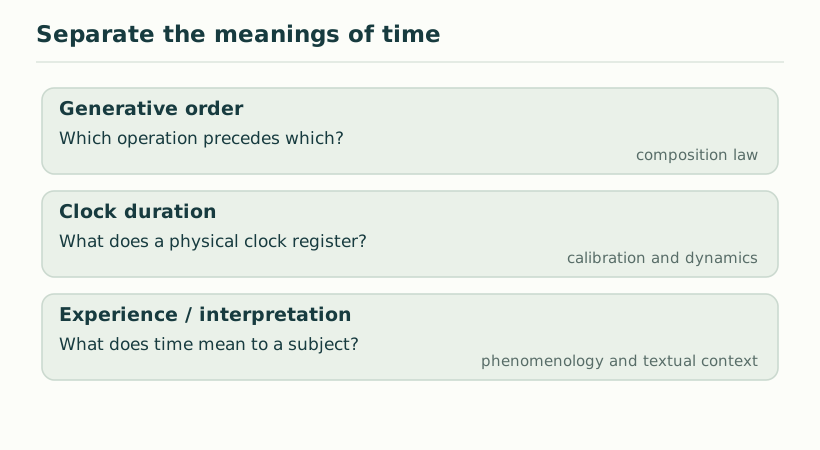
Figure 1. Separate the meanings of time. An interpretive map separates generative order, measured duration, and experienced or theological meanings. A relation between them is a question to formulate, not an automatic identification. View full size ↗
03The future is represented through conditional possibilities
A predictive state does not need to contain future events as already recorded facts. It can determine a set of allowed continuations and their probabilities. The difference between memory and prediction then becomes operational: memory concerns retained correlations with earlier events, while prediction concerns the consequences of the current state and law.
For example, a prepared two-state system may yield either detector outcome with specified probabilities. Before the detection, the model contains the preparation and probability rule. Afterward, it also contains an outcome record. These are different informational conditions even when the underlying dynamics is described without a fundamental collapse.
04A present boundary depends on the causal structure
For a local observer, some events can influence the current event, some can be influenced by it, and others are spacelike separated. This causal classification is more invariant than a global division into simultaneous presents. A drawing of one horizontal now line should not be mistaken for a universal physical boundary.
DTT may introduce an inner construction order that differs from observable causal order. The theory must show how the two are related and whether the internal ordering is accessible. Otherwise an unexplained universal present can conflict with the relativistic clock structure the model aims to recover.
05How a record arrow can emerge
A recurrent inner process can revisit the same phase while the accessible record set grows or changes in an ordered way. The observer then distinguishes earlier from later through record availability. This is a possible formal route from recurrent generation to an outer history.
The route requires an explicit order and a physical mechanism for maintaining records. Merely attaching increasing labels to states is insufficient, because decreasing labels would describe the same unlabeled sequence. The arrow must arise from a meaningful asymmetry in operations, information or boundary conditions.
06The SMM/DTT connection
SMM places the succession of appearances within one generative dependence. DTT investigates how completed events become related through records and predictions. Together they suggest that past, present and future should be analysed through an observer’s position in a generated history rather than through an independently flowing substance.
The value of this approach lies in the distinctions it makes calculable. What information is retained? Which continuations are admissible? Which events can exchange signals? Which order is a convention and which is physically constrained? Answering these questions develops the conceptual account while leaving broader metaphysical choices clearly identified as interpretations.
KEEP THE CONNECTION
Key ideas
The past is known through present records and their lawful correlations.
Predictions and memories are different informational structures.
A local present should not be silently extended into a universal simultaneity surface.
Scope of the argument. Operational interpretation of temporal categories; no unique metaphysics of present existence is asserted.
Original public topic. This edition provides an independently written explanation; article-level references identify the passages and additional sources used.