A070Public article topicExpanded article4 min read
Superstrings and the Science of Letters
Explore the proposed comparison between strings and the science of letters as a historical-conceptual analogy. Specify the respective meanings before assessing whether a mathematical bridge is available.
The source compares physical construction from modes with a cosmological science of letters, where meaningful forms arise through ordered combinations. The productive common theme is compositionality: a limited vocabulary can generate diverse structures through rules. The comparison should remain explicit about its domains. A letter in a symbolic cosmology is not automatically a quantum string, and a shared number of categories does not establish an equivalent mathematical theory.
02Alphabet, grammar and meaning
An alphabet alone does not determine a language. One also needs rules for forming expressions and an interpretation of those expressions. The same symbols can support different grammars and different meanings. Likewise, a set of elementary degrees of freedom does not determine a physical theory without a dynamics, composition law and connection to measurement.
This provides a useful explanatory template for SMM: primitive distinctions correspond to vocabulary, allowed combinations to grammar, and completed records to operational meaning. The analogy is structural and does not identify the components literally.
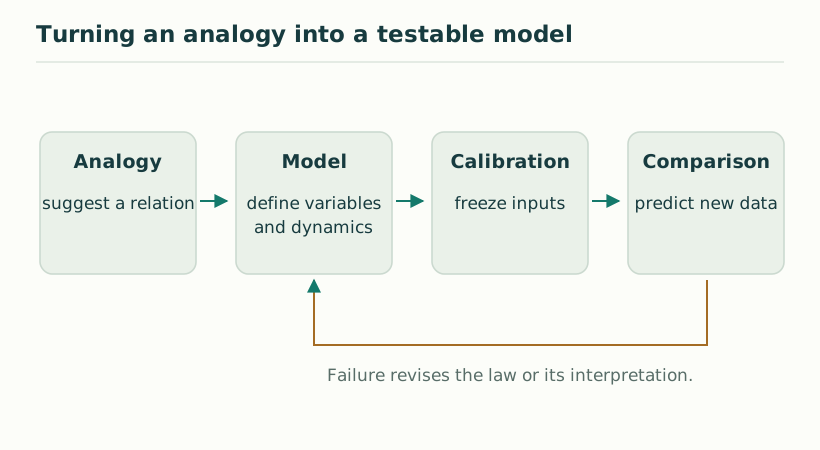
Figure 1. Turning an analogy into a testable model. A numerical or symbolic correspondence motivates a question. A physical claim needs a specified model, independent calibration, and a result that could disagree with observation. View full size ↗
03Modes as a worked mathematical example
A periodic function can be expanded in modes e^(inθ), with integer n. Different coefficients specify different functions even though the basis is shared. The diversity lies in the organization of the mode amplitudes and the equations governing them, not merely in the existence of a circle.
For instance, a mode operator −d²/dθ² acts on e^(inθ) with eigenvalue n². This exact calculation follows from differentiating twice. It becomes a physical spectrum only when the operator, coordinate and conversion to measured quantities are justified by a model.
−d²[exp(inθ)]/dθ² = n² exp(inθ)
04Why dimensions cannot be inferred by resemblance
A theory's spatial dimensions, internal state dimensions and algebraic indices play different roles. Counting six inner stages in DTT does not make them six compact spatial dimensions in a string model. A genuine bridge would require a map between the state spaces, dynamics and observables of the two constructions.
Such a map could preserve only part of the structure, which would still be useful if its limits were stated. Without it, the comparison is a heuristic suggestion rather than a mathematical equivalence.
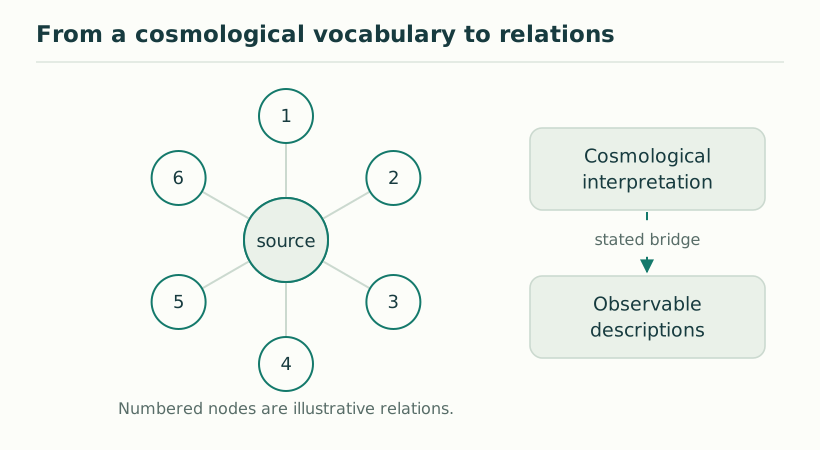
Figure 2. From a cosmological vocabulary to relations. The diagram is a reading aid for the SMM vocabulary: source, relations, manifested plurality, and observation. The arrangement does not assign physical locations to metaphysical terms. View full size ↗
05The SMM/DTT composition problem
SMM seeks a common origin of many forms; DTT proposes ordered inner generation and outer completion. A compositional model must show how elementary relations combine and how complete records acquire stable properties. The crucial question is whether the composition rule is forced by source principles or introduced independently.
If phase-carrying contributions combine, their order may matter. If completion forgets some distinctions, the observable algebra may differ from the inner one. These are concrete questions that the language analogy helps formulate, but they require explicit operations and proofs.
06Composition may be order-sensitive
For ordinary real numbers, multiplication commutes: ab=ba. For transformations, composition need not commute. Rotating an object about one axis and then another can differ from reversing the order. Thus a generative grammar must specify not only which elementary operations exist but how their order affects the result. This is particularly relevant when DTT attributes structure to nested inner operations. Noncommutativity can encode genuine order dependence, but introducing it does not automatically identify a particular physical algebra. The theory must derive the appropriate composition law and connect its representations to completed records. The letters analogy is useful because changing order can change meaning even when the vocabulary is unchanged.
07Composition supplies the bridge
Symbols acquire organized meaning through composition rules; physical modes acquire observable significance through dynamics and measurement. This is the precise structural comparison underlying the analogy. It does not identify ancient letters with modern particles. Its strongest lesson is that lawful combination is indispensable to any account of multiplicity from a common origin, and that the combination law must itself be explained.
KEEP THE CONNECTION
Key ideas
A vocabulary needs composition rules and interpretation.
Mode mathematics becomes physics only through a justified measurement connection.
Six nested DTT roles are not automatically six compact spatial dimensions.
Scope of the argument. Source-based conceptual interpretation with original worked examples; physical conclusions are stated with their assumptions.
Original public topic. This edition provides an independently written explanation; article-level references identify the passages and additional sources used.