A structured entry point to the listed emergence proposal. Explain what counts as reconstructing a spatial dimension and what further work is needed to recover distance, dynamics, and empirical geometry.
A model may produce a three-dimensional vector space, a spectral counting exponent of three, or a metric space that locally behaves like ordinary three-space. Each is a legitimate result, but they do not imply one another without assumptions. The listed spectral-triple proposal should be read with those meanings kept distinct.
SMM/DTT seeks the stronger explanatory chain: the source’s temporal composition should determine the structure that observers identify as spatial extension. The central challenge is not choosing three indices but explaining why three independently readable directions are selected and persist.
02A mode count illustrates spectral dimension
Consider nonnegative integer triples (n₁,n₂,n₃) with weighted frequency ω₁n₁+ω₂n₂+ω₃n₃≤Λ, for positive fixed weights. At large Λ their number grows like the volume of a tetrahedral region, namely Λ³/(6ω₁ω₂ω₃), with lower-order boundary corrections. The cubic exponent is the relevant counting feature.
This calculation starts with three independent mode indices. It explains the consequence of that input; it does not explain why the source generated exactly three such indices. Calling the indices inner temporal directions can change their interpretation but does not remove the initial choice.
N(Λ) ~ Λ³/(6ω₁ω₂ω₃), for the stated nonnegative weighted lattice.
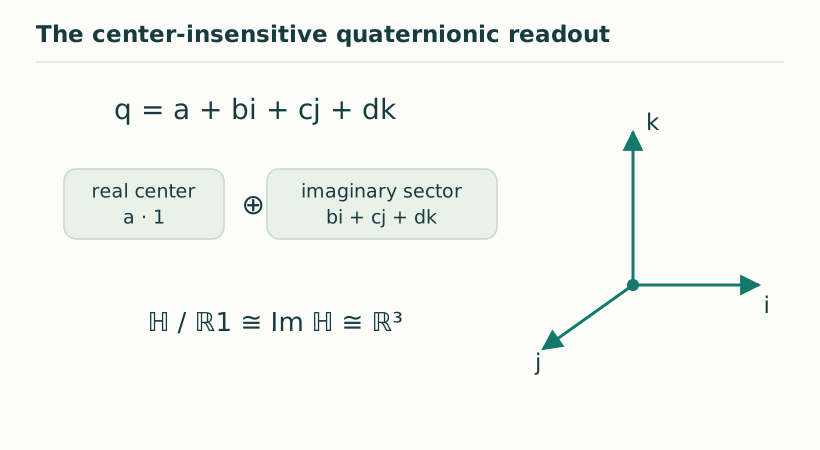
Figure 1. The center-insensitive quaternionic readout. Under the stated associative positive-norm and noncommutation hypotheses, the carrier is quaternionic. Quotienting the real center leaves the three-dimensional imaginary sector. This is a conditional readout result, not a standalone spatial dynamics. View full size ↗
03The algebra tells observers what can be distinguished
Eigenvalue counting concerns D. Geometry also depends on how the algebra acts on states. If observables cannot distinguish a proposed direction, it is not an independently accessible spatial coordinate for that interface. Conversely, adding observables can refine the state distinctions even when the eigenvalue list is unchanged.
A useful operational construction therefore specifies detector tests. Two source histories represent the same location only if the designated spatial tests agree; they may still differ under other tests. The quotient must preserve enough information for later propagation and interference, or it will not provide a closed effective description.
04Distance needs a relational rule
The simplest relational geometry is a weighted graph. Vertices label distinguishable records; edges declare allowed comparisons or transitions; edge weights set their costs. A shortest-path metric then follows. But the graph and weights are substantive inputs unless the source dynamics constructs them.
A spectral distance can reproduce such a metric in suitable normalized graph constructions. Checking that equality is more informative than announcing a dimension from a mode count. It shows that the operator controls actual comparisons of localized states and identifies exactly which normalization supplies the unit of distance.
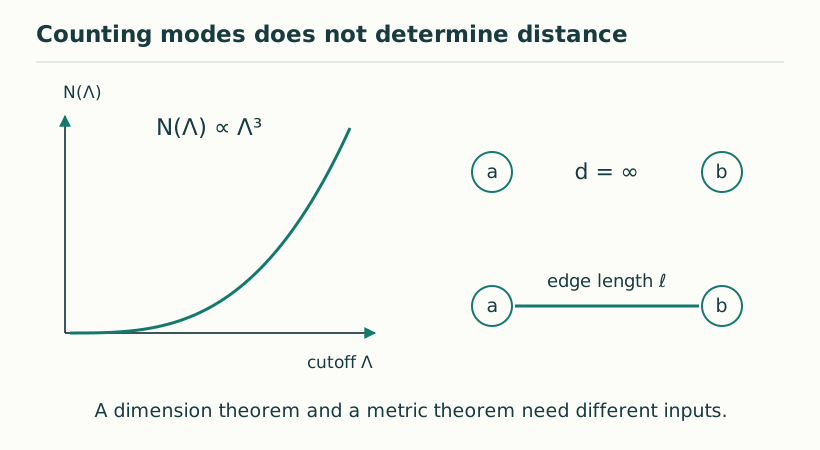
Figure 2. Counting modes does not determine distance. Spectral growth concerns how many modes lie below a cutoff. Distance concerns how observables vary under a normalized operator. The draft gives explicit examples in which the former is finite-dimensional while diagonal-state distances are infinite. View full size ↗
05Why locality is an additional selection problem
An arbitrary collection of relations need not resemble a lattice or a manifold. Most large relational structures can be highly nonlocal under natural counting ensembles. The locality draft’s entropy obstruction makes one version of this difficulty quantitative. A geometric memory can be possible yet statistically rare without a suitable preparation mechanism.
Thus spatial emergence has at least three tasks: define potential relations, select a local organization, and retain that organization under subsequent evolution. Six nested inner stages can provide an explicit program for those tasks, but the program’s physical selection remains an issue unless derived from the source law.
06Reading the proposal constructively
Ask which notion of dimension each argument establishes, which observables define position, and which process produces the required operator and algebra. A successful finite reconstruction can then be presented with complete calculations, while a continuum interpretation is stated as a further limit.
The newer spectral and locality articles refine the research target: spectral dimension, metric distance, stable records, and local transport must be checked independently and then connected. This turns the general idea of time creating space into a collection of precise constructions whose compatibility can be tested.
KEEP THE CONNECTION
Key ideas
A three-mode count establishes a conditional spectral exponent.
Spatial distance depends on the represented observable algebra.
Locality and persistence require dynamical selection beyond dimension counting.
Scope of the argument. The lattice-count example derives an exponent from three supplied indices; it is not an assumption-free derivation of physical three-space.
Bibliographic status is as listed on the author’s papers page, checked 16 October 2026. The accompanying thematic guide states its source coverage and the additional steps needed to assess the proposed results.