Discrete and continuous spectral projections: a guide
Introduce the listed preprint’s proposal to relate discrete and continuous descriptions through projections. A future expansion should identify the precise objects on each side and their shared construction.
01Discrete and continuous are descriptions of something
The listed preprint proposes that discrete and continuous descriptions can be understood as complementary projections of a temporal framework. To make this idea precise, one must first name the objects being described. A discrete set of detector outcomes, a discrete operator spectrum, a countable state basis, and a discrete evolution parameter are four different properties.
Quantum mechanics already combines some of these features without contradiction. The purpose of a DTT reconstruction is therefore not merely to allow both words, but to explain how particular discrete records and continuous laws arise from a common source and observation rule.
02A two-level system supplies a simple example
Take a Hamiltonian with two energy eigenvalues E₀ and E₁. A superposition evolves through two continuous phase factors. An energy measurement has only two possible values, even though the state moves continuously with time. The finite outcome set does not force the temporal parameter to jump.
Conversely, sampling a continuously evolving state only at times nτ produces a discrete record sequence. That sequence reflects the chosen sampling interface; it does not prove that the underlying state law has no values between samples. The model must say which level of description is fundamental.
ψ(t) = a e^(-iE₀t/ℏ)|0⟩ + b e^(-iE₁t/ℏ)|1⟩.
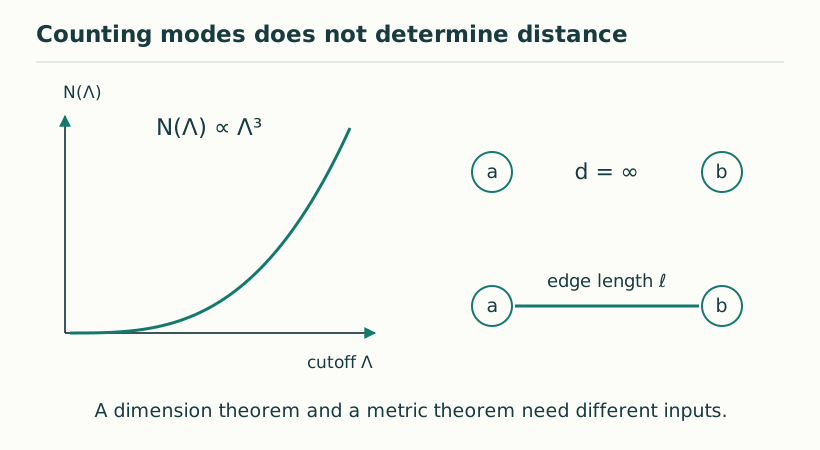
Figure 1. Counting modes does not determine distance. Spectral growth concerns how many modes lie below a cutoff. Distance concerns how observables vary under a normalized operator. The draft gives explicit examples in which the former is finite-dimensional while diagonal-state distances are infinite. View full size ↗
03A continuum limit is different from an observational quotient
A quotient identifies states that admitted tests cannot distinguish. A limit takes a family of models toward a new mathematical object as a parameter changes. These operations can appear together, but they answer different questions. One is about accessible information; the other is about approximation across scales.
For a one-dimensional lattice with spacing a, the centered difference [f(x+a)-2f(x)+f(x-a)]/a² tends to f″(x) for sufficiently smooth functions as a approaches zero. Taylor expansion gives an error proportional to a² when the fourth derivative is controlled. This is an explicit approximation theorem, not evidence that every discrete update automatically has a smooth continuum limit.
Suppose a history contains phase information that is not visible in the current detector label. If a later experiment recombines alternatives, that hidden phase can affect future outcomes. A quotient that erases it prematurely will fail to predict the interference. A correct observation map must therefore be tied to the full admitted future test language.
This is where the completion principles become relevant. A completed record can be discrete while its predictive state retains continuous parameters. The distinction is not philosophical bookkeeping: it determines whether the reduced description remains dynamically sufficient.
05The SMM/DTT reading
SMM proposes that observable multiplicity is generated rather than independently primitive. DTT distinguishes inner generation from outer completed observation. A mathematical realization could have a discrete event language, coherent transport between branches, and a continuous effective clock recovered after suitable calibration and coarse-graining.
Each ingredient must be constructed. The existence of a compact phase circle does not alone produce a minimum time interval, and a Fourier basis of integer modes does not by itself discretize all observables. The benefit of the framework is to place these questions into a common construction without assuming their answers are identical.
06A productive synthesis
When comparing the original preprint with the newer articles, ask three concrete questions: what is discrete, what is continuous, and which map or limit connects them? Then identify what errors or information loss the connection permits. A diagram should label these roles explicitly.
A successful explanation can be modest and rigorous: for example, a particular family of discrete records has a controlled continuum diffusion limit, or a continuous unitary dynamics yields a finite outcome instrument. A universal emergence claim would need a selection argument showing why the actual source realizes the specific family and interface.
KEEP THE CONNECTION
Key ideas
Discrete outcomes and continuous evolution are compatible.
Quotients and continuum limits perform different mathematical operations.
Future interference can require information absent from a present detector label.
Scope of the argument. The two-level and lattice examples are standard illustrative constructions; they do not establish a unique microscopic spacetime.
Bibliographic status is as listed on the author’s papers page, checked 16 October 2026. The accompanying thematic guide states its source coverage and the additional steps needed to assess the proposed results.