
In this article
- Specify the problem before assessing a gap
- Why a compact circle produces a tempting scale
- Constraints require a physical-state analysis
- The limits must preserve the lower bound
- The SMM/DTT interpretation
- What remains to establish
Prepare a careful audit of the listed mass-gap proposal. Distinguish a regulated model result from the continuum four-dimensional Yang–Mills problem, and compare the claim with newer gap-obligation drafts.
A mass gap is a positive separation between the vacuum energy and the rest of the physical spectrum. Its meaning depends on the theory, the Hilbert space, constraints, volume, and limiting procedure. A finite matrix has discrete levels almost automatically; that fact is much weaker than constructing a continuum quantum gauge theory with a nonzero physical gap.
The public catalogue’s discrete inner-time proposal therefore needs to be read alongside the exact formulation of the Yang–Mills problem. The Clay problem concerns a nontrivial quantum theory on four-dimensional spacetime satisfying suitable mathematical axioms and possessing a mass gap. A different regulated model may be interesting without solving that problem.
On a circle of radius R, the operator -∂² has eigenvalues n²/R² for integer n. Nonzero modes start at 1/R². If a physical energy were proportional to |n|/R after appropriate units and dynamics, that would provide a positive threshold in the nonzero sector.
But the n=0 mode still exists in the elementary circle problem. Removing it by hand is not the same as proving that the physical constraints remove every gapless excitation. Nor does a one-dimensional frequency gap establish the interacting gauge theory’s full Hamiltonian spectrum.
Gauge constraints restrict admissible states and observables. Their action cannot be inferred merely from the name Gauss law. One must exhibit the constrained state space, show how the constraint acts on zero modes, and check whether gauge-invariant combinations remain gapless.
For example, a charged sector can have a positive threshold while a neutral collective mode has arbitrarily low energy. This is why the newer finite-cycle draft distinguishes charged root frequencies, centralizer modes, screening statements, and full quantum gap obligations. Each addresses a different spectral question.
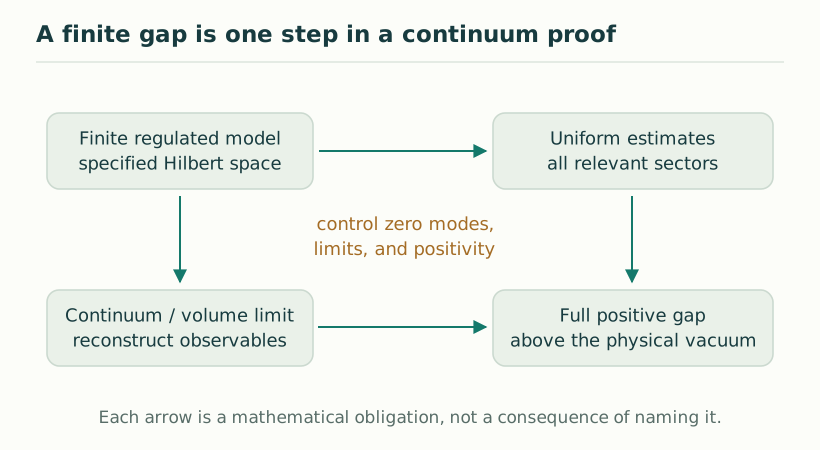
Suppose finite-volume Hamiltonians H_L have gaps Δ_L>0. If Δ_L tends to zero as the volume grows, there is no volume-uniform gap from that family. A successful bound must survive the appropriate infinite-volume limit and, separately, removal of the ultraviolet regulator in physical units.
One also needs a reconstructed nontrivial theory, not a sequence that loses all fluctuations. Estimates on correlation functions, domains, positivity, and local observables connect the spectral claim to a well-defined continuum quantum field theory. A variational trial state ordinarily bounds an energy from above; a gap proof generally needs stronger control to bound all unwanted excitations away from the vacuum.
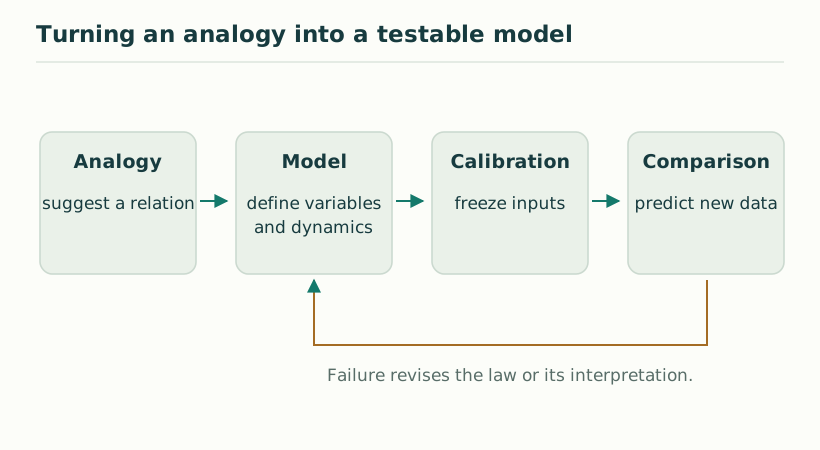
Compact inner recurrence can motivate a spectral scale and a selection rule. Its physical significance depends on why the source chooses that recurrence, how it couples to spatial propagation, and how gauge-invariant matter and fields appear in completed observations. A supplied radius alone cannot finish that chain.
The promising direction is to retain exact finite-model results while exposing the matching problem. The newer SU(2) center-selection work provides an example of this narrower strategy: a specified potential yields exact thresholds and controlled comparisons, while remaining connected-expansion and gauge-matching tasks are stated separately.
A careful exposition can provide a complete finite model, define its constraints, calculate the relevant sectors, and give a transparent account of which limits have been controlled. That is substantial mathematical content even when the continuum Millennium problem remains open.
The older preprint’s full text was not accessible during this revision, so this article does not certify its proof. Instead it supplies the conceptual and technical checklist needed to evaluate it against the current drafts. The separate finite-cycle articles explain the newer model-level results in detail, without importing the stronger claim from the older title.
KEEP THE CONNECTION
Scope of the argument. A scope and proof-obligation guide. No solution of four-dimensional Yang–Mills existence and mass gap is asserted.
Bibliographic status is as listed on the author’s papers page, checked 16 October 2026. The accompanying thematic guide states its source coverage and the additional steps needed to assess the proposed results. A direct destination could not be resolved; the link opens the papers catalogue where the title can be located.
Source register →