
In this article
- The mathematical target
- Why a self-adjoint operator is attractive
- An elementary construction exposes circularity
- What counting laws can and cannot show
- The role SMM/DTT could play
- A rigorous way to read the proposal
Prepare a critical reading of the listed spectral proposal. Identify the exact operator, spectral correspondence, and proof obligations; the catalogue entry is not evidence that the Riemann hypothesis is proved.
The Riemann hypothesis concerns the nontrivial zeros of the analytic continuation of the zeta function: their real part should be one half. Its relation to prime-number fluctuations makes it a precise number-theoretic statement, not simply a claim that some observed frequencies display an appealing pattern. The Clay Mathematics Institute lists it as unsolved.
The SMM/DTT preprint proposes a spectral framework motivated by fractal tick-time operators. The source’s complete argument was not accessible in this revision, so this article develops the exact questions such a framework must answer rather than attributing uninspected proofs to it.
A self-adjoint operator has real spectral values. If one could construct an operator T whose entire relevant spectrum corresponds exactly to every nontrivial zeta zero through s=1/2+iλ, real λ would place those zeros on the critical line. This explains the appeal of a spectral strategy.
The italicized logical burden is completeness of the correspondence. Showing that selected zeros can be represented by real numbers, or that an operator has a plausible density of states, does not establish that every nontrivial zero appears and that no off-line zeros remain.
Given any chosen real sequence λₙ, define a diagonal operator on ℓ² by (Ta)ₙ=λₙaₙ with domain consisting of square-summable sequences for which (λₙaₙ) is also square-summable. This supplies a self-adjoint multiplication operator under the standard real-sequence construction.
If λₙ were selected from already known critical-line zeros, the resulting operator would encode the input data; it would not prove that all zeros lie on the line. The source dynamics must determine the spectrum independently, and the identification with the analytic zeta function must then be proved. Otherwise the crucial conclusion has been placed in the definition.
Two spectral sets can share the same leading counting asymptotic while differing at infinitely many positions. Thus matching a leading density of levels is a useful necessary consistency check but is not an exact zero correspondence. Even very accurate finite computations cannot replace an argument for the full infinite set.
A trace identity or determinant relation could be stronger, provided its domain of validity, regularization, analytic continuation, and multiplicities are controlled. A formal infinite product is not automatically an analytic function with the desired zeros. Each limiting operation needs a justification independent of the hypothesis.
A temporal operator might supply a principled choice of algebra, state space, recurrence law, or spectral measure. Those are constructive contributions even before any number-theoretic theorem follows. The real question is whether the source rules force the analytic structure needed by zeta, rather than merely allowing one to imitate it.
The nested inner-stage vocabulary by itself does not determine prime factors or the Euler product. A viable bridge would need to explain how multiplicative arithmetic is represented by temporal composition and why the associated spectral identity has the required analytic properties. That is where the conceptual motivation becomes a concrete research program.
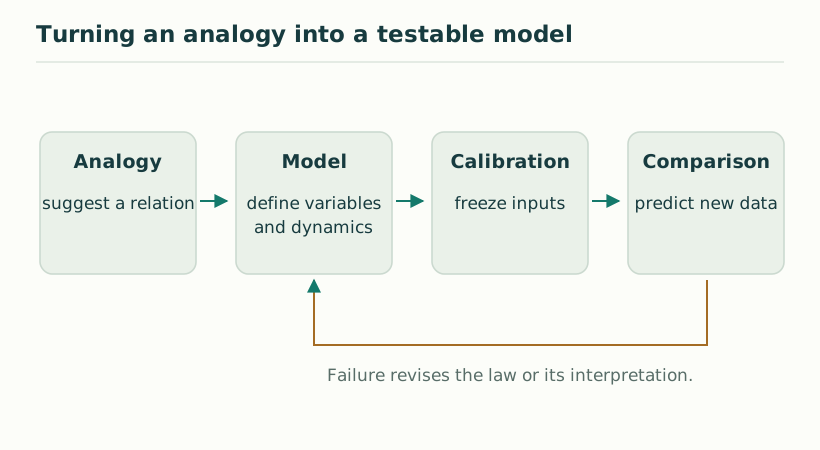
Begin with the operator definition, not the claimed final equality. Check its dense domain, symmetry and self-adjointness; then examine the independent spectrum calculation. Finally audit the map to zeros, especially whether it is onto the entire nontrivial zero set. Keep heuristic analogies and numerical evidence in their appropriate roles.
A negative outcome at one of these steps still clarifies the program. It can reveal a useful toy model, a spectral approximation, or a precise missing lemma. Each would be a contribution at its own mathematical level, while the outstanding hypothesis remains unresolved.
KEEP THE CONNECTION
Scope of the argument. A mathematical reading and proof-obligation guide; no proof of the Riemann hypothesis is claimed.
Bibliographic status is as listed on the author’s papers page, checked 16 October 2026. The accompanying thematic guide states its source coverage and the additional steps needed to assess the proposed results. A direct destination could not be resolved; the link opens the papers catalogue where the title can be located.
Source register →