Examine the proposed identification of the Single Monad with a minimal magnetic monopole. A bundle example separates ontological unity, topological charge, and physical field strength, then identifies the reconstruction steps needed to connect them.
The source proposal identifies the Single Monad with a minimal magnetic monopole. A useful exposition separates an ontological claim about a unique source from an effective field-theory claim about magnetic flux. A monopole in ordinary geometric language is defined through fields and surfaces in a spatial or spacetime description. A pre-spatial source cannot inherit that definition without a reconstruction map.
The conceptual proposal can still motivate research. It asks whether a unique generative object could produce a nontrivial phase topology whose completed spatial readout appears as quantized charge. That is a specific bridge to construct rather than a conclusion contained in the terminology.
02A bundle picture explains the topological integer
Imagine describing a phase field on a sphere surrounding a candidate defect. One coordinate patch covers the northern region and another the southern region. Their phase conventions are related on the overlap by a circle-valued transition function. Going once around the equator, this function can wind an integer number of times.
The integer survives continuous deformations that preserve the bundle class. It is a topological label. Its existence does not fix the size of an electromagnetic coupling: topology classifies allowed sectors, while the action and physical normalization determine energetic and response scales.
g(φ)=e^(inφ), n∈ℤ, g(φ+2π)=g(φ).
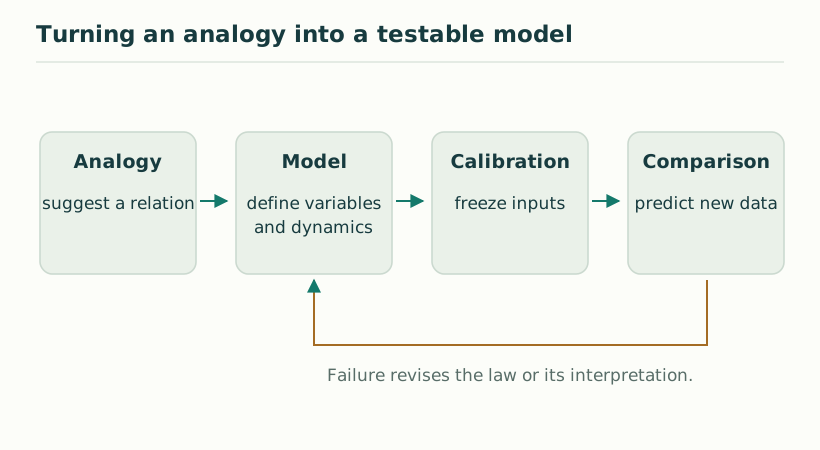
Figure 1. Turning an analogy into a testable model. A numerical or symbolic correspondence motivates a question. A physical claim needs a specified model, independent calibration, and a result that could disagree with observation. View full size ↗
03Quantization is not selection of one state
Even if the mathematical construction permits integer winding, it can permit many integers. Selecting n=1 as a minimal nonzero sector is different from proving that the physical vacuum contains an actual monopole in that sector. A dynamical argument must compare admissible configurations and their energies, stability, and boundary conditions.
Likewise, calling a unit topological object a source does not show that all observed electric charges or particle multiplets follow from it. One must define the charge operator, its representation on matter, and the observation map that identifies its eigenvalues with measured charge.
04A phase loop need not be a monopole
Holonomy is a phase or group element obtained by transport around a loop. Curvature is a local measure of path dependence, while a Chern number is a global integral or transition-function invariant under suitable conditions. These notions are related, but they are not interchangeable.
A contractible loop can have nontrivial holonomy in a curved connection without enclosing a topologically nontrivial monopole. A nontrivial bundle can also require several patches even when no single preferred loop represents all its information. The article collection’s Hopf, holonomy, and gauge examples help keep those levels distinct.
05The reconstruction sequence required by SMM/DTT
A complete chain would start with source histories and their composition, construct a retained phase relation, show that completed readout supports a suitable base geometry, and derive a bundle and connection over that base. Only then could one identify a flux or topological charge with a physical monopole observable.
The six nested inner roles might organize the formation and comparison of readout directions, but their number alone does not imply a particular Chern class. The source law must explain why a nontrivial phase bundle rather than a trivial one is realized. The recent quaternionic/Hopf draft supplies a conditional mathematical setting for asking part of this question.
06What would make the proposal informative
The proposal becomes stronger when it yields relations that survive calibration: a quantized phase sector, a fixed ratio of charges under an independently specified representation, or a constrained response to a transport protocol. It becomes weaker when a desired physical label is simply assigned to a convenient mathematical object.
At present this guide treats the monopole identification as a research interpretation. The topological example explains the mechanism that could support a quantization argument, while the physical identification remains a separate task. This preserves the conceptual ambition without hiding the geometry and dynamics needed to realize it.
KEEP THE CONNECTION
Key ideas
A pre-spatial source and a magnetic monopole require a reconstruction bridge.
Integer winding classifies topology but does not fix a coupling constant.
Holonomy, curvature, and global charge are related but distinct.
Scope of the argument. The bundle example is pedagogical. A physical monopole identification is not established by the analogy alone.
Bibliographic status is as listed on the author’s papers page, checked 16 October 2026. The accompanying thematic guide states its source coverage and the additional steps needed to assess the proposed results.