Spectral noncommutative dual-time geometry: a guide
A guide to the listed paper’s mathematical theme. Organize the algebra, operator, and readout questions before relating spectral constructions to physical distance and causal geometry.
A spectral approach describes a geometry through observables acting on a space of states and an operator that measures variation. This gives SMM/DTT a language in which temporal composition can be specified before an observer-level coordinate picture. The listed paper and newer drafts explore this direction using noncommuting observables and temporal operators.
The conceptual attraction is real, but noncommutativity is not by itself a derivation of space. One must identify a suitable observable algebra, show that its representation has the required properties, and define how observers recover distances and dimensions from it.
02The three ingredients and their distinct jobs
In a spectral triple (𝒜,ℋ,D), the algebra 𝒜 describes observables, the Hilbert space ℋ carries their representation, and the Dirac-type operator D controls variation through commutators [D,a]. In standard compact settings, self-adjointness, compact resolvent, and bounded commutators on an appropriate dense algebra are among the structural requirements.
A number operator can be an unbounded component of D without being a bounded element of 𝒜. Confusing these roles can make a construction formally invalid before any physics is discussed. The same symbol may be useful in several roles, but its domain and algebraic membership must be stated separately.
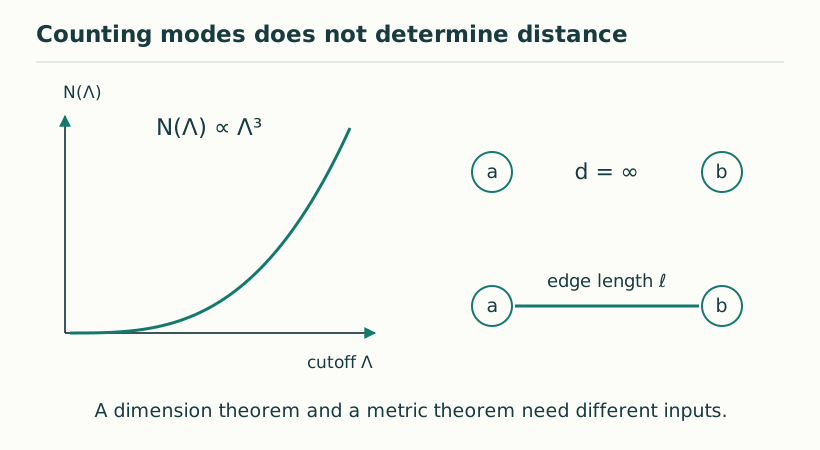
Figure 1. Counting modes does not determine distance. Spectral growth concerns how many modes lie below a cutoff. Distance concerns how observables vary under a normalized operator. The draft gives explicit examples in which the former is finite-dimensional while diagonal-state distances are infinite. View full size ↗
03An exact two-point distance example
Take two diagonal observables a=diag(a₁,a₂) acting on a two-component state space. Choose D with off-diagonal entries 1/ℓ and zero diagonal, where ℓ>0. Then the commutator norm is |a₁-a₂|/ℓ. Restricting this norm to at most one bounds the difference of the two evaluation states by ℓ.
The largest allowed difference is attained, so the distance is exactly ℓ. This tiny example illustrates how an operator scale becomes a metric scale. It also exposes the input: ℓ was chosen in D. Calling the resulting distance emergent does not mean its numerical scale was derived independently.
D = [[0, 1/ℓ], [1/ℓ, 0]], ||[D,a]|| = |a₁-a₂|/ℓ.
d(1,2) = sup{ |a₁-a₂| : ||[D,a]||≤1 } = ℓ.
04Spectral counting answers another question
If the number of eigenvalues of |D| below Λ grows like CΛᵈ, the exponent d gives a spectral dimension under the stated asymptotic framework. The preceding distance formula instead probes how D fails to commute with the represented observables. Those two tests can give very different information.
For example, an operator diagonal in the same basis as every observable has vanishing commutators. It may have a rich eigenvalue count, yet the commutator constraint fails to bound differences between distinct diagonal evaluation states. Their distance can then be infinite. A mode count alone is not a geometry audit.
05Temporal origin and physical readout
The DTT connection is to interpret shifts or compositions of inner histories as the primitive operations from which the observable algebra is constructed. Completed records then select the accessible subalgebra and state functionals. This is more informative than declaring a conventional spatial algebra to be temporal by renaming its coordinates.
A full reconstruction should show which histories generate the representation, which quotient implements observational equivalence, and how the resulting metric relates to independently measured displacement. Lorentzian causality and gravitational dynamics are further targets; a compact spectral model does not establish them automatically.
06How to compare older and newer formulations
The public catalogue lists a spectral noncommutative paper, while the newer supplied spectral-triple draft explicitly separates dimension from metric distance. These should be compared through definitions rather than treated as interchangeable versions. The older direct destination could be identified, but its full text was not available for this revision.
The newer two-question method is a useful reading discipline: verify the analytic spectral construction, then verify its physical interpretation. Exact finite examples can make both tasks reproducible. They also reveal which quantities remain free and which would have to be selected by the Single Monad source law.
KEEP THE CONNECTION
Key ideas
A spectral triple gives observables, states, and variation different roles.
Distance depends on commutators, not only eigenvalue counting.
An emergent metric still needs a justified operational scale.
Scope of the argument. The two-point calculation is an exact explanatory example, not a claim that the source uniquely selects its length.
Bibliographic status is as listed on the author’s papers page, checked 16 October 2026. The accompanying thematic guide states its source coverage and the additional steps needed to assess the proposed results. A direct destination could not be resolved; the link opens the papers catalogue where the title can be located.