Neutrino oscillations as a benchmark for temporal phase
Neutrino oscillations show how relative quantum phases become observable through propagation and detection. A two-flavour calculation provides a precise benchmark for SMM/DTT accounts of temporal phase and matter. It also identifies the separate tasks of deriving masses, mixing and a universal propagation law.
A common phase multiplying every component of a quantum state cannot change ordinary outcome probabilities. Relative phases can. Neutrino flavour oscillations provide a physical setting where propagation changes those relative phases and therefore changes the flavour probabilities at detection.
The SMM/DTT programme treats phase and completion as central ingredients of observable matter. This comparison asks whether a source-derived excitation model can reproduce the familiar phase-difference law and then explain any part of its otherwise supplied mass or mixing data. A temporal interpretation is useful when it identifies those ingredients precisely rather than simply observing that oscillations involve time. [2]
02A two-flavour preparation
Use two orthonormal mass states |1⟩ and |2⟩ and define flavour states |α⟩ = cosθ|1⟩+sinθ|2⟩ and |β⟩ = −sinθ|1⟩+cosθ|2⟩. Propagation gives the mass components phases exp(−iφ₁) and exp(−iφ₂). The transition amplitude is sinθ cosθ[exp(−iφ₂)−exp(−iφ₁)].
Taking its absolute square gives sin²(2θ)sin²[(φ₂−φ₁)/2]. The result vanishes when the mixing angle is zero or when the phase difference is an integer multiple of two pi. A phase common to both components cancels, as it must.
P(α→β) = sin²(2θ) sin²(Δφ/2)
Δφ = φ₂−φ₁
Two-flavour coherent unitary model; source and detector define the flavour basis.
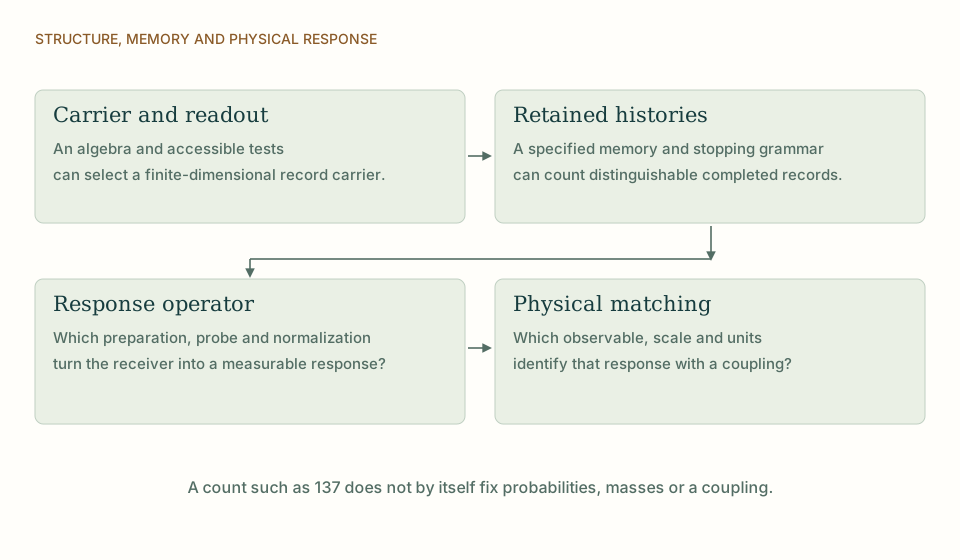
From carrier structure to a measurable response. Representation dimension, a chosen retention grammar, a response operator and physical calibration are separate stages of the constants programme. View full size ↗
03The relativistic propagation benchmark
For an ultrarelativistic coherent beam in vacuum, the standard leading phase difference is Δm²L/(2E) in units ℏ = c = 1. The corresponding transition probability is sin²(2θ)sin²(Δm²L/4E). Here Δm² is the difference of squared masses, L the baseline and E the beam energy.
With maximal mixing, θ = π/4, the probability reaches one when Δm²L/(4E) = π/2 and returns to zero when that argument reaches pi. These symbolic values demonstrate the oscillatory dependence without adopting a current best-fit mass splitting or claiming that a two-flavour model describes every measured channel.
Δφ ≈ Δm²L/(2E)
P(α→β) ≈ sin²(2θ) sin²(Δm²L/4E)
Natural units; vacuum propagation; ultrarelativistic and coherent regime. The full physical theory uses the appropriate number of flavours and matter effects.
04What the observations establish and what they leave open
Atmospheric-neutrino measurements supplied major evidence for flavour oscillations. Interpreting the full set of neutrino observations involves multiple flavours, mixing parameters, baseline and energy distributions, detector response and, where appropriate, matter effects. The elementary equation here is a benchmark inside that broader theory.
The formula depends on mass-squared differences rather than a common additive shift of all mass-squared values in its leading oscillation phase. It therefore does not by itself determine every absolute mass. A model that fits oscillation frequencies has not automatically derived the mass-generation mechanism. This is a useful distinction for any spectral or temporal theory of particles. [2]
05The SMM/DTT source task
A source construction could define stable excitation sectors, derive their phase generators and specify how completed interactions prepare and detect flavour-like combinations. The mixing matrix must then arise from a physical relation between propagation states and interaction records. Assigning it independently after choosing the masses would leave an important source freedom intact.
The common propagation law also matters. If different inner cycles produce different effective signal velocities or preferred-frame effects, those deviations must be calculated in the actual observable model. A relative phase law can coexist with many ontological descriptions; an additional discriminating prediction requires source-selected dynamics beyond the shared standard benchmark. [1]
06The observed channel depends on preparation and detection
The same two mass components can produce different measured oscillation patterns if the preparation and detection bases change. In the elementary two-flavour model the mixing angle specifies those bases relative to the propagation eigenstates. At zero mixing, a prepared flavour is already a propagation eigenstate and the transition probability vanishes even when the two masses differ. At maximal mixing, the oscillatory factor can reach unit transition probability under the ideal coherent assumptions.
This separates three physical ingredients: the source prepares a superposition, propagation accumulates a relative phase, and the detector reads a particular combination of components. A temporal explanation of phase addresses only part of the full measured process unless it also explains the preparation and readout. SMM/DTT is well suited to pose these questions together because generation and completed access are explicit in its architecture. The useful next construction would derive a definite effective mixing and phase law from one source model, then identify how coherence and the receiver response limit the observable oscillation pattern.
07A constructive comparison rather than a numerical coincidence
The useful next calculation is a source-derived two-sector model with independently defined preparation, propagation and completion measurements. It can first recover the displayed oscillation probability, verify normalization and coherence limits, and then identify which masses or mixing relations are forced by the source instead of supplied.
Such a model would make temporal phase do explicit physical work. If it reproduces the standard formula with the same free inputs, its contribution is an interpretation or a new realization. If it reduces those inputs or predicts a protected additional relation, it offers a stronger matter result. The distinction lets a familiar phenomenon become a rigorous benchmark for the SMM/DTT programme.
THE SAME QUESTION, DIFFERENT STARTING POINTS
The comparison at a glance
Question
SMM/DTT
Flavour oscillations
Phase
Source excitations should supply observable relative phase generators.
Flavour probabilities depend on phase differences, not a common global phase.
Matter
Derive propagation sectors and their relation to interaction records.
Mass splittings and mixing enter the oscillation law as physical parameters.
Novelty
Reduce independent parameters or derive a new protected relation.
Reproducing the standard formula is a benchmark, not by itself a new prediction.
KEEP THE CONNECTION
Key ideas
Relative temporal phase can change a detector probability while a global phase cannot.
The two-flavour vacuum law gives a precise symbolic propagation benchmark.
A source derivation must address masses, mixing, preparation and detection together.
Connect propagation states with interaction structure.
Sources and further reading
References support the comparator and the specific mathematical or interpretive claims indicated. SMM/DTT connections are developed in the analysis above.