
In this article
- The question behind this comparison
- The SMM/DTT starting point
- How the comparator works
- The decisive comparison
- Worked benchmark
- What follows for the source programme


One particle can produce phase-sensitive interference because alternative amplitudes contribute to one detection. This comparison with objective collapse models examines how DTT’s sequential inner generation could preserve those alternatives, works through a balanced interferometer, and identifies the coherent memory that an explanatory completion mechanism must actually supply.
Single-particle interference is interference between alternative amplitudes contributing to one detection event. The particle number can be one while the quantum state has support on several paths. An interference pattern accumulates over many trials because the relative phase changes the probability of each individual detection; it does not require two particles to collide at the detector.
The SMM/DTT idea of sequential inner production offers a possible physical narrative for how alternative contributions belong to one completed event. Its useful mathematical content would be a coherent rule for combining those contributions before registration. A classical source that randomly chooses one path and retains only its label produces a mixture, not an interference pattern. Phase memory, a recombination operation and the measurement context therefore carry the decisive explanatory work. [3] [4]
The Single Monad Model begins with one nonspatial generative source. The Duality of Time Theory distinguishes the source’s inner production from the outer order in which completed records become accessible. Its six inner levels are nested functional roles of one process: a higher role organizes lower-level work. The seventh is the completion or observation interface. They are neither six independent clocks nor six additional time coordinates.
This distinction supplies a useful research question: which features of an observed world can follow from the way a source produces, retains and releases information? A concrete answer needs a state space, an autonomous update, retained memory and a rule connecting completion to an accessible measurement. In the constructions discussed here, those mathematical ingredients are stated explicitly. A successful finite example establishes what its specified mechanism can do; further arguments connect it to physical particles, spacetime or universal laws. [1]
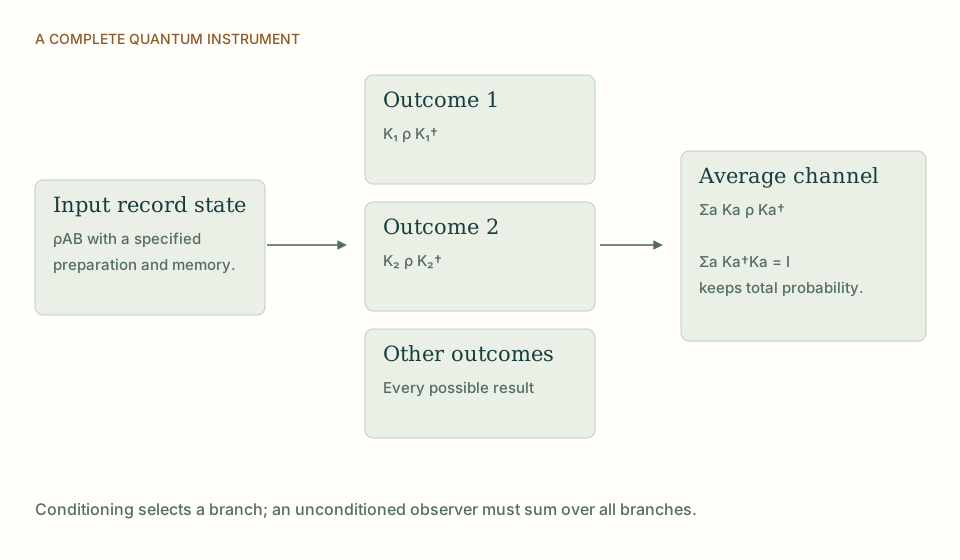
Objective collapse theories modify quantum dynamics so that sufficiently macroscopic alternatives are suppressed by a physical stochastic process. In GRW-type and continuous-spontaneous-localization families, the modification contains a rate and a spatial or mass-related structure. Amplification makes microscopic coherence relatively persistent while reducing macroscopic superpositions. These are dynamical proposals with measurable consequences, rather than interpretations that necessarily preserve every prediction of ordinary unitary quantum theory.
Outer completion in DTT is not automatically an objective collapse. A completion channel may simply expose a decohered record or condition on an ordinary outcome. It becomes a collapse proposal only when the state evolution changes in a specified way, with a probability law, energy accounting and a physical scale. Collapse models consequently provide a demanding comparison: they illustrate how an account of definite records can take quantitative risks. No bound on their parameters directly bounds an unspecified generative process; the two mechanisms must first be translated into comparable observable dynamics. [2]
Collapse models can reduce interference by physically localizing spatially separated alternatives. The size, mass distribution and duration of the superposition then matter through the chosen collapse law. DTT completion could yield a similar loss of contrast if it makes alternatives irreversibly exclusive before they recombine. It would resemble ordinary decoherence instead if the distinguishing information remains in an environment or source register that can in principle be controlled.
This gives the comparison a direct mathematical target: the dependence of visibility on separation, time and the material system. One cannot infer a collapse rate from the count of inner stages alone; six nested functions do not specify seconds, a localization length or a coupling to mass. A concrete completion model could derive those quantities or a relationship among them, while using the ideal interferometer as its zero-modification limit. The positive lesson from collapse research is the value of committing to a functional law that can fail. Agreement with one lost-fringe observation has little force because many environmental and instrumental mechanisms produce the same effect. [2] [3] [4]
Use an ideal balanced Mach–Zehnder interferometer. After the first beam splitter the path state is (|0⟩+|1⟩)/√2. A phase plate multiplies the second component by e^{iφ}. With a second balanced recombiner in the corresponding phase convention, the first output amplitude becomes (1+e^{iφ})/2. Its probability is cos²(φ/2), and the other output has probability sin²(φ/2).
For φ=0 every ideal trial reaches the first output; for φ=π none does; for φ=π/2 the outputs are equiprobable. If an environment records the paths in states with overlap γ, the interference term becomes Re(γe^{iφ}) and the visibility is |γ|. This calculation explains precisely what an inner-time mechanism must preserve: the relative phase and the coherence between alternatives. Changing the duration of private work while keeping these quantities and the registered phase fixed produces no new interference prediction. [3] [4]
The ideal coherent case has γ=1. Phase φ is dimensionless; loss and detector inefficiency are separate experimental parameters.
The comparison rewards a model that identifies why a completion event combines amplitudes coherently, and why which-path information changes that combination. A finite-state simulation can exhibit the mechanism explicitly. Its result is an implementation of the interference law until independent restrictions on phase generation, memory capacity or recombination create a new testable relationship. A claimed fringe shift needs a formula tied to measured settings rather than an adjustable inner duration. [3] [4]
THE SAME QUESTION, DIFFERENT STARTING POINTS
| Question | SMM/DTT | objective collapse models |
|---|---|---|
| Starting structure | One nonspatial source, retained memory and six nested inner functions with an outer completion interface. | Quantum states with a specified stochastic modification of dynamics. |
| Observable connection | The source update and readout must generate the measured records and their calibrated relations. | A physical localization or selection law suppresses alternatives. |
| Single-particle interference | This gives the comparison a direct mathematical target: the dependence of visibility on separation, time and the material system. | Collapse models can reduce interference by physically localizing spatially separated alternatives. |
| Status of the claim | A constructive research programme; a specified finite model establishes only its stated conditional results. | Dynamical proposals with parameters and potentially distinguishable predictions. |
KEEP THE CONNECTION
Connects this comparison with the author’s underlying construction.
Connects this comparison with the author’s underlying construction.
Connects this comparison with the author’s underlying construction.
Connects this comparison with the author’s underlying construction.
Places the comparison alongside the programme’s published results, assumptions and open targets.
References support the comparator and the specific mathematical or interpretive claims indicated. SMM/DTT connections are developed in the analysis above.
How these comparisons distinguish premises, results and physical claims