
In this article
- The question behind this comparison
- The SMM/DTT starting point
- How the comparator works
- The decisive comparison
- Worked benchmark
- What follows for the source programme


Why should a source produce squared-amplitude probabilities in every measurement basis? This comparison with standard Hilbert-space quantum mechanics examines the Born rule through a qubit whose coherent and incoherent preparations have sharply different outcomes, clarifying where source counting helps and where a stronger composition or probability law is needed.
The Born rule connects a quantum state to probabilities of possible records. For a pure state and a sharp rank-one outcome it gives the squared modulus of an amplitude; for a general measurement it gives the trace of the state times an effect. A derivation of this rule must identify the independent assumptions that restrict probability assignments. Writing amplitudes as square roots of desired frequencies merely builds the rule into the notation.
SMM/DTT can contribute by specifying how a source produces reproducible frequency weights and how completion samples them. The weights need not equal the number of underlying addresses: different addresses can map to the same observable record, and amplitudes can interfere. The six-level architecture organizes production, but the number of levels alone does not fix a probability measure. A proposed derivation becomes informative when a symmetry or consistency law selects the measure before the outcomes are used for calibration. [3] [2]
The Single Monad Model begins with one nonspatial generative source. The Duality of Time Theory distinguishes the source’s inner production from the outer order in which completed records become accessible. Its six inner levels are nested functional roles of one process: a higher role organizes lower-level work. The seventh is the completion or observation interface. They are neither six independent clocks nor six additional time coordinates.
This distinction supplies a useful research question: which features of an observed world can follow from the way a source produces, retains and releases information? A concrete answer needs a state space, an autonomous update, retained memory and a rule connecting completion to an accessible measurement. In the constructions discussed here, those mathematical ingredients are stated explicitly. A successful finite example establishes what its specified mechanism can do; further arguments connect it to physical particles, spacetime or universal laws. [1]
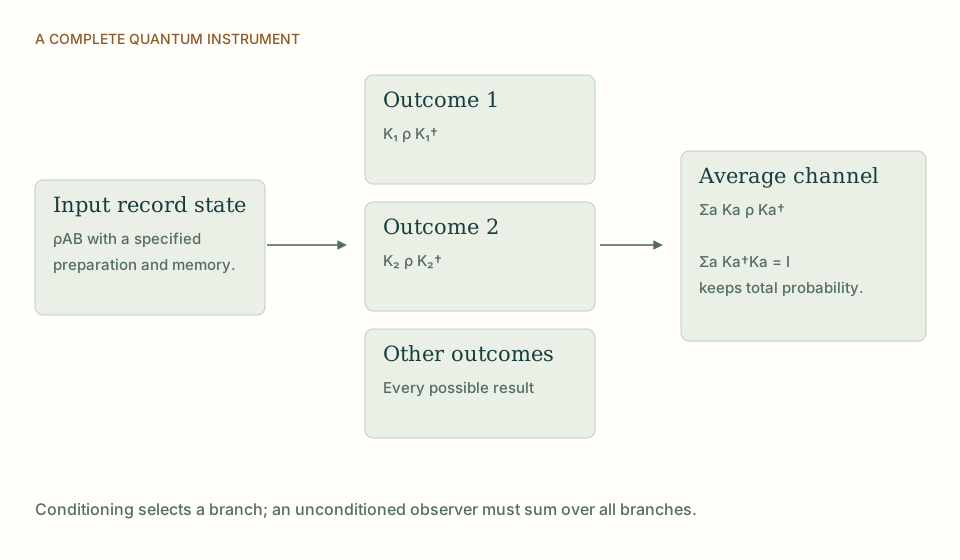
Operational quantum mechanics represents a preparation by a positive density operator of unit trace. A measurement outcome corresponds to an effect, and an instrument specifies both its probability and the conditional state left behind. Closed evolution is unitary; an open system can evolve by a completely positive, trace-preserving map. These ingredients are sufficient to calculate laboratory statistics without deciding whether the wavefunction describes an ontic object, a relation or an agent’s expectations.
The instrument language is especially close to DTT’s distinction between production and accessible records. An unobserved interaction and a registered outcome are mathematically different objects. Yet an ordinary instrument does not itself contain a hidden generative time, nor does a sequence of instruments derive the space in which laboratories operate. It provides a precise interface against which a proposed inner process can be tested: if the process reproduces exactly the same instruments, the difference is explanatory or structural unless another accessible measurement distinguishes it. [2]
In Hilbert-space quantum mechanics the Born rule is part of the operational connection between preparations and measurements; probability-representation theorems show how strongly it is constrained by assumptions about effects and their sums. DTT can use these theorems as a target for a source-based reconstruction. The relevant achievement would be to explain why the completion interface realizes the requisite effect structure and additivity, rather than assume them and announce the resulting trace formula as entirely new.
The two-basis qubit example exposes a specific failure of simple source counting. An archive may reproduce the Z frequencies 1/3 and 2/3 while omitting the phase that makes the X result almost certain. A completed account must retain enough information to answer both tests consistently. This suggests a positive route through operational equivalence: histories are identified only when every permitted continuation assigns the same statistics. Such a quotient can organize predictive states. Additional composition and positivity conditions then determine whether those states really form the quantum effect calculus, which remains a substantive theorem to establish. [2] [3]
Prepare |ψ⟩=√(1/3)|0⟩+√(2/3)|1⟩. A Z measurement gives probabilities 1/3 and 2/3. A measurement in the X basis gives p(+)=|[√(1/3)+√(2/3)]/√2|²=(3+2√2)/6, approximately 0.9714. Replacing the coherent state by the mixture with the same Z frequencies gives p(+)=1/2.
Thus matching the counts in one basis is insufficient. The very same preparation must supply consistent probabilities across incompatible measurements. Busch’s extension of Gleason-type reasoning makes this restriction precise when probabilities are normalized and additive on the effects of generalized measurements. The theorem does not derive its own effect structure or additivity assumptions. A DTT account can aim to explain those premises operationally, for example through the way alternative completion outcomes are combined, but cannot claim the theorem removes every independent assumption about probability. [3] [2]
ρ is a positive unit-trace operator and E is an effect with 0≤E≤I. The illustrative qubit is not a fit to experimental data.
The strongest comparison concerns consistency across an entire measurement language. Uniform source visitation, equal branch counting and an observer’s ignorance are distinct proposals for a probability law. A completed theory has to say which one applies and why coherent recombination obeys the same law. This gives the source programme a concrete target: derive an operational probability structure stable under composition, rather than identify a familiar numerical frequency after selecting a convenient readout. [3] [2]
THE SAME QUESTION, DIFFERENT STARTING POINTS
| Question | SMM/DTT | standard Hilbert-space quantum mechanics |
|---|---|---|
| Starting structure | One nonspatial source, retained memory and six nested inner functions with an outer completion interface. | Density operators, effects and instruments on a specified Hilbert space. |
| Observable connection | The source update and readout must generate the measured records and their calibrated relations. | A registered outcome is a conditional instrument output. |
| Born rule and probability | The two-basis qubit example exposes a specific failure of simple source counting. | In Hilbert-space quantum mechanics the Born rule is part of the operational connection between preparations and measurements; probability-representation theorems show how strongly it is constrained by assumptions about effects and their sums. |
| Status of the claim | A constructive research programme; a specified finite model establishes only its stated conditional results. | Operational quantum mechanics is a predictive formalism; its ontology is not uniquely fixed. |
KEEP THE CONNECTION
Connects this comparison with the author’s underlying construction.
Connects this comparison with the author’s underlying construction.
Connects this comparison with the author’s underlying construction.
Connects this comparison with the author’s underlying construction.
Places the comparison alongside the programme’s published results, assumptions and open targets.
References support the comparator and the specific mathematical or interpretive claims indicated. SMM/DTT connections are developed in the analysis above.
How these comparisons distinguish premises, results and physical claims
SMONAD
Share this page, or keep a clear reference to the work you are reading.
Use this reference for the explanation on this page. “n.d.” means its first publication date is not specified; the update date is recorded separately.