
In this article
- The question behind this comparison
- The SMM/DTT starting point
- How the comparator works
- The decisive comparison
- Worked benchmark
- What follows for the source programme


Bell correlations challenge a particular local causal factorization while preserving ordinary no signalling. Comparing DTT with Everett many-worlds interpretation, this article calculates the ideal singlet violation and its unchanged local marginals, then asks what a single generative source must explain to reproduce both features through one physical mechanism.
Bell inequalities test restrictions on correlations, not the speed of an observed signal. In the usual local causal model, outcomes at two separated laboratories become independent once the relevant common cause and local settings are specified. Measurement-setting independence is another premise. Quantum states can violate the resulting bounds while preserving the inability to transmit a controllable message by changing a distant measurement choice alone.
A Single Monad is naturally a common origin for records, but a common origin by itself does not evade Bell’s argument: the hidden variable in a Bell model already represents an arbitrarily rich common cause. The decisive issue is the form of the conditional probabilities. A DTT account must specify whether its source violates factorization, changes a setting-independence assumption, or uses a different causal structure. An inaccessible inner ordering is not an automatic explanation of the observed correlation law. [3] [4] [5]
The Single Monad Model begins with one nonspatial generative source. The Duality of Time Theory distinguishes the source’s inner production from the outer order in which completed records become accessible. Its six inner levels are nested functional roles of one process: a higher role organizes lower-level work. The seventh is the completion or observation interface. They are neither six independent clocks nor six additional time coordinates.
This distinction supplies a useful research question: which features of an observed world can follow from the way a source produces, retains and releases information? A concrete answer needs a state space, an autonomous update, retained memory and a rule connecting completion to an accessible measurement. In the constructions discussed here, those mathematical ingredients are stated explicitly. A successful finite example establishes what its specified mechanism can do; further arguments connect it to physical particles, spacetime or universal laws. [1]
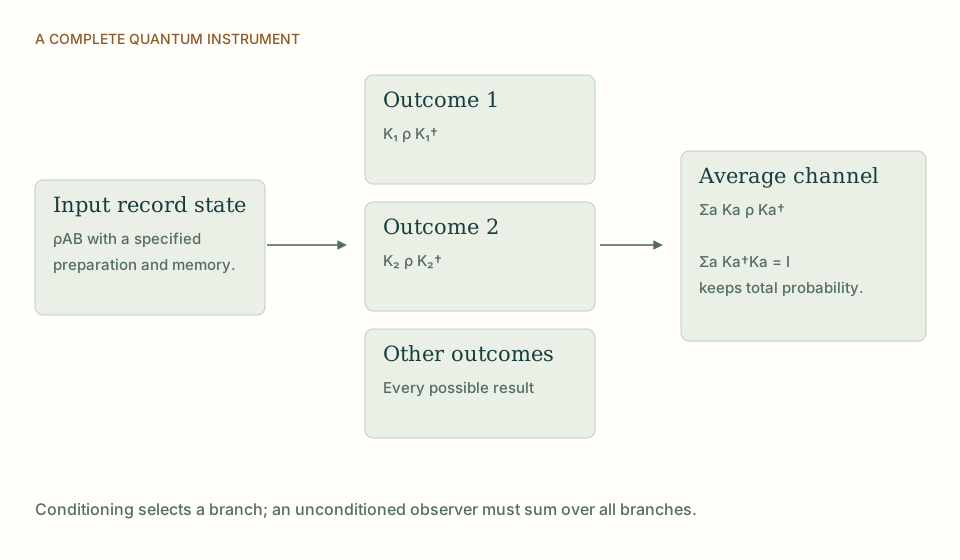
Everett’s relative-state formulation applies unitary quantum evolution to the apparatus and observer as well as to the measured system. Correlated components of their joint state encode different relative outcomes. Modern decoherence-based accounts use effectively stable environmental records to explain why these components behave as autonomous branches for practical observation. Their language of worlds is an interpretation of this branching structure, not an additional term in the Schrödinger equation.
Its main contrast with a completion account is the status of the alternatives. Everett keeps all components in the universal state; a DTT model must specify whether completion releases a relative record, selects one outcome by an additional rule, or discards information through an explicitly open channel. Each option has a different relationship to unitarity. Mere sequential generation of a superposition does not make it Everettian, and describing observed definiteness does not by itself disprove relative-state quantum mechanics. Both accounts still need justified probability assignments for repeated records. [2]
Everettian descriptions retain a global entangled state and explain Bell records through correlations among its relative components. They do not add a collapse signal travelling from one wing to the other. DTT can agree that an observed Bell pair belongs to one nonseparable generative structure, but a universal single completed outcome pair is a different ontological commitment from retaining all relative branches.
The experimental correlation does not by itself resolve that commitment. Both accounts can give |S|=2√2 and unbiased local outcomes when they employ the same quantum state and instruments. The useful contrast is what happens to the global alternatives and how their weights are justified. A DTT selection rule must retain the exact no-signalling ensemble structure even if its hidden update has a preferred order. Everett’s universal unitary state already supplies an ensemble-independent way to preserve those marginals. A source model could offer a new explanation by deriving the allowed joint completion maps from one architecture. Simply calling the source nonlocal would leave the correlation coefficients and the no-signalling requirement unexplained. [2] [3] [4] [5]
For a spin singlet, the correlation of ±1 outcomes along unit vectors a and b is E(a,b)=−a·b. Choose a=z, a′=x, b=(z+x)/√2 and b′=(z−x)/√2. In the CHSH combination E(a,b)+E(a,b′)+E(a′,b)−E(a′,b′), the four terms add to −2√2, whose absolute value exceeds the local bound 2.
Each local outcome remains equally likely. Indeed the reduced state at either wing is I/2. A distant trace-preserving operation leaves the local reduced state unchanged when its outcome is not conditioned upon. Correlation beyond the Bell bound and no signalling therefore coexist in the same calculation. This is the benchmark for temporal source proposals: a mechanism must reproduce both facts. Explaining only the strong correlation while allowing the remote setting to change a local marginal would describe a different, experimentally constrained theory. [3] [4] [5]
CHSH outcomes are ±1. The local bound presupposes local factorization and suitable independence of measurement choices from the common cause.
The strongest use of DTT here is to make the hidden production architecture precise enough that its causal assumptions can be inspected. A source update that coordinates records may be nonlocal at the underlying level while yielding a relativistically admissible observable interface. That is a substantive possibility, but a claim of compatibility requires the interface calculation. Existing Bell violations support the quantum correlation structure, not a unique ontology of its origin. [3] [4] [5]
THE SAME QUESTION, DIFFERENT STARTING POINTS
| Question | SMM/DTT | Everett many-worlds interpretation |
|---|---|---|
| Starting structure | One nonspatial source, retained memory and six nested inner functions with an outer completion interface. | A universal quantum state with unitary evolution. |
| Observable connection | The source update and readout must generate the measured records and their calibrated relations. | A stable record is relative to a correlated branch. |
| Bell nonlocality and causal structure | The experimental correlation does not by itself resolve that commitment. | Everettian descriptions retain a global entangled state and explain Bell records through correlations among its relative components. |
| Status of the claim | A constructive research programme; a specified finite model establishes only its stated conditional results. | Relative-state interpretation retains ordinary unitary quantum predictions. |
KEEP THE CONNECTION
Connects this comparison with the author’s underlying construction.
Connects this comparison with the author’s underlying construction.
Connects this comparison with the author’s underlying construction.
Connects this comparison with the author’s underlying construction.
Places the comparison alongside the programme’s published results, assumptions and open targets.
References support the comparator and the specific mathematical or interpretive claims indicated. SMM/DTT connections are developed in the analysis above.
How these comparisons distinguish premises, results and physical claims
SMONAD
Share this page, or keep a clear reference to the work you are reading.
Use this reference for the explanation on this page. “n.d.” means its first publication date is not specified; the update date is recorded separately.