


The answer in brief
A completed record supports autonomous prediction only if histories merged by its readout remain indistinguishable under the admitted future operations. Finite models make the required memory calculable.
Go to the research challengePrediction means a usable successor law
A completed record need not announce its entire future. The relevant requirement is that the record contain enough information to apply the model’s future law. In a deterministic model, that means a well-defined successor for every retained state. In a stochastic model, it means a well-defined distribution of future results. Unknown future interventions remain inputs to the prediction.
SMM/DTT makes this issue central because a spatial or observational readout may forget part of the inner generative history. Forgetting is often desirable: an observer cannot retain every microscopic detail. The question is which details may be omitted while preserving valid predictions under the allowed tests. A beautiful display of positions can fail to contain the memory needed for its next step.
The article on retained observations and predictive states develops this distinction. A current observation describes what is visible now; a predictive state summarizes what the admitted future experiments can reveal.
Four hidden states, two visible labels
Let the complete source state be s∈{0,1,2,3}, with update U(s)=s+1 modulo four. Let the visible record be y=0 for s=0 or 1 and y=1 for s=2 or 3. Both preparations s=0 and s=1 show zero, but their next visible records are respectively zero and one. No deterministic rule using only the present y can predict both.
Two consecutive readings do recover the state in this example. Starting from s=0,1,2,3, the current and next outputs are 00,01,11 and 10. These four ordered pairs are distinct. The extra retained bit has a concrete use: it removes the ambiguity that a single present display leaves. A sensor allowed to observe only once cannot claim the same predictive resolution.
| Source state | Current display | Next display | Two-reading record |
|---|---|---|---|
| 0 | 0 | 0 | 00 |
| 1 | 0 | 1 | 01 |
| 2 | 1 | 1 | 11 |
| 3 | 1 | 0 | 10 |
The source law is deterministic throughout. Apparent unpredictability arises because the chosen observation map merges states with different futures. This is an explicit explanation of missing memory, not evidence that the source must be random.
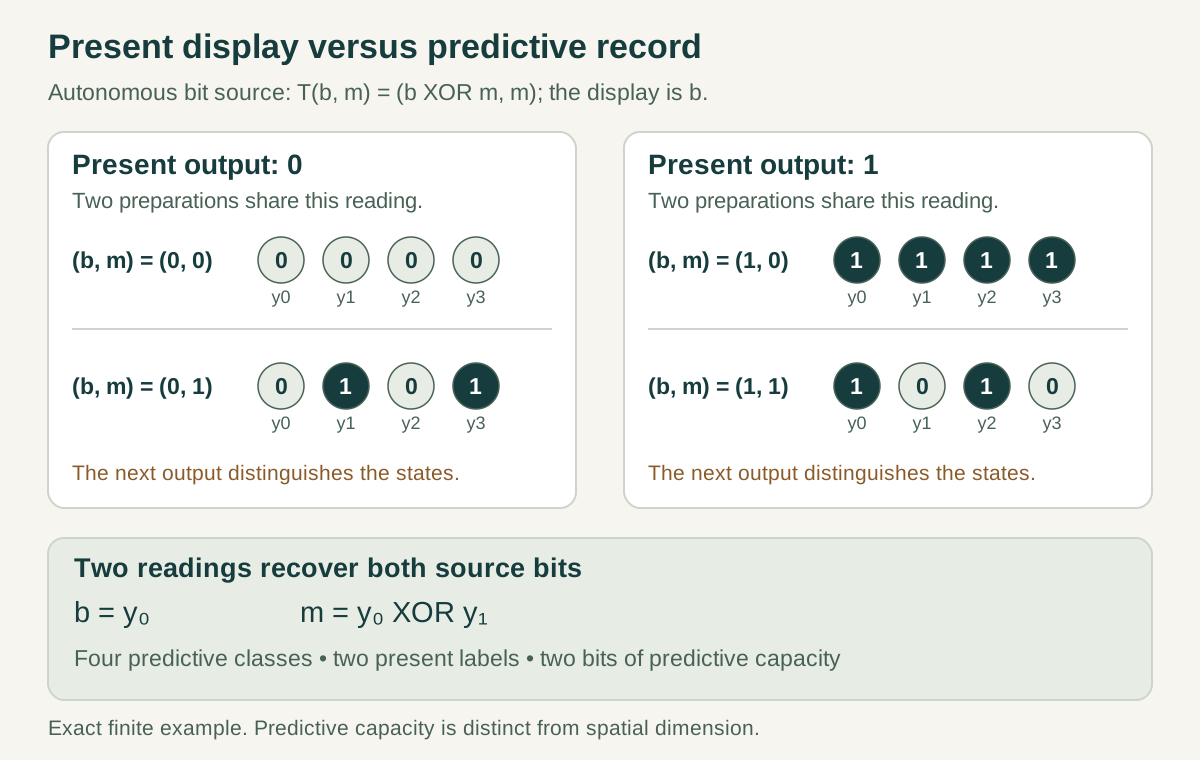
The exact criterion for a closed record update
Write Π for the map from complete source states to retained records. A deterministic update V on records exists with ΠU=VΠ exactly when equal records have equal next records: Π(x)=Π(z) implies Π(Ux)=Π(Uz). Necessity follows by applying the same function V to the same input. For sufficiency, define V(r) using any source representative with Π(x)=r; the condition makes the answer independent of that choice.
When interventions C are admitted, the condition must hold for each relevant controlled continuation, not just the unperturbed U. A record that predicts a free cycle may fail after a permitted pulse. The operational state space therefore depends on the intervention vocabulary, the reachable preparations and the measurements readers can actually perform.
The test-language article gives the natural generalization: two preparations are equivalent if every admitted future test yields the same result or statistics. Adding new tests can refine the equivalence classes, revealing distinctions hidden from a simpler detector.
A random model needs equal transition probabilities
Suppose a finite source has transition probabilities P(x,z). For an observed class R, sum P(x,z) over all z belonging to R. A closed one-step law on records requires these totals to agree for every pair of source states with the same present record. Their detailed hidden destinations may differ; their probabilities for all observable destinations must agree.
For example, let hidden states a and b both display zero, while c and d display one. If a always moves to c and b always moves to a, the next probability of display one is respectively one and zero. A record-only transition probability cannot describe both. If both a and b instead move into the one-class with total probability one-half, the next display law agrees even when their individual destinations differ.
Averaging over one specially chosen initial mixture can conceal this failure. A stronger test varies the hidden preparation whenever the operational model permits it. The resulting closure theorem should state whether it holds for every allowed preparation or only a stationary ensemble.
Construct the missing memory systematically
For a finite deterministic source, begin by grouping states with the same current output. Split any group whose members reach different groups under an admitted operation. Repeat until no further split is required. Each nontrivial refinement increases the number of groups; with N source states there can be at most N groups. The procedure therefore terminates.
The final partition is stable under the declared operations. It supplies a predictive quotient without assuming that every microscopic detail must be retained. In the four-state counter, the initial two classes split into four once next outputs are compared. In a parity-only source whose update simply toggles parity, two classes may remain sufficient for arbitrarily many steps.
Infinite systems require additional mathematical control, and approximate records require an error tolerance. The finite procedure nevertheless gives a practical research tool. It shows exactly which future tests force each refinement and how much extra memory they require.
Apply the criterion to a spatial completion
Choose a finite nested source with a spatial readout and a completion flag. Compute its predictive partition using the allowed transport and detector operations. Then compare the minimal predictive state with the displayed position alone. Does it need a carry register, a phase label, a previous reading or a certificate of completed work?
The desired deliverable is a compact autonomous description whose variables have operational meanings. A failure is equally informative if it identifies a shortest sequence of tests that distinguishes two supposedly identical records. Such a counterexample specifies the missing memory rather than vaguely declaring the model incomplete.
This connects an abstract quotient theorem to the central physical ambition of SMM/DTT. The source may generate many internal histories, while outer completion retains just enough structure for stable observation and future interaction. Establishing that sufficiency is a concrete step toward a world that carries its own usable history.
Develop the argument
Questions to take further
- What is the shortest continuation that distinguishes two equal spatial records?
- How many predictive classes remain after all admitted controls are included?
A concrete next step
Compute a predictive quotient
Fix a finite source, preparation family and control language; refine present-output classes until their transitions close.
What to share
The final partition, minimal required memory and a distinguishing test for every necessary split.
I welcome collaboration with experts in physics, mathematics and philosophy. Get in touch with a question or proposal.