


The answer in brief
A closed phase map or U(1) representation can enforce integer labels. Physical electric charge also requires field and action normalization, a selected matter sector and a measurable interaction.
Go to the research challengeTopology can fix an integer while leaving a unit free
A phase field that closes consistently around a circle can carry an integer winding. That is a natural structural ingredient for a theory in which recurrent inner generation leaves a retained phase. The next question is whether this integer determines physical electric charge, including its unit, coupling strength and relation to matter representations.
Those are distinct claims. An integer labels how a phase map wraps its target circle. A charge is a physical coupling inferred through interactions with a calibrated electromagnetic field. The site's winding and charge guide connects these questions while keeping the normalization explicit. This discussion develops finite and continuous examples that help locate what a proposed temporal derivation has actually established.
The winding calculation is exact
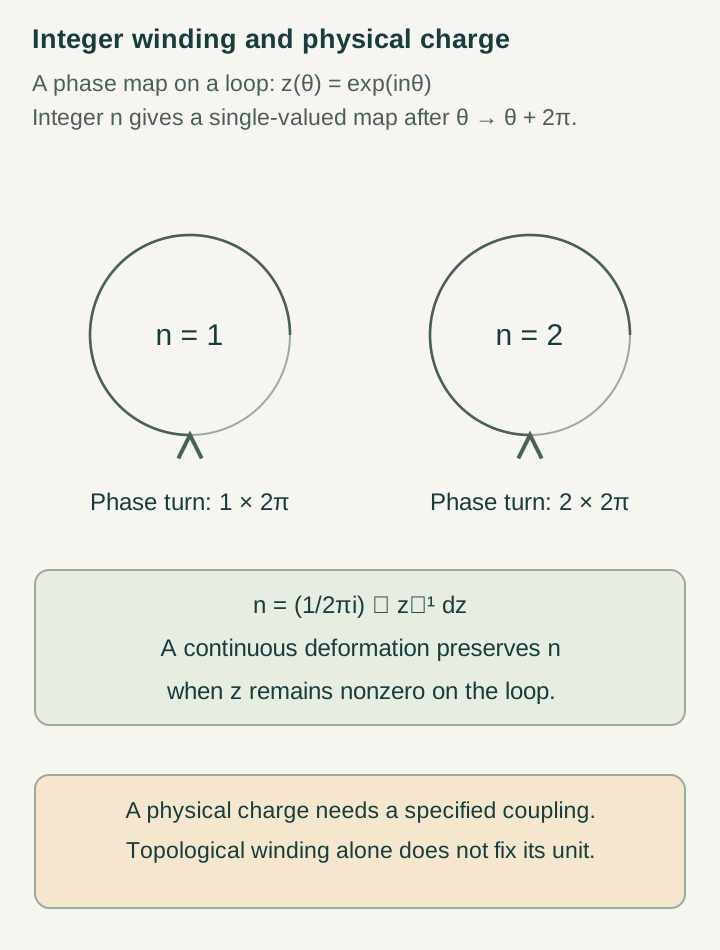
Let fₙ(θ)=einθ for θ between zero and 2π. Requiring fₙ to be a single-valued map from a circle to U(1) gives fₙ(2π)=fₙ(0), so n is an integer. Equivalently, its winding is the integral of the phase derivative around the source circle:
For n=2, the phase advances through two complete turns while θ advances through one. The integer remains unchanged under a continuous deformation that keeps the map within U(1) and preserves the domain circle. A phase singularity, a changed boundary condition or leaving the specified configuration space can remove that protection. The assumptions defining the admissible deformation are therefore part of the result.
A representation of U(1) on a complex line has the same periodicity requirement: χₙ(eiθ)=einθ. The integer n is the representation weight after the group's angle and period have been fixed. This is a group-theoretic charge label. Identifying it with an electric charge in coulombs requires an additional physical dictionary.
Why the electric coupling is not fixed by the integer
Suppose the physical charges are qₙ=nq₀. Parallel transport in a supplied electromagnetic potential can then carry phase exp[iqₙ∫A·dl/a], where a is the action scale. Rescaling the potential by A↦λA and the charge unit by q₀↦q₀/λ leaves this phase unchanged. The integer representation label has not removed the normalization freedom.
A complete electromagnetic theory controls that freedom by specifying the field's kinetic term, the energy stored in its configurations and the calibration of the probes. Once those are fixed independently, a coupling can be compared with observation. If the kinetic normalization is allowed to change with q₀, the same winding data can describe a family of response strengths.
This is closely related to the distinction between a structural count and a physical response coefficient. A proposed temporal charge derivation should keep q₀, the field normalization and a visible until it has an equation that fixes their invariant combination. Naming a fundamental winding elementary charge is a useful convention; deriving its coupling requires more.
What a magnetic monopole consistency condition contributes
A phase winding around a one-dimensional cycle is not itself a proof that a magnetic monopole exists in physical space. A monopole proposal also needs the field or bundle over an enclosing sphere, compatible local potentials and a flux observable. These data make a topological consistency condition applicable to electromagnetic transport.
In a convention where Φ_B is the total magnetic flux and the carrier's phase around a closed route is exp[iq∮A·dl/a], consistency between two spanning surfaces leads to qΦ_B/a=2πn. The exact placement of factors in a symbol called magnetic charge depends on its definition; the flux form makes the relevant phase normalization explicit.
Dirac's original paper on quantised singularities is the primary reference for the connection between monopole consistency and electric-charge quantization. The condition relates electric coupling and magnetic flux under the stated quantum and field assumptions. It does not by itself establish the existence of a monopole or separately calculate both dimensional scales.
The minimal-monopole reading guide is a route into the SMM/DTT proposal. A close analysis should identify the proposed carrier, flux definition and normalization before equating a pre-spatial source with a measured magnetic object.
Boundary conditions and sampling can change what is counted
For a wavefunction on a circle, the boundary condition ψ(θ+2π)=eiβψ(θ) shifts the eigenvalues of the angular derivative from integers n to n+β/(2π). This can describe a twisted boundary condition or a supplied background holonomy. It is not the same statement as replacing the integer weights of an already fixed U(1) representation by arbitrary electric charges.
A discretized loop brings another distinction. If only a finite set of phase values is recorded, neighbouring phase differences are known modulo 2π. Summing chosen principal differences yields a winding only after a branch or regularity condition makes the interpolation meaningful. A coarse sampler can miss extra turns between recorded points. Refining the sampling without changing the physical state is therefore a useful consistency test.
In DTT, nested inner stages may encode the needed phase history. The model must show which part of that history remains available to determine the winding and why it is stable under permitted source updates. A count inferred from an arbitrarily chosen interpolation cannot yet serve as a protected physical label.
Integer possibilities still need a selection mechanism
Even when the admissible sectors are labelled by all integers, topology does not choose which sector is prepared, which one is lowest in energy or which excitations persist. A model may contain n=0, ±1, ±2 and further states. Selecting the observed matter content requires a dynamics, stability criterion and operational preparation. The energy cost might depend on n², |n| or a more complicated interaction; the winding classification alone does not determine it.
A constructive contribution could begin with a finite phase network whose allowed deformations preserve a winding. Specify an energy and a completion test independently of the desired electric unit. Then derive the stable sector, its transport response and the effect of changing the field normalization. State which prediction is topological, which follows from the supplied dynamics and which requires calibration.
The resulting result may establish protected integer ratios while leaving one coupling free. That would still be a valuable structural achievement. The next research target would then be clearly identified: a source law linking the protected label to a uniquely calibrated response, rather than a second use of the same integer argument.
Develop the argument
Questions to take further
- Which physical invariant fixes the charge unit after field-rescaling freedom is exposed?
- What source dynamics selects and stabilizes the winding sectors assigned to matter?
A concrete next step
Separate winding from charge calibration
Construct a phase-bearing source with explicit boundary conditions, admissible deformations, a field kinetic normalization and a calibrated transport probe.
What to share
An integer-classification proof, the stable-sector calculation and a statement of which coupling combinations are fixed or remain free.
I welcome collaboration with experts in physics, mathematics and philosophy. Get in touch with a question or proposal.