
Compact U(1) characters have integer weights, and a sphere bundle can have flux ∫f=2πn in a dimensionless convention. Neither fact alone selects the realized sector or fixes an electromagnetic coupling.
Why a phase can return after several turns
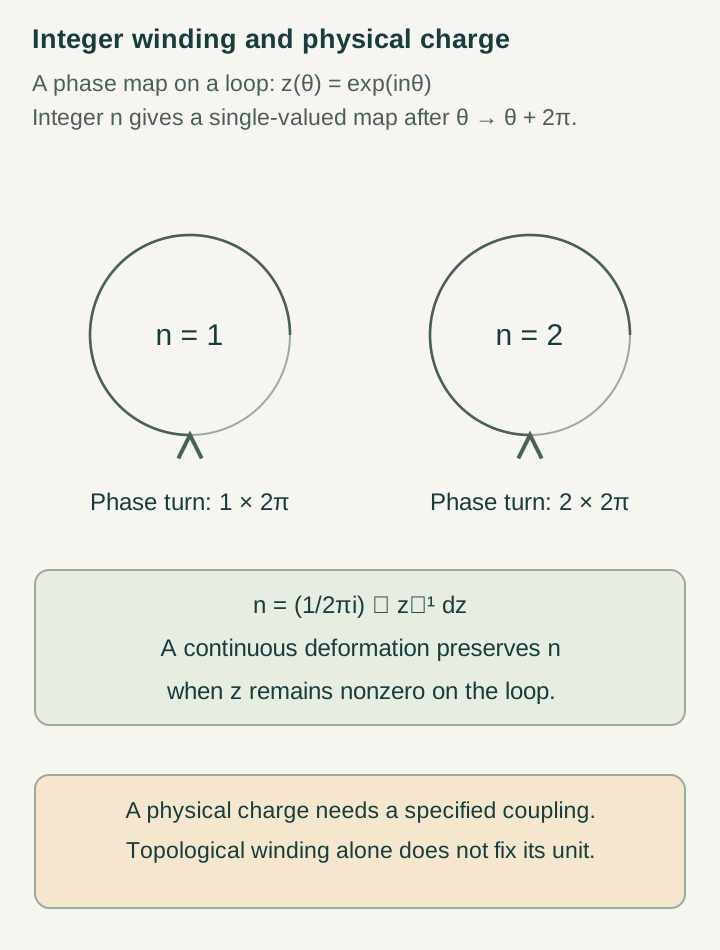
Let g(φ)=exp[inφ] be a phase defined on a circle with φ identified with φ+2π. Single-valuedness requires exp(i2πn)=1, so n is an integer. The same phase at the start and finish can therefore conceal one or more complete turns along the route.
For SMM/DTT, winding offers a precise way to encode a cyclic history whose local phase returns. It is a property of the supplied phase map and base circle, not a consequence of source unity alone. The physical question is which completed record, transport comparison, or conserved quantity preserves that integer.
Calculate and protect the winding
For a smooth nonvanishing circle map, the winding can be written n=(1/2πi)∮g−1dg. Substitution of exp(inφ) gives n directly. A continuous deformation through circle-valued maps cannot change this integer because a continuous integer-valued quantity is constant.
The restriction to the circle is essential. If an order parameter is allowed to leave the circle by passing through zero amplitude, its phase can become undefined and winding can change through a defect. A source model claiming protected charge must therefore identify both the phase manifold and the energetic or dynamical rule that prevents or controls such transitions.
Open the full-size diagram →
Integer representation weights
A continuous one-dimensional unitary representation of the compact phase group U(1) has the form ρq(exp(iχ))=exp(iqχ), with integer q. The periodicity of χ requires the integer weight. This differs from a representation of the additive group ℝ, where the parameter is not periodically identified and real weights are possible.
Once a reference unit of physical charge e₀ is specified, one can label a representation by charge qe₀. Choosing the phase group and its representations organizes relative charges. It does not determine the value of e₀, prove which representations occur as stable particles, or establish the dynamics that couples them to a field. Faithfulness and allowed matter content also affect which global group is actually observed.
A two-patch flux construction
Cover a sphere with northern and southern patches. In a dimensionless real-connection convention choose aN=(n/2)(1−cosθ)dφ and aS=−(n/2)(1+cosθ)dφ. On their overlap the difference is n dφ, corresponding to transition phase exp(inφ).
f=da=(n/2)sinθ dθ∧dφ, (1/2π)∫S²f=n.
Each patch avoids its problematic pole, while the shared curvature is smooth. Integrating sinθ over the sphere gives the stated integer flux. This explains a topological charge using local comparisons without pretending that one globally nonsingular potential covers the entire sphere.
An integer flux does not fix an interaction strength
The connection above is dimensionless after integration. Relating it to a physical electromagnetic potential introduces a charge and action conversion. A field-energy functional also contains a positive coefficient multiplying a quadratic curvature term. Changing that coefficient changes the energetic response while leaving the integer bundle class untouched.
For instance, an action proportional to κ∫f² can use any positive κ without changing n. A topological classification therefore leaves a continuous normalization freedom. The same distinction matters in the constants programme: a winding integer, a determinant degree, a state count, and an inverse coupling are different quantities until an explicit response law connects them.
From a pre-spatial source to a monopole interpretation
A magnetic monopole interpretation requires a spatial or spacetime surface, a connection over it, and a nontrivial flux class. A pre-spatial monad does not begin as a point already surrounded by such a sphere. The proposed reconstruction must first generate the relevant relational geometry and then show how its retained phase data define a bundle.
Even if the construction allows n=1, it may also allow zero and other integers. Selecting a minimal nonzero sector differs from proving that the physical vacuum or a stable particle realizes it. Energy, boundary conditions, stability, and accessible measurements decide that physical question. The monopole proposal guide makes this sequence explicit.
A useful next charge theorem
The six nested inner roles could organize the formation of directional records and their phase comparisons. To contribute a charge result, a source law should determine the transition functions or representation weights from those operations and prove their conservation under admissible completions.
A constructive first target is modest but informative: build one nontrivial retained bundle, calculate its integer from independently specified source operations, and show how an allowed protocol distinguishes it from the trivial sector. Then derive a field response with a fixed normalization. These two stages would connect source topology and interaction physics without identifying an integer label with a measured coupling by definition.
Continue with the articles
- Hopf geometry from a spinor doublet
Introduce the relation between a two-component complex description and a sphere of readout directions. Explain the Hopf bundle’s role in the draft’s reconstruction.
- Two phase actions and determinant closure
Compare the inherited polynomial phase with the selected coherent-output phase. Explain why determinant closure can produce a 137-fold condition only after the stated phase identifications.
- The minimal magnetic monopole proposal
Examine the proposed identification of the Single Monad with a minimal magnetic monopole. A bundle example separates ontological unity, topological charge, and physical field strength, then identifies the reconstruction steps needed to connect them.
- What the holonomy Hessian does and does not contain
Explore the exact trace structure of the response near identity holonomy. Explain why the absence of an independent squared-trace term matters for the model’s coefficient relations.