
Closed-path transport changes by conjugation under a local frame choice. Its conjugacy data can be invariant while still remaining experimentally inaccessible unless the preparation and readout detect the affected sector.
Close the comparison path
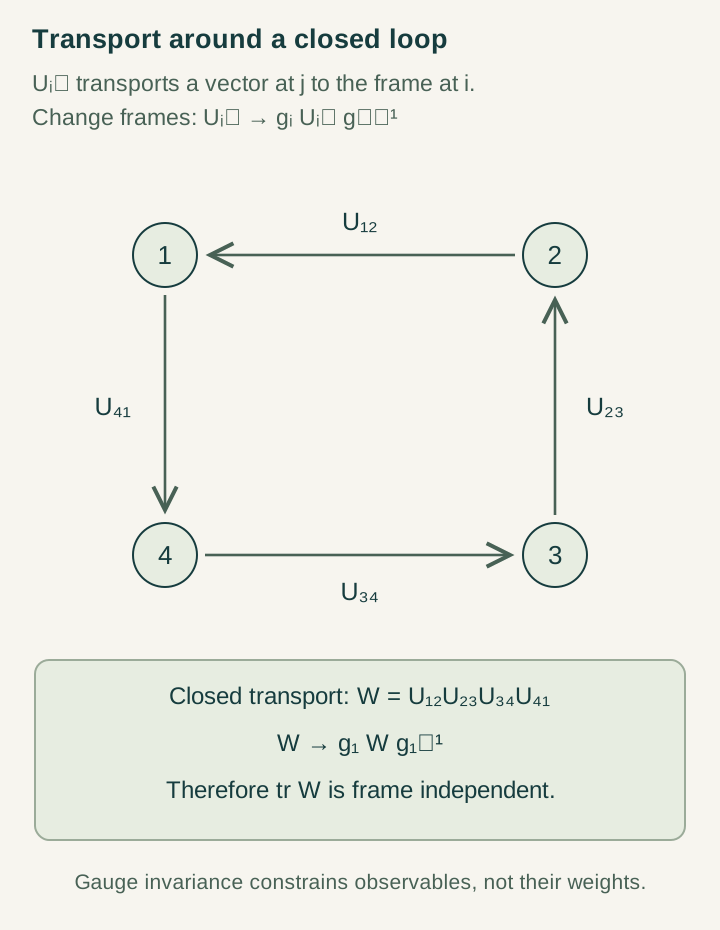
Begin at a record v, transport a carrier around a loop γ, and compare the final state with the starting frame. The resulting operator Wγ:Ev→Ev is the holonomy. With a consistent sequence of links it is their ordered product. It contains information that a list of local carrier dimensions does not contain.
For SMM/DTT, this is a natural language for a completed generative cycle: the source can return to a declared comparison point without erasing the accumulated action on its retained carrier. Whether the loop is a spatial path, a controlled parameter cycle, or a temporal recurrence must be stated in the model.
What survives a change of frame
The endpoint law for an open path becomes W′γ=hvWγhv−1 when both endpoints coincide. Hence the trace, determinant, and eigenvalues are independent of the chosen starting basis. The individual matrix entries generally are not.
For a one-dimensional carrier W=exp(iΦ), the phase is defined modulo 2π. For a two-component special-unitary carrier with eigenvalues exp(±iθ), tr W=2cosθ. A trace can fail to separate distinct higher-rank conjugacy classes, so the choice of invariant observables determines how much loop information the retained record preserves.
Open the full-size diagram →
Changing the base record along the same loop also conjugates the holonomy by the intervening transport. This preserves its conjugacy class while changing the matrix used to describe it. A comparison of loop matrices at different records therefore needs a declared transport between their base frames.
Small loops and local curvature
With D=d+A, the curvature is F=dA+A∧A. On a sufficiently small positively oriented coordinate rectangle, the parallel-transport convention U=P exp(−∫A) gives W=I−Fμνδxμδxν plus higher-order terms. The commutator part of F retains the mismatch of noncommuting local comparisons.
For an Abelian connection A=−ia, this becomes F=−i da and W=exp(i∮a). Stokes' theorem relates the phase to ∫da over a spanning surface when the connection is defined there with the required regularity. A nonzero loop phase need not imply a topological defect; an ordinary smooth curved connection can already produce it.
A flat circle can still have nontrivial monodromy
Take a base circle with coordinate φ modulo 2π and a=β dφ. Its curvature two-form vanishes: there is no nonzero two-form on a one-dimensional base. Nevertheless, transport once around the circle gives W=exp(i2πβ).
A single-valued frame change with χ=nφ, n integer, shifts β by n and leaves W unchanged. A noninteger β cannot be removed by such a global gauge transformation. This separates local flatness from global triviality. The continuous phase β modulo integers is also different from an integer winding number of a map into U(1). Both involve circles, but they classify different data.
A coherent reference makes a loop phase visible
Suppose a balanced two-arm experiment sends one component around an Abelian loop with phase Φ and leaves a coherent reference arm unchanged. Recombining the two arms gives the ideal plus-port probability:
The phase has become relative between two histories. Without the reference, multiplying the entire state by exp(iΦ) leaves its density matrix unchanged. Loss of path coherence also removes the ideal interference contrast. A proposed inner-time holonomy effect must therefore identify the reference, the coherent comparison, and the completed output. A nontrivial mathematical loop cannot substitute for that observation protocol.
An exact test for inaccessible loop structure
Consider a finite linear system with generator L, preparation map B, and readout C. Suppose a loop operator W obeys [W,L]=0, WB=B, and CW=C. Every reachable state is a linear combination of LkBv, and W fixes each one because it commutes with L and fixes B.
For example, take L=diag(−1,−2), B=e₁, C=e₁†, and W=diag(1,exp(iΦ)). The second coordinate carries a nontrivial phase, but the declared apparatus cannot prepare or observe it. All responses are unchanged. Adding access to that coordinate changes the experiment and removes the old invisibility conclusion.
A source model should predict an accessible loop law
The strongest DTT use of holonomy is a relation between source history and a measurable completed comparison. It should specify whether the relevant loop is a control protocol or a generated recurrence, determine its transport from the same dynamics, and establish which observable distinguishes it from a flat or inaccessible alternative.
The six nested inner roles might constrain the order or representation of the allowed operations. Their number alone does not set a loop phase. A useful next result would predict several loop responses from one frozen parameter set, including a protocol where the effect vanishes. That would connect the generative interpretation to an explicit operational restriction.
Continue with the articles
- Relational transport and gauge freedom
Explain why independently unframed record fibers require a rule for comparison. Introduce gauge transport as a conditional reconstruction idea, distinct from the draft’s exact Hamiltonian results.
- Invisible holonomy in inaccessible sectors
Explain the draft’s classification of residual parallel monodromy invisible to the prepared interface. Nontrivial structure can survive outside the behavior an experiment can access.
- Empirical equivalence is not full structural equivalence
Separate equality of observed behavior from a global trivialization of the complete model. Explain why two exact questions require different evidence.
- How a protocol can reveal dual-time structure
Outline ways to move beyond the finite prepared linear interface: protocol-dependent access, noncommuting transport, or richer memory. Each route must be defined as an observable procedure.
- The minimal magnetic monopole proposal
Examine the proposed identification of the Single Monad with a minimal magnetic monopole. A bundle example separates ontological unity, topological charge, and physical field strength, then identifies the reconstruction steps needed to connect them.