
Early registration can contract later phase-sensitive completion contrasts, while late registration preserves final flag populations. Ordinary quantum control reproduces this effect; a DTT test must also validate its source architecture.
Hold the ingredients fixed and change their order
Declare a prepared source state ρ, a further generation channel U, a registration channel D and a final acceptance effect E. Compare U after D with D after U. Use the same durations, channel parameters and detector definition in both protocols. The order is the intervention; changing the detector calibration as well would create a different comparison.
In DTT, generation can retain phase distinctions that are absent from a current public record. Registration describes a physical coupling that writes or discards information about that record. It is not merely a change in the observer’s vocabulary. The mathematical task is to identify exactly which coherences are affected and how the later source evolution converts them into completed outcome probabilities.
Calibrate the coherence multiplier independently
For a two-sector flag with ZF eigenvalues ±1, use the unread channel Dν(ρ)=(1+ν)ρ/2+(1−ν)ZFρZF/2, where 0≤ν≤1. Its two nonnegative weights sum to one, so it is a completely positive trace-preserving mixture of unitaries. It leaves diagonal flag populations unchanged and multiplies off-diagonal matrix entries by ν.
The extremes are informative: ν=1 is no dephasing and ν=0 is complete unread flag registration. Population preparations and a coherent reference preparation have different calibration jobs. The former check that the populations survive; the latter measures the coherence multiplier. Estimating ν from the very completion contrast reserved for the test would make the comparison circular.
Work through an exact qubit example
Prepare |+⟩=(|0⟩+|1⟩)/√2 and let the generation operation be the Hadamard gate H. Final acceptance is |0⟩. Early registration gives (I+νX)/2; H changes this to (I+νZ)/2. Late registration follows H|+⟩=|0⟩, whose population is untouched. Thus:
For the illustrative channel input ν=1/2, the model probabilities are 3/4 and one. No apparatus measurements are being reported. The lost contrast is ordinary measurement backaction: the early operation removes part of the phase information the Hadamard would have converted to a population. Both channels remain normalized, so the effect requires no conditioning on rare successful outcomes.
Use opposite preparations to remove a common offset
Repeat the same calculation with |−⟩. Its early acceptance is (1−ν)/2 and its late acceptance is zero. Subtracting the two preparation probabilities yields Δearly=ν and Δlate=1. More generally, the specified source protocol gives Δearly(ν,v)=νΔlate(v), provided the contrasted contribution is the affected coherence and final acceptance is flag diagonal.
A general population-preserving channel can multiply coherence by c with |c|≤1, introducing a rotation as well as contraction. Four phase preparations permit two independent contrast quadratures. Their norm contracts by |c|, while the rotation depends on a declared quadrature convention. One visibility alone can miss that coherent phase error. If the late contrast vanishes, a contrast ratio is undefined and that setting supplies no multiplier estimate.
Under a pure-register realization, the best single-copy flag-guessing probability is [1+√(1−ν²)]/2. With the illustrative ν=1/2 this is (2+√3)/4. The normalized retained contrast and the resulting distinguishability obey a unit-circle tradeoff. Extra mixing or uncontrolled phase generally changes that equality, providing another check on the registration model rather than evidence for a new probability rule.
Retain the instrument that creates the record
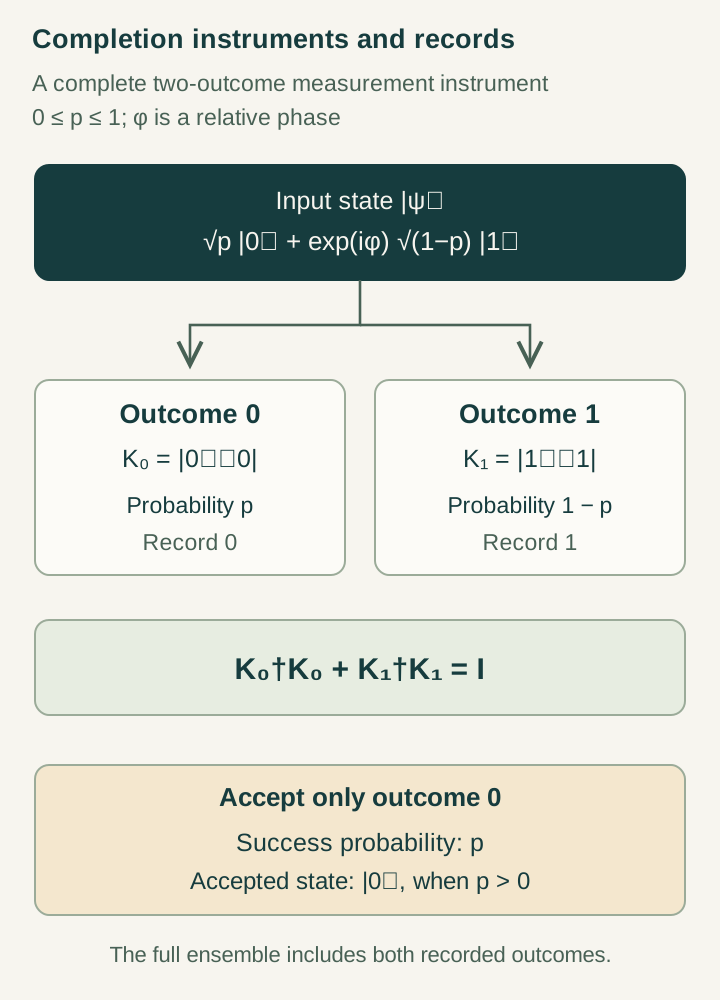
An unread channel is the sum over registered outcomes. If those outcomes are actually stored, the analysis must retain their joint probabilities with final acceptance. A selective branch MkρMk† has a trace equal to its success probability; dividing by that trace changes the question to a conditional one.
Open the full-size diagram →
The figure gives an exact projective example, the ν=0 limit of unread registration after summing its outcomes. A source completion protocol can also have rejected and unfinished branches. Record those before calculating conditional quality. A sharp accepted state does not show that most trials completed, and input-independent acceptance does not by itself establish recoverable failure.
Identify what the source model adds to the qubit baseline
The qubit calculation already produces the order effect. A loaded SMM/DTT construction can add independent record refinement, a scale comparator, source-controlled work, a generated completion flag and protected retained output. Those are additional physical functions with separate observables. Demonstrating only contrast contraction tests coherence loss, without selecting that larger architecture.
A meaningful comparison therefore asks whether one fixed source update predicts the order effect together with those other readouts. The six inner roles must specify actual nested dependencies between operations; they cannot serve as six freely adjustable delays chosen to fit the outcome. The seventh completion interface must certify the work produced by the same dynamics. A conventional quantum circuit implementing all identical channels remains an appropriate comparator unless a further source restriction makes a different prediction.
Define the uncertainty and the decision before comparison
Write the expected joint probability table for each preparation and ordering. Include independently bounded preparation error, registration mismatch, source-evolution error and final-readout error. For bounded Hamiltonian discrepancy δH over duration v, Duhamel’s estimate supplies a unitary error no larger than |v|‖δH‖/a; channel and measurement bounds then propagate this to the reported probabilities.
State which relation would fail if the calibrated protocol disagreed: the channel model, the source dynamics, or their matching. Agreement validates that relation in its stated range. It does not derive the Born rule or establish a unique temporal ontology. The constructive advance is an observable connection between retained inner phase and outer completion, accompanied by a baseline that explains how much of the connection ordinary quantum control already supplies.
Continue with the articles
- A quantum source for generation and completion
Introduce the positive phase–dilation model as an explicit realization within quantum mechanics. Explain how it distinguishes inner work from completed observation without deriving quantum kinematics itself.
- Completion without biasing an unknown input
Explain the construction of a loaded completion channel with input-independent success probability. Clarify why this condition matters when the matter state is unknown.
- A phase-sensitive registration experiment
Outline the proposed protocol linking source coherence to later completion statistics. Compare its response matrix and energy diagnostic with a simpler qubit baseline.
- How a protocol can reveal dual-time structure
Outline ways to move beyond the finite prepared linear interface: protocol-dependent access, noncommuting transport, or richer memory. Each route must be defined as an observable procedure.