
A complete instrument includes all outcomes. Completion can be unbiased with respect to an unknown payload while still depending on source preparation and apparatus resources.
What you will learn
- Calculate probabilities and conditional states in a two-outcome measurement.
- Compare coherent evolution before and after registration.
- Derive retry probabilities with explicit recovery and independence assumptions.
Before you begin: Lessons 01–06. This lesson introduces two-component quantum states and supplies the measurement rule it uses.
Supply the quantum framework explicitly
A normalized two-level pure state is ψ=a|0⟩+b|1⟩, where a and b are complex amplitudes and |a|²+|b|²=1. In the measurement rule used here, a detector of the displayed basis reports zero with probability |a|² and one with probability |b|². We are supplying this quantum rule to study a completion mechanism; the preceding phase construction alone did not derive it.
A density matrix ρ describes pure preparations and probabilistic mixtures in one language. For a pure state it is |ψ⟩⟨ψ|. Its trace equals one. Off-diagonal entries carry coherence relative to the selected basis, which can affect later phase-sensitive tests even when the immediate basis probabilities coincide.
Worked example: write every outcome
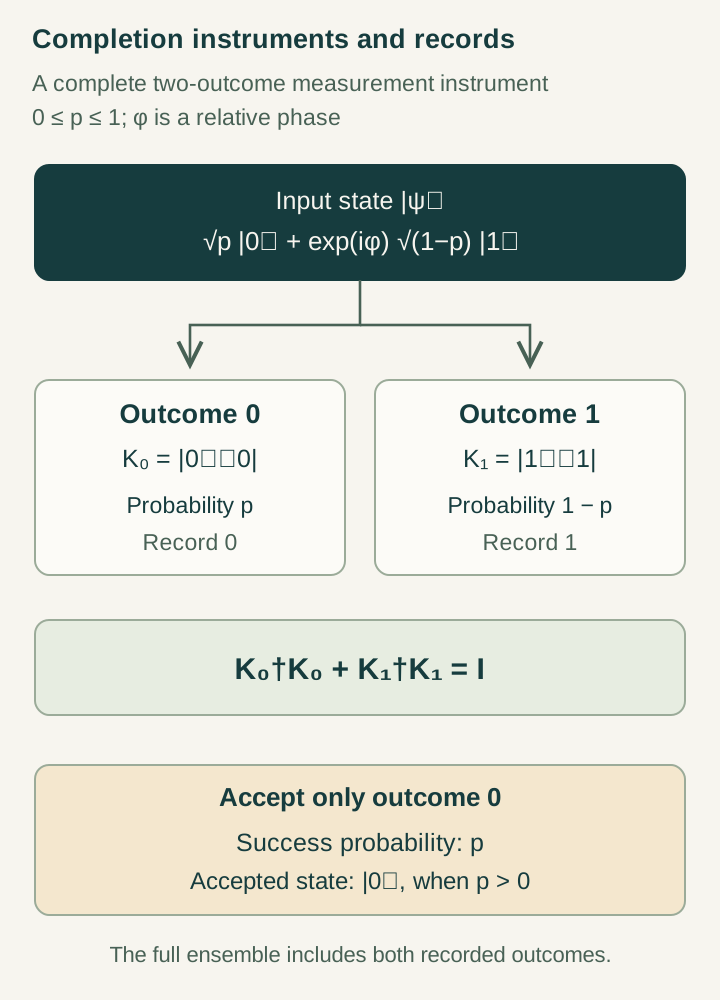
Prepare ψ=(√3/2)|0⟩+(1/2)|1⟩. The projectors P0=|0⟩⟨0| and P1=|1⟩⟨1| define unnormalized outcome maps Ik(ρ)=PkρPk. Their traces are 3/4 and 1/4, which sum to one. Conditional on the first result, the normalized state is |0⟩⟨0|; conditional on the second, it is |1⟩⟨1|.
If the apparatus performs the measurement but its result is ignored, the remaining state is diag(3/4,1/4). The input's off-diagonal entries √3/4 have vanished. Keeping only successful zero records would instead report a pure zero state together with success probability 3/4. Omitting that probability would hide the discarded trials and misdescribe the operation.
Open the full-size diagram →
Completion requires the entire instrument
More generally, outcome operators Mk obey ΣMk†Mk=I. This identity ensures that the sum of outcome probabilities is one for every input. The unnormalized map, its trace and the normalized conditional state are three distinct objects. Conditional normalization is meaningful only when the selected outcome has nonzero probability.
In DTT terms, a work register can evolve internally before a completion flag exposes a result. The flag must be produced by the specified dynamics and correlated with an actual completion condition. Calling a projector completion does not explain how a physical apparatus produces or retains the flag. The state of the work register, accepted and rejected outcomes, and later memory readout all belong to the model.
Registration changes what later work can use
Let |+⟩=(|0⟩+|1⟩)/√2 and let H be the Hadamard operation, which sends |+⟩ to |0⟩. Write D for an unread measurement in the zero–one basis. Compare D followed by H with H followed by D, using the same initial state and final basis detector.
In the first protocol, D removes coherence and gives I/2. A unitary H leaves I/2 unchanged, so the final outputs are balanced. In the second protocol, H first produces |0⟩, which D leaves unchanged; the final result is certainly zero. The difference is standard quantum registration physics. A distinctive source proposal must predict how its actual registration operation couples to inner work, rather than treating this familiar contrast as evidence by itself.
A completion that preserves an unknown payload
Choose Macc=√p V and Mfail=√(1−p)W, with fixed unitaries V,W and 0<p≤1. The squared effects sum to I, and acceptance has probability p for every normalized payload. The accepted conditional state is VρV†. On failure, applying W† restores the original state, including correlations with a passive reference.
With fresh independent apparatus and the same p on each restored attempt, first success at attempt n has probability (1−p)n−1p. The mean attempt count is 1/p. These statements require the failure recovery and fresh preparation just specified. An arbitrary rejected branch can leak information irreversibly, in which case restoring the payload and applying this geometric retry law are not justified.
A result must remain available
After successful writing, test whether the record remains readable at declared later delays. A perfect initial flag and a rapidly overwritten memory do not provide the same operational resource as a protected record. Completion accuracy, payload disturbance and retention lifetime need separate measurements, even when a common source supplies all three mechanisms.
The course now connects its two meanings of sufficient information. Lesson 03 asked whether a record predicts future tests. This lesson asks how an instrument prepares that record and changes the state. The completion guide expands the instrument and recovery examples. A common source explanation becomes stronger when one fixed dynamics constrains both its coherent phase and its readable outcomes.
Try the exercises
Work through each question, then open the answer to compare the steps.
Exercise 1
For recoverable independent attempts with p=1/4, calculate the probability of first success on attempt three, the probability of success within three attempts, and the mean attempt count.
Show the worked answer
Two failures followed by success have probability (3/4)²(1/4)=9/64. Failure on all three attempts has probability (3/4)³=27/64, so success within three has probability 1−27/64=37/64. The mean count over all possible attempts is 1/p=4. This mean is not a guarantee of success by attempt four.
Exercise 2
Start with |+⟩ and apply an unread zero–one measurement. What remains, and why can a final Hadamard not recover a certain zero output?
Show the worked answer
The input density matrix is one half times the matrix whose four entries are one. Unread measurement sets its off-diagonal entries to zero, giving I/2. Conjugation by H gives H(I/2)H†=I/2 because HH†=I. The final zero probability is therefore 1/2, whereas applying H directly to the coherent |+⟩ would give zero with probability one. The missing coherence cannot be restored by that unitary alone.
Continue with the articles
- A quantum source for generation and completion
Introduce the positive phase–dilation model as an explicit realization within quantum mechanics. Explain how it distinguishes inner work from completed observation without deriving quantum kinematics itself.
- Completion without biasing an unknown input
Explain the construction of a loaded completion channel with input-independent success probability. Clarify why this condition matters when the matter state is unknown.
- Undoing rejected partial work
Explore coherent recovery after a failed completion attempt, including inputs entangled with a reference. Explain the inverse access and control resources needed for the construction.
- Reliable completion by repeated attempts
Explain the geometric success law for fresh, recoverable attempts and the finite-archive reliability bound. Relate reliability to resource budgets rather than an assumption of guaranteed completion.
- A record that carries its own completion certificate
Introduce autonomous generation of a record and a flag certifying completion. Explain why the certificate must arise from the specified dynamics rather than an external declaration.
- Keeping an observed label stable
Study repeated interrogation of a stored label, including selective measurement backaction. Explain the transport assumptions that preserve the label and the errors they allow.