
An invertible skew generator selects J=A(−A²)⁻¹ᐟ² on its dynamic sector. For forward A=JΩ and positive H=aΩ, conventional Schrödinger notation uses i=−J.
What you will learn
- Verify that a real quarter-turn squares to minus the identity.
- Separate rotation rate from phase orientation by polar normalization.
- Distinguish ordinary complex phase, split-complex geometry and physical time calibration.
Before you begin: Lessons 01–05. Basic coordinates are sufficient; operator multiplication means applying one rule after another.
Begin with a rule on a real plane
Define J(x,y)=(−y,x). A point on the positive horizontal axis moves to the positive vertical axis, so J is a counterclockwise quarter-turn. Apply it again: J(−y,x)=(−x,−y). Two applications reverse every vector, which is written J²=−I, where I leaves vectors unchanged.
The ordinary imaginary unit i obeys i²=−1. We can therefore represent one complex convention by letting multiplication by i act as J on this real plane. This operation does not introduce an extra physical dimension or clock. It equips an existing two-real-component carrier with a consistent scalar multiplication. Its norm is preserved because (−y)²+x²=x²+y².
Worked example: watch the rotation
Open the phase-rotation demonstration and select θ=30 degrees. The unit vector is ψ=(√3/2,1/2). Applying J gives (−1/2,√3/2), and applying it again gives (−√3/2,−1/2). Every vector has squared norm 3/4+1/4=1.
For any angle, the rotation is exp(θJ)=cosθ I+sinθ J. Grouping even and odd powers in the exponential series proves the identity because J²=−I. The slider sets a dimensionless angle. To convert it to elapsed time, supply a phase rate ω and a clock relation θ=ωt. Merely labelling an angle inner time does not calibrate that relation or explain how a detector reads it.
Let the dynamics choose orientation
Suppose a real norm-preserving continuous evolution has generator A with Aᵀ=−A and no stationary direction. Its positive magnitude is Ω=(−A²)1/2. In finite dimensions Ω commutes with A and is invertible. Define J=AΩ−1. Then J²=A²Ω−2=−I: removing the rate leaves an oriented quarter-turn structure.
For A=3J0, the magnitude is 3I and J=J0. For A=−3J0, the magnitude remains 3I while J=−J0. Thus the direction of evolution, not just the unoriented circle, supplies the sign. This exact selection assumes the oriented generator already exists; it does not by itself derive the source dynamics producing that generator.
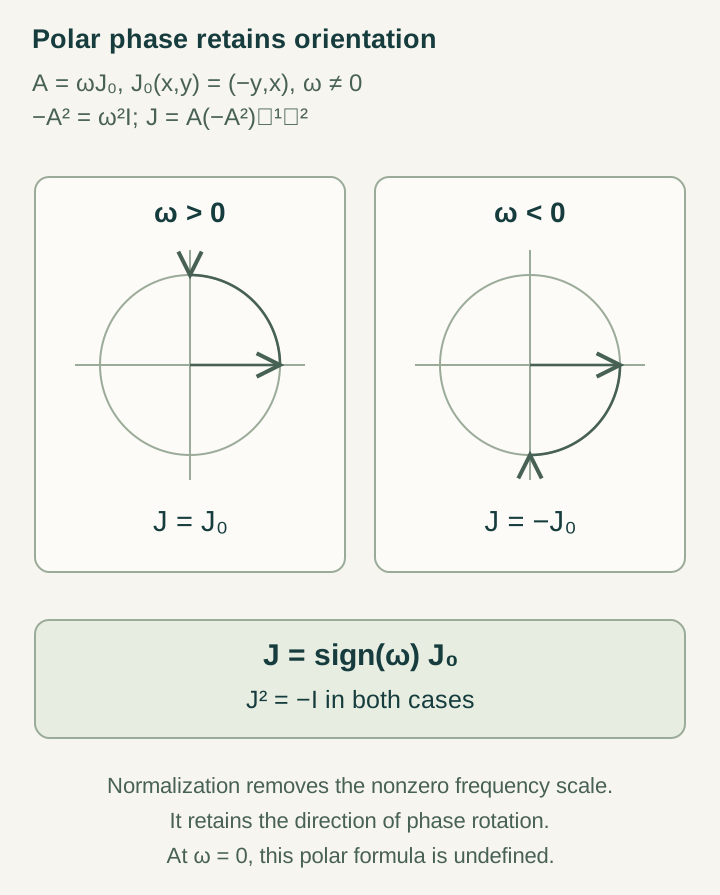
Open the full-size diagram →
Keep the forward-flow sign consistent
Now write the forward real evolution as dψ/dt=Aψ=JΩψ. Choose a positive action constant a and define H=aΩ, which is positive on the dynamic sector. Conventional Schrödinger notation is ia dψ/dt=Hψ. These expressions agree when its scalar i is represented by −J.
Choosing i=J instead would give ia dψ/dt=−aΩψ for this same forward flow. Either scalar convention is mathematically possible, but the sign of the Hamiltonian and orientation must be tracked together. The earlier quarter-turn exercise establishes an ordinary complex structure; it does not require identifying that convention with the conventional positive-energy i without this additional sign choice.
Stationary directions and another algebra
If A vanishes on a direction, Ω has a zero eigenvalue there and its inverse cannot be used. The polar construction selects phase on the dynamic sector, the complement of the stationary kernel. A stationary real line cannot carry an operator squaring to −I; a stationary plane admits such operators but the zero dynamics does not choose their orientation.
Split-complex notation uses a different unit j with j²=+1. Its exponential is coshη+j sinhη and preserves an indefinite quadratic form in the appropriate real representation. Ordinary J²=−I gives circular phase. Split-complex j²=+1 gives hyperbolic mixing. Similar notation is no reason to exchange these identities or identify a quantum phase coordinate directly with spacetime.
What phase contributes to the course
SMM asks whether one source can generate the mathematical structures used across physics. The polar result supplies a precise conditional dependency: an oriented real orthogonal dynamics selects a compatible phase on its moving sector. DTT then asks how that internal coherent activity becomes an available record.
A phase structure alone does not fix which outcomes are possible, their probabilities, how separate systems compose or which action unit relates frequency to energy. Those ingredients must be supplied or derived through additional constructions. Lesson 07 introduces an explicit quantum instrument and checks its normalization. For the broader proof and symmetry-compatibility questions, read real dynamics and phase, including its treatment of stationary modes.
Try the exercises
Work through each question, then open the answer to compare the steps.
Exercise 1
A=diag(2J₀,−5J₀) acts on two real planes. Find Ω and J, and verify the sign choice for H=aΩ.
Show the worked answer
Squaring gives −A²=diag(4I,25I), so Ω=diag(2I,5I). Multiplication by its inverse yields J=diag(J₀,−J₀), and J²=−I on both planes. With i represented by −J, iaA=(−J)aJΩ=aΩ=H. Both energy blocks are positive for a>0 even though the original plane rotations have opposite orientations.
Exercise 2
Compare J(x,y)=(−y,x) with S(x,y)=(y,x). What is each square, and which quadratic form does exp(ηS) preserve?
Show the worked answer
J²(x,y)=(−x,−y), whereas S²(x,y)=(x,y). Thus J represents an ordinary complex unit and S a split-complex unit. The latter exponential maps x to x coshη+y sinhη and y to x sinhη+y coshη. Expanding x′²−y′² cancels the cross terms and gives (cosh²η−sinh²η)(x²−y²)=x²−y².
Continue with the articles
- Split-complex time and ordinary quantum phase
Explain why the split-complex pairing used for temporal roles differs from the ordinary complex scalar selected for phase. Avoid treating two algebraic uses of complex language as identical.
- Selecting phase by polar decomposition
Explain how a positive-time generator can select a compatible complex structure on the dynamic sector. Make clear why zero-frequency modes need separate treatment.
- Real-commutant phase selection: a paper guide
Introduce the paper’s phase-selection question in real Hilbert representations. Prepare an accessible route from the commutant to compatible complex structures and their physical interpretation.