
The supplied Coulomb model fixes radius and binding energy together. Its ground-state relative RMS speed is gc, while the real 1s probability current is zero.
What you will learn
- Minimize the exponential-family Coulomb energy.
- Connect radius, binding energy and relative momentum using one Hamiltonian.
- Separate relative RMS speed, electron centre-of-mass speed and probability current.
Before you begin: Lessons 01–09. This lesson supplies its quantum Hamiltonian and uses elementary differentiation and normalized-state expectations.
State what makes the pair bind
Neutrality alone does not establish an atom: two opposite charges can be far apart. Binding requires a localized state below the energy of separated constituents. Supply a three-dimensional relative-coordinate Hamiltonian H=−D∇²−C/r, with positive D and C and separation threshold zero. The first term is a kinetic cost; the second is attractive.
For an electron of mass me and nucleus of mass M, the reduced mass is μ=meM/(me+M). Conventional matching sets D=ℏ²/(2μ) and C=gℏc. The dimensionless g becomes the electromagnetic coupling after matching to that physical interaction. Geometry, coherent dynamics, the inverse-distance potential and their coefficients are inputs to this lesson's calculation.
Worked example: find the preferred size
Take the normalized exponential ψ(r)=exp(−r/a)/√(πa³), where a>0 controls its spatial size. Its exact expectation in the supplied Hamiltonian is E(a)=D/a²−C/a. Differentiating gives E′(a)=−2D/a³+C/a², which vanishes at a*=2D/C.
For D=1/2 and C=1 in model units, the radius parameter is one and the energy is −1/2, below the separation threshold. This is a minimum within the trial family. The full Coulomb derivation supplies a square-completion lower bound for all admissible states and shows that the optimized exponential is the exact ground state of this operator.
Compare the entire binding curve
Set x=a/a* and divide energy by |E*|. The hydrogen-energy demonstration plots the resulting function 1/x²−2/x. Its value plus one equals (1/x−1)², proving the minimum is −1 at x=1.
At x=1/2, kinetic and potential contributions are four and minus four, giving zero. At x=2 they are 1/4 and minus one, giving −3/4. The curve captures the balance between confinement cost and attraction. Doubling C at fixed D halves a* and quadruples |E*| but leaves this dimensionless curve unchanged. Therefore the existence or shape of the bound curve cannot select a numerical coupling by itself.
A probability profile is not an orbit
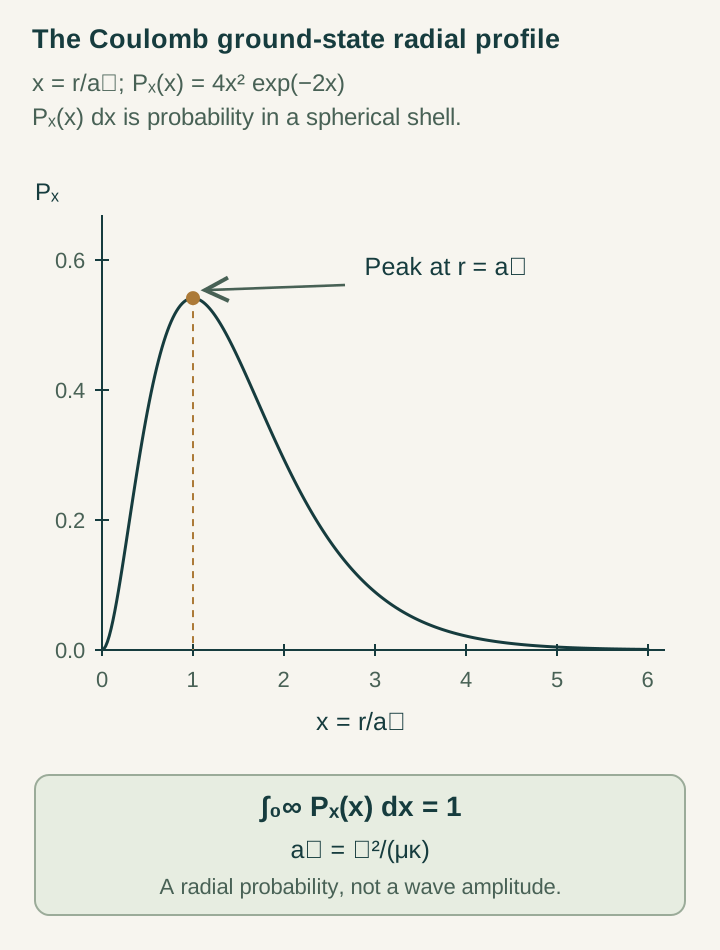
The normalized radial probability is P(r)=4r²exp(−2r/a*)/a*³. It includes the volume of a spherical shell. Its peak is at r=a*, whereas the probability density per unit volume is largest at the origin. Its mean radius is 3a*/2, so even the peak and mean describe different statistics.
The real stationary 1s wavefunction has zero probability current. This does not imply zero momentum variance. A broad stationary state can have vanishing mean momentum and nonzero mean squared momentum. The radial plot therefore describes repeated position statistics, not an electron tracing a circular path. Interpret every claimed source prediction using the same specific observable.
Open the full-size diagram →
Derive the speed statistic carefully
For a Coulomb bound state the virial relation is 2⟨T⟩=−⟨V⟩, so E=−⟨T⟩. The spectrum En=−μc²g²/(2n²) then gives ⟨p²⟩=μ²c²g²/n². The relative RMS speed is √⟨p²⟩/μ=cg/n. In the ground state and after electromagnetic matching, vrel,rms/c=α.
In the centre-of-mass frame the electron carries the same relative momentum p but its velocity is p/me. Its RMS ratio is therefore (μ/me)g/n. For an equal-mass pair, each constituent has half the relative RMS speed. Only an infinitely heavy nucleus makes the electron and relative ratios coincide exactly.
Use several linked atomic checks
The same input g gives a*=ℏ/(μcg), ground binding magnitude μc²g²/2 and relative RMS speed cg. At fixed coupling, changing nuclear mass alters μ, so radius scales inversely with μ, energy directly with μ and relative RMS speed remains unchanged. The electron centre-of-mass speed still changes through μ/me.
A source-derived matter law should reproduce these relations with one common clock and action dictionary. It should identify additional corrections before comparing precision spectra; the present model omits relativistic, spin, radiative and nuclear effects. Lesson 11 asks what could fix g upstream. Producing a structural integer is one candidate ingredient, while the normalized physical response remains an independent calculation.
Try the exercises
Work through each question, then open the answer to compare the steps.
Exercise 1
With D=2 and C=4, find a*, E* and E(a) at a=2. How far is that energy above the minimum?
Show the worked answer
The minimizing scale is a*=2D/C=4/4=1 and the minimum is E*=−C²/(4D)=−16/8=−2. At a=2, E=2/4−4/2=1/2−2=−3/2. The energy lies (−3/2)−(−2)=1/2 above the minimum. Its dimensionless value is (−3/2)/2=−3/4, consistent with x=2 in the demonstration.
Exercise 2
For an illustrative nucleus M=9mₑ and g=1/100, calculate the ground-state relative and electron centre-of-mass RMS speed ratios. What is the mean velocity vector of the real 1s state?
Show the worked answer
The reduced-mass factor is μ/mₑ=M/(mₑ+M)=9/10. Hence v_rel,rms/c=1/100=0.01 and v_e,rms/c=(9/10)(1/100)=0.009. The mean velocity vector and probability current are zero for the real stationary 1s state. Nonzero RMS speed refers to the positive momentum variance, not a nonzero mean vector or a sharply defined orbit.
Continue with the articles
- A normalizable hydrogen-like ground state
Introduce the lower-bound and bound-state results of the effective model. Explain how the supplied kinetic and potential rules produce a meaningful atomic test case.
- Why binding does not fix the coupling
Introduce the dilation argument showing that a family of positive couplings remains compatible with binding and completion. Identify the extra source-selection law needed to obtain a specific interaction strength.
- Hydrogen and deuterium as complementary probes
A proposed isotope-comparison article within the differential-test program. Identify which effects are shared and which require separate mass and nuclear inputs before interpreting a residual.