


Retention is an additional physical task
A detector can produce an outcome that a later observer cannot recover. A fading mark, a lost register, or a noisy transmission can destroy the practical record without changing what happened at the detector. Stability therefore belongs to the physical account of observation, not just to its notation.
The SMM/DTT distinction between generation and accessible records makes this requirement concrete. A retained state must remain usable by later comparisons, while the matter supporting that memory must obey its own dynamics. The published recorder programme treats completion as a construction with explicit conditions and resources. [P01] [A02]
Our memory lab is deliberately classical. It assumes that an already available logical bit can be stored as 000 or 111. Each physical bit then flips independently with probability ε. Reading the majority corrects any single flip. This is a simple demonstration of reliability under a specified noise model, not a scheme for copying an unknown quantum state.
Trade physical copies for logical reliability
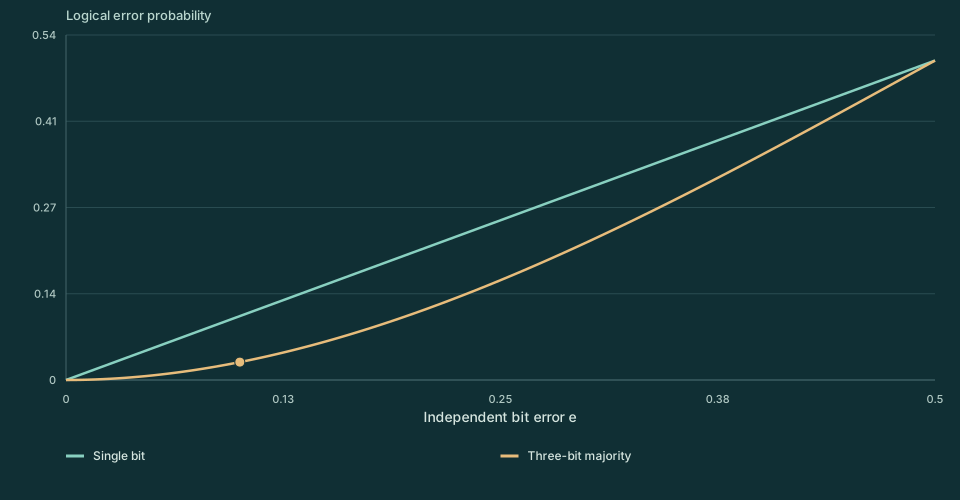
Change the independent flip probability ε between zero and one half. Compare the error probability of one physical bit with the decoded error probability of the three-copy memory. At ε=0.1, a single copy fails 10% of the time, whereas the majority output fails with probability 0.028.
Interactive calculation
Change the inputs to compare the model outputs.
Enable JavaScript for adjustable values. The static figure and worked calculation remain available.
At ε=0.5, all three bits are independent fair errors and the majority is no better than a single bit. Extending the formula beyond the slider range to ε greater than one half makes this decoder worse. If that reversal were known and stable, a different calibrated decoder could use it; the laboratory keeps the stated majority rule fixed.
Count the failures exactly
A wrong majority requires exactly two flips or exactly three. There are three choices of the pair that flips, which produces the first term. Summing the two cases gives the polynomial shown in the readout. No simulated trial sequence is needed to compute it.
The factorization shows immediately that majority decoding improves the error rate for 0<ε<1/2. Near ε=0, the leading logical error is 3ε² rather than ε. That suppression explains the benefit of redundancy in this idealized setting.
The success probability is (1−ε)³+3ε(1−ε)². Adding it to p_fail gives one, as required. The memory consumes three physical bits for one logical bit, and a real implementation also needs preparation, readout, and any repair operation. Repeated cycles require a model for errors accumulated between corrections.
Independence is essential. If one disturbance flips all three copies together with probability ε, the majority fails with probability ε, not 3ε²−2ε³. Spatial separation, different error channels, or shielding might reduce such common disturbances, but each is a physical assumption to verify.
Memory connects observation with matter and time
The lab protects a known classical symbol after measurement. It does not preserve arbitrary relative phases, create an outcome, or explain the Born rule. A quantum memory needs a channel and recovery description suited to quantum information; copying a classical outcome and duplicating an unknown coherent state are different operations.
Record stability also has a temporal scope: reliable for which interval, environment, and later readout? A memory that lasts long enough for one comparison may fail in a longer experiment. Thermodynamic interpretations additionally require energy exchanges and a physical model of resetting. Merely calling information discarded does not determine those costs. [O03] [B16]
Continue to Matter to examine persistent carriers, or to finite resolution to see a different limitation: a perfectly stable memory can faithfully store a measurement that was coarse from the start.