

An event and its probability are different objects
A detector event can leave a localized mark, a voltage pulse, or a stored bit. Its probability belongs to a model of how the apparatus responds to a specified preparation. The mark is one outcome; the probability describes a family of possible repeated records. Confusing these levels turns a predicted average into an invented observation.
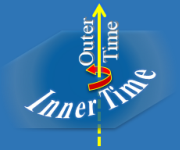
In SMM/DTT, inner generation concerns the production of distinctions, whereas outer observation concerns completed records available to later comparison. A useful record must be physically retained and interpretable with its preparation and apparatus settings. The operational postulate motivates this separation, but does not itself supply the probability law used below. [B02] [B24]
Our first laboratory assumes independent repetitions of a two-outcome test with a constant success probability p. Independence, a fixed preparation, and stable detector behavior are substantive conditions. A drifting laser, a detector that recovers slowly, or a shared environmental fluctuation can violate them even when every pulse is individually visible.
Count expected outcomes without inventing data
Change the number of preparations N and the supplied probability p. The display gives the expected plus and minus totals, their sum, and the standard deviation of the observed plus fraction. These are calculations from the stated model, not a random simulation or measurements collected from a real detector.
Interactive calculation
Play scans Number of independent trials. Step advances it. No animation starts automatically.
Enable JavaScript for adjustable values. The static figure and worked calculation remain available.
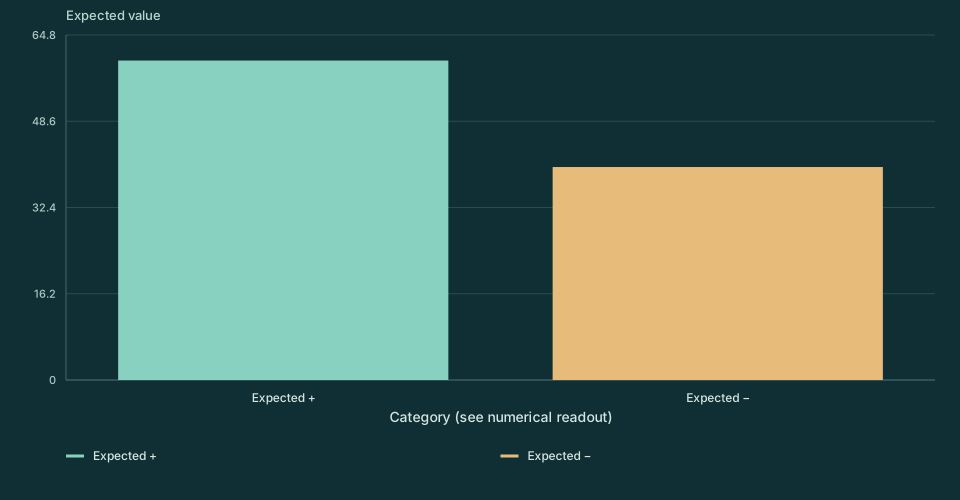
With N=100 and p=0.6, the expected totals are 60 and 40. The standard deviation of the plus count is √24≈4.899, while the standard deviation of its fraction is about 0.049. At N=400, the expected plus count becomes 240 and its count deviation grows to about 9.798; the fractional deviation falls to about 0.0245.
Derive the scaling from independent trials
For one indicator, Xᵢ²=Xᵢ, so its variance is p−p². Independent trials have zero cross-covariances. Adding their expectations and variances gives the count statistics, and dividing by N gives the fraction statistics:
A fourfold increase in the sample size therefore halves the standard deviation of the fraction. This square-root improvement is a property of independent sampling. It is not an explanation of how a microscopic event selects one outcome, and it cannot remove a systematic offset in detector efficiency.
The exact count distribution is binomial: Pr(K=k)=C(N,k)pᵏ(1−p)ᴺ⁻ᵏ. An expected count need not be an integer: N=3 and p=0.5 gives E[K]=1.5, although every realized K is an integer between zero and three. Expectations average over possible runs; they are not intermediate detector readings.
Unequal efficiencies show why the denominator matters. If plus and minus detections have efficiencies η₊ and η₋, the plus fraction among detected events is η₊p/[η₊p+η₋(1−p)], whenever that denominator is nonzero. It need not equal p. For p=1/2, η₊=1, and η₋=1/2, the detected-only fraction is 2/3. Counting every preparation instead introduces a third, missed-detection outcome and preserves the distinction between source statistics and selection by the apparatus.
What has to survive with the record
A reproducible record should retain the apparatus setting, a clear outcome convention, an exposure or trial count, and the rule used to include or exclude trials. Losing failed detections can change a probability estimate. Reordering samples can conceal a drift that was visible in the original time sequence.
The published reconstruction programme asks when a retained output supports its own later evolution. Its record criteria concern the information available to future dynamics; they are stronger than merely placing a timestamp on a value. [P01] [A02]
Continue to future tests to see two preparations with identical current counts but different later predictions. The final evidence laboratory returns to finite samples and asks how much a synthetic count can actually exclude.