
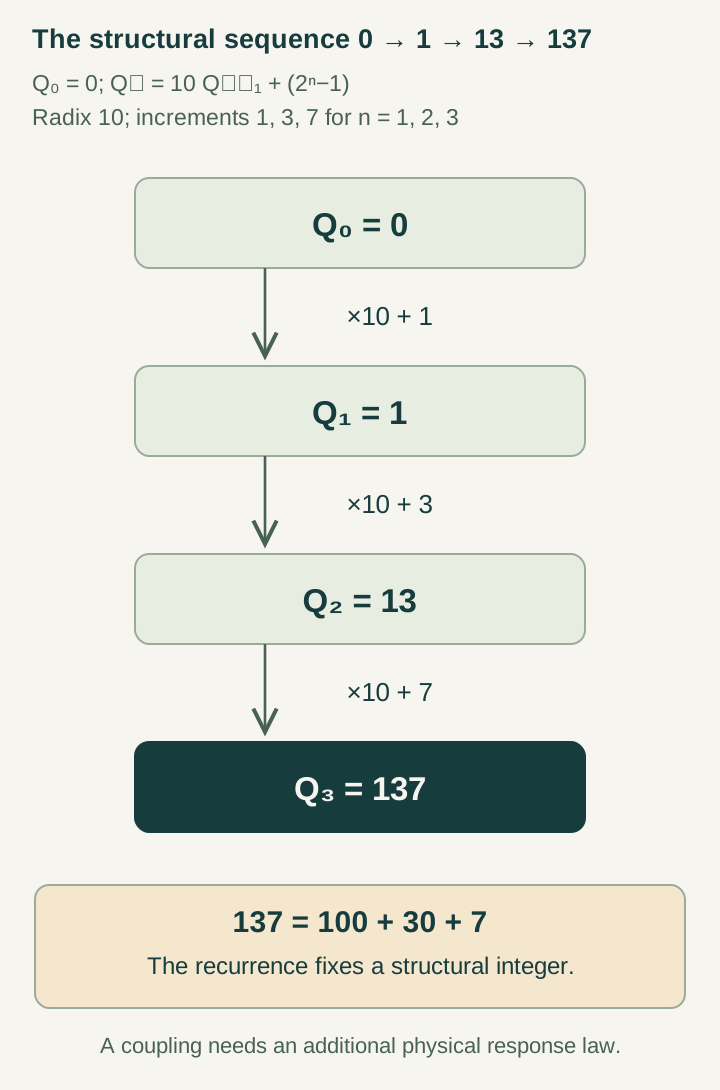
The free construction R₀=0 and R_d=(Q⊗R_d−1)⊕B_d, with dim Q=10 and dim B_d=2^d−1, gives dim R₃=100+30+7=137. This is a conditional record dimension.
1. Specify what the integer counts
The number 137 is interesting here because a declared retention grammar produces it exactly. The mathematical result is a dimension: the number of independent completed record labels in a free construction. To understand its significance, first reconstruct the ingredients and ask which physical task would require preserving them. Neither the decimal appearance of the number nor its proximity to an inverse electromagnetic coupling supplies the missing physical interpretation.
The construction starts with a three-component real readout W and an identity channel, forming a four-component envelope Vℝ=ℝ⊕W. The identity component is an operational unit, not another spatial axis. We use V=ℂ⊗Vℝ, so dimensions below are complex dimensions. Complex amplitudes are continuous even when the labels of a basis are finite.
Three explicit selections follow: retain all symmetric bilinear pair information in Q=Sym²V; retain nonempty exterior innovation branches at depths one through three; and carry every earlier record forward independently with each Q label. These assumptions make the arithmetic exact. Showing that one source must implement them is a separate theorem that the SMM/DTT programme seeks.
The three grammar depths are not the six nested inner roles. One describes the recursive organization of these records, while the other describes a proposed organization of generative operations. A model connecting them should state which operations prepare, preserve, and complete each register.
2. Build ten normalized continuation modes
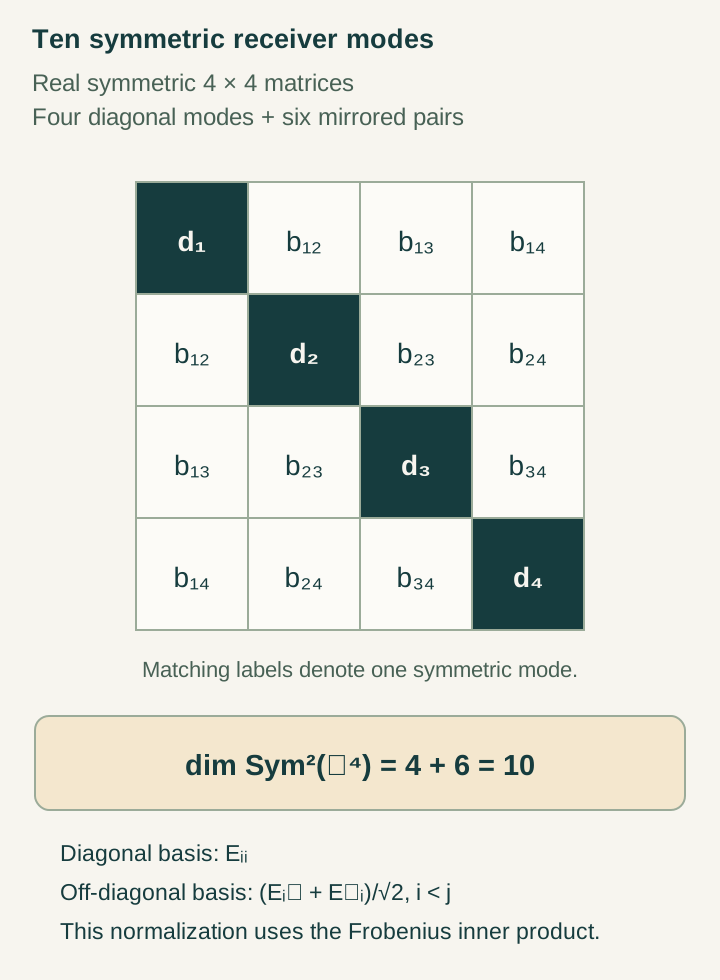
Let e₀,e₁,e₂,e₃ be an orthonormal envelope basis. On V⊗V, the swap operator S sends u⊗v to v⊗u. Since S²=I and S†=S, the operator (I+S)/2 is an orthogonal projector. Its image is the symmetric square. Four diagonal tensors and six normalized mixed tensors form an orthonormal basis:
sab=(ea⊗eb+eb⊗ea)/√2 (a<b).
dim Q=4+6=10.
The normalization matters if these labels later carry probabilities or energetic weights. For u=(e₀+e₁)/√2, the pair tensor is u⊗u=s₀₀/2+s₀₁/√2+s₁₁/2. Its squared coefficient magnitudes sum to one. Equal written pair labels do not mean equal amplitudes.
Why retain ten rather than merely multiply two envelope elements? Under a quaternionic realization, symmetric multiplication m(u⊙v)=(uv+vu)/2 maps Q onto a four-dimensional envelope. It loses six independent directions. Three are mixed imaginary pairs; three are diagonal combinations sii+s₀₀. Thus recording only the final product cannot implement the full pair-memory task.
Every symmetric bilinear test factors uniquely through Sym²V. This universal property supplies minimality for that declared family of tests: an encoding that compresses a nonzero direction loses at least one test. It does not prove that every physical completion mechanism must offer all such tests. Nor does preparing a pair tensor authorize copying an unknown state; physical pair preparation and retained correlations remain part of the model.
3. Derive the nonempty branch ranks
At depth d introduce a d-dimensional innovation space Id. Select the branch space Bd=⊕k=1dΛkId. Exterior multiplication imposes v∧v=0, and expansion of (u+v)∧(u+v)=0 gives u∧v=−v∧u. A basis monomial therefore contains distinct increasing indices. Choosing k indices among d gives dim ΛkId=binom(d,k).
b₁=1, b₂=3, b₃=7.
At depth two, the labels are e₁, e₂ and e₁∧e₂. At depth three, there are three singletons, three pairs and one triple. “Binary” refers to whether an innovation appears in a monomial, not to binary-valued amplitudes. The scalar empty monomial is explicitly excluded.
That exclusion is testable within the mathematics: including degree zero would instead give branch ranks two, four and eight. With the same continuation rule, the final dimension would be 248. Likewise, replacing exterior retention by symmetric powers changes the branch spaces. The selected rule must be justified by the source’s actual information-preservation and stopping mechanism rather than by a desired final integer.
4. Expand the free grammar and prove unique parsing
Start from R₀=0 and define Rd=(Q⊗Rd−1)⊕Bd. The tensor term means that a continuation label and an earlier record remain jointly distinguishable. The direct sum means that continuation and immediate termination are disjoint alternatives. Dimensions multiply in the tensor term and add across the alternatives.
r₁=1, r₂=13, r₃=137.
R₃≅(Q⊗Q⊗B₁)⊕(Q⊗B₂)⊕B₃,
137=100+30+7.
The three sectors have a direct word interpretation: q₁q₂b₁, q₁b₂, or b₃. Continuation symbols are tagged as such, and terminal symbols carry their branch type. The first terminal symbol ends the word. These conventions make the parsing unique, so no word is counted in two sectors. Within a sector, independent tensor basis labels distinguish the words.
For an arbitrary continuation dimension q, the same three-stage calculation gives r₃(q)=q²+3q+7. Thus q=9 gives 115 and q=11 gives 161. This sensitivity is useful: it exposes the exact dependence on the ten-mode selection. The recurrence is not a universal numerological identity that survives a changed receiver.
A generating polynomial F(t)=100t²+30t+7 records continuation length. Its value F(1) counts words; its derivative F′(1) counts total continuation events across the full basis. The variable t is a bookkeeping device until the model assigns and measures a physical cost for each continuation.
5. State and prove the discrimination minimum
Suppose a receiver must identify any of the 137 labels with certainty in one readout. Let ψᵢ be its encoded pure states and Eᵢ the positive measurement effects, summing to the identity. Perfect success gives ⟨ψᵢ,Eᵢψᵢ⟩=1 and ⟨ψⱼ,Eᵢψⱼ⟩=0 for j≠i. Since 0≤Eᵢ≤I, positivity implies Eᵢψᵢ=ψᵢ and Eᵢψⱼ=0.
=⟨ψᵢ,Eᵢψⱼ⟩=0 (i≠j).
There must therefore be 137 orthogonal states, requiring a Hilbert-space dimension of at least 137. A register with that orthonormal basis attains the bound. The result is a task-relative minimum, not a statement that every observer or every atom has a 137-dimensional physical state.
Allowing errors, restricting the questions, or using an interactive protocol changes the information task. Sequential resources can move information into time, ancillary registers, or repeated preparation; they do not make the original single-readout proof false. A proposed physical realization must identify all resources used before comparing its capacity with this bound.
6. Track the cost of erased distinctions
A free construction can overcount a physical implementation if the implementation imposes relations. Let δd be the number of independent dimensions lost at stage d relative to its actual incoming receiver. The realized ranks satisfy x₀=0 and xd=10xd−1+bd−δd. Expanding gives:
If one distinction is lost at depth two and no others are lost, x₃=127. Earlier losses propagate through more continuation labels. This is why preserving only an accumulated quaternionic product cannot silently retain the free count: multiplication has already discarded pair distinctions upstream.
The formula assumes δd describes a linear rank loss under the stated recurrence, with nonnegative realizable ranks at each stage. It is not an arbitrary numerical correction to a coupling. To apply it, exhibit the actual quotient map or relations and compute their rank. A named “correction” without an operator or a lost test cannot establish the output count.
7. Count, probability and mean delay are separate
A uniform distribution over final words assigns probability 1/137 to each. It can be generated recursively: at depth d, assign probability 1/rd to each terminal label, and rd−1/rd to each continuation label, then sample the earlier record uniformly. The probabilities sum to one and every completed word receives the same product probability.
A different, equally legitimate rule chooses uniformly among available local choices. At depth three there are seventeen choices: ten continuations and seven terminals. At depth two there are thirteen. Consequently each immediate terminal word has probability 1/17; each of the other 130 words has probability 1/221. The sum 7/17+130/221 equals one. The receiver still has 137 dimensions.
=F′(1)/F(1)=230/137.
This average is a grammar statistic for a particular sampler. It becomes a physical delay only after costs and a clock are supplied. Failed trials, preparation, memory reset and export may contribute additional work. A source-level argument must specify which operations the physical clock counts; it cannot turn the number of labels into a clock law by changing notation.
8. Check which phase action is actually retained
Let each original envelope vector and innovation acquire phase z. A symmetric envelope pair has weight two, while a degree-k exterior monomial has weight k. Propagating these weights through the same free grammar gives the multiplicity polynomial:
P(1)=137, P′(1)=612.
The first equality at z=1 counts dimensions. The derivative adds phase weights, so the determinant of the inherited action is z612. Dimension and determinant degree answer different questions. Forgetting the construction labels does not change the eigenvalues of an already specified phase operator.
A separately selected common output action zI₁₃₇ has determinant z137. If one additionally imposes determinant-neutral closure, then z137=1 and the smallest positive phase fraction is 1/137. This is a correct conditional statement about that action. It does not show that the inherited graded action was already common-weight, nor that a phase fraction is a normalized interaction strength.
The SMM/DTT question is concrete: which physical operation compares those phases, and what completion mechanism selects or replaces the inherited action? An answer should identify a coherence-preserving map or an explicit dynamical rule, not merely discard inconvenient labels.
9. Connect the count to the source programme
The structural integer now has a complete provenance: a faithful pair receiver, exterior branch rule, free continuation, unique parsing and an error-free discrimination task. Each piece is mathematically meaningful. Together they define a model-level result whose physical selection remains open.
The published completion and real-commutant framework supplies relevant language for completed tests and compatible phase structures. It is not the source of a published absolute-alpha theorem. The count and response discussion on these pages belongs to the site’s explicit working reconstruction, with the extra assumptions stated here.
In the next chapter, ordinary trace coupling to a positive response operator gives capacity C=N/s and, after a specified continuum and matter matching, coupling g=scont/(4πacN). Setting N=137 does not fix scont/(4πac). That remaining dimensionless ratio must be selected by the same source dynamics before the ideal value 1/137 becomes an interaction prediction.
A useful research implementation would prepare the declared records, demonstrate their retained tests, measure or calculate the response stiffness with a fixed current normalization, and recover a common action and propagation dictionary. It would then test a new observable with the same parameters. This sequence preserves the value of the exact count while making the physical bridge falsifiable.
Sources and connected derivations
- Ten normalized symmetric receiver modes: basis normalization, universal retention, and the multiplication kernel.
- Worked derivation of the structural integer 137: free grammar, discrimination, sampling and graded phase.
- Binary branches and retained records: interpretation and sensitivity to changed assumptions.
- Mohamed Haj Yousef, “Completion principles, real commutants, and positive-frequency geometry for orthogonal Hilbert representations,” Open Journal of Mathematical Sciences 10 (2026), 996–1012. DOI: 10.30538/oms2026.0328. Cited for the completion/phase architecture, not the numerical coupling claim.