
Free nonempty exterior branches have ranks 1, 3 and 7. Combining them with a fixed ten-mode continuation receiver gives 137 distinct completed words; physical coupling requires a separate response law.
What binary means in this construction
At depth d, introduce d independent innovations. A branch label records a nonempty subset of those innovations. Each innovation is either included or absent, giving 2d subsets before the empty one is removed. The resulting branch count is 2d−1.
A linear realization uses positive exterior degrees: Bd=Λ¹Id⊕⋯⊕ΛdId. Alternation makes a repeated innovation vanish and fixes signs under interchange. Binary support does not mean that amplitudes take only two values: the coefficients of these basis modes remain complex. SMM/DTT supplies the motivating question of how generative alternatives remain distinguishable; the exterior rule specifies one exact retention proposal.
Work through the branch alphabets
With one innovation the only label is e1. With two, the labels are e1, e2 and e1∧e2. With three there are three singletons, three pairs and one triple. These are the ranks one, three and seven.
b1=1, b2=3, b3=7
The empty subset would add a scalar branch at every depth. Excluding it is part of this grammar, so changing that rule changes the answer. The counts describe distinguishable modes, not automatically their probabilities, particle species or durations. They also do not replace the six nested inner roles with three independent temporal axes.
Add continuation memory and derive 137
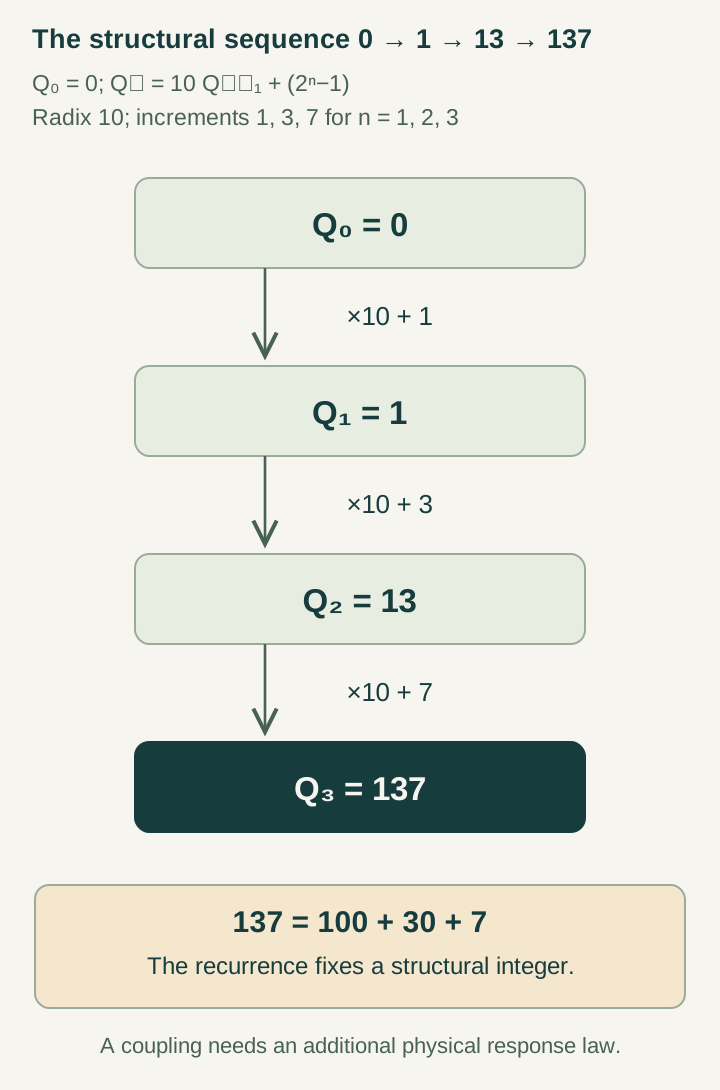
Let Q be the ten-dimensional symmetric receiver described in the preceding guide. At depth d, either terminate with a Bd branch or append a Q label and continue with a record from the previous depth. These alternatives are disjoint, so direct sums add their dimensions. Independent continuation labels multiply dimensions through a tensor product.
r1=1, r2=10+3=13, r3=130+7=137
Open the full-size diagram →
Expanding the last receiver gives Q²B1⊕QB2⊕B3, with dimensions 100, 30 and 7. Each contribution has an explicit provenance. The arithmetic is exact once the branch, continuation and stopping rules have been declared.
What minimality and probability actually require
Each completed word has a uniquely readable continuation prefix and terminal branch. A single error-free quantum readout that distinguishes all 137 words requires 137 mutually orthogonal record states. A register with those basis states attains the bound. This is minimality for the specified discrimination task, not a proof that every possible completion process needs that many states.
The count also leaves the sampling law free. At depth three, a uniform choice among seven terminal symbols and ten continuation symbols gives probability 1/17 to each immediate terminal word. A longer word requires a further choice and has a different probability. A sampler that weights branches by their remaining word counts can instead produce a uniform final distribution. Equal receiver dimension does not select either law.
How discarded records alter the result
Suppose a realized stage identifies δd previously independent combinations. Denote its actual rank by xd. The same recurrence with these losses reads xd=10xd−1+(2d−1)−δd. Expanding three stages gives a useful diagnostic.
Earlier losses propagate through more continuation factors. In an illustrative case with δ1=0, δ2=1 and δ3=0, the final count is 127. Thus faithful retention is an essential premise. A source implementation that compresses or erases a record must recompute the output instead of retaining the free value 137 by name.
One receiver can carry different phase actions
Assigning a common phase z to every completed mode gives C(z)=zI137. Under an additional determinant-neutral closure rule, det C(z)=z137=1, so the smallest positive phase fraction is 1/137. This is a property of that chosen output action and closure rule.
The inherited polynomial action of the symmetric and exterior construction is different. Its weights are 1, 2, 3, 4 and 5 with multiplicities 3, 3, 21, 10 and 100; the determinant exponent is 612. Forgetting construction labels does not automatically turn that action into a common weight-one phase. A physical completion process must explain what coherence and phase comparisons it preserves.
The ideal-vacuum interpretation and next result
The notation α0=1/137 denotes a proposed ideal-model coupling after additional response normalization. It is not automatically the measured low-energy constant or a bare parameter in a specified field theory. Likewise, proposed ideal-vacuum counts 128 and 137 should not be relabeled as high-energy and low-energy running values. Their physical sector meanings require explicit matching.
The forward task is to derive the grammar, source weights and response stiffness from the same nested generative update, then connect the result to an identified electromagnetic current. The next guide shows exactly where these coefficients enter. The alpha workbench lets readers compare structural and response routes without treating one as a proof of the other.
Continue with the articles
- From three-dimensional readout to retained records
Trace the latest draft’s route from quaternionic readout to a selected grammar with 137 distinguishable records. Keep each structural choice visible in the explanation.
- Why a record count is not yet a coupling
Explain why the static response depends on the source and inverse response operator, not simply on the number of records. This is the central bridge required by the coupling proposal.
- The conditional ideal value one over 137
Summarize the extra normalization and electromagnetic matching needed for the ideal model coupling. Explain why the draft’s alpha-zero notation does not denote the measured low-energy constant.
- Why the symmetric receiver has ten modes
Count the independent symmetric quadratic combinations of a four-component envelope. Explain the receiver interpretation and why selecting that construction is a substantive modeling choice.
- Alternating branches and the ranks one, three, seven
Explain how positive-degree exterior sectors produce the branch counts used by the reconstruction. Keep the counting argument separate from any identification with particle families.
- Two phase actions and determinant closure
Compare the inherited polynomial phase with the selected coherent-output phase. Explain why determinant closure can produce a 137-fold condition only after the stated phase identifications.