
In this article
- What an analogy preserves
- A map between structures
- Similarity is weaker than mechanism
- SMM and structural economy
- DTT and recurrence imagery
- An exact structural comparison
- Disciplined analogy
Study macrocosmic analogies as interpretive tools for understanding the source framework. Explain what an analogy illuminates and what must still be supplied by a causal or mathematical model.
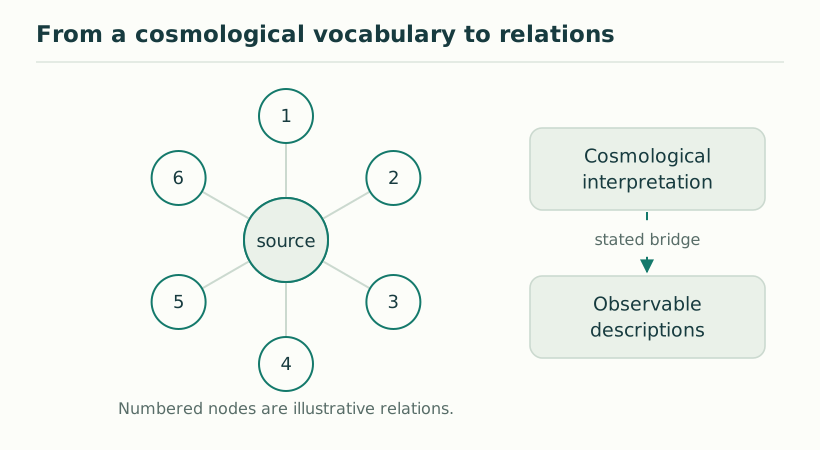
The source compares cosmic organization with familiar symbolic settings, especially the relation of the Kaaba, the Black Stone and circumambulation to its account of origin and manifestation. These comparisons belong to an interpretive framework in which a smaller setting can reflect relations attributed to a larger one. The valuable question is which relation the analogy preserves, rather than whether every visible detail has a literal physical counterpart.
An analogy can be represented as a map from one set of roles to another. A center may correspond to an origin, a circuit to recurrence, and a starting marker to a reference. Such a mapping is informative when it preserves the relation relevant to the discussion. It becomes misleading when additional properties are imported without justification.
A road map preserves connections and approximate directions while omitting building materials. No one expects the paper to bear the weight of a bridge. Likewise, a cosmological analogy should be judged by the relation it clarifies, not treated as a complete transfer of properties between its domains.
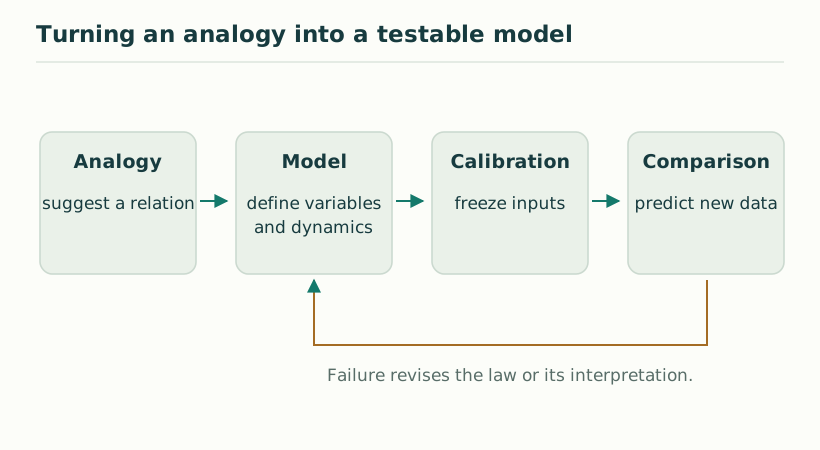
Two systems may share a pattern because of a common mechanism, a mathematical constraint, a design choice or coincidence. The shared pattern alone does not choose among these explanations. To establish a mechanism, one must identify operations and show how they generate the pattern in both settings or in a common underlying model.
This is especially important for numerical correspondences. Many objects can be counted in several ways. A proposed match gains force when the counting rule is fixed in advance and predicts additional structure that was not used to choose it.
SMM is naturally interested in recurring forms because a common origin might impose common constraints. The strongest use of analogy is therefore heuristic: it suggests which invariant or relation to search for. A shared compositional law, symmetry action or conserved quantity would turn a resemblance into a mathematically defined connection.
For example, two systems with an isomorphic relation graph share a precise structural property. They still need not share the same material realization or dynamics. The isomorphism should be stated, and its scope should not be expanded beyond what it preserves.
Circular motion offers a helpful image for repeated inner generation and completed outer records. Yet a circle alone carries neither a clock rate nor a history. To represent elapsed time, the construction also needs a count or retained comparison. To represent spatial emergence, it needs relations among records, not merely repeated traversal of a loop.
Adding a record counter and a completion boundary distinguishes recurrence from elapsed duration. The counter supplies retained comparisons, while the boundary identifies when an organized result becomes accessible. These additional structures reveal which parts of the circular image remain metaphor and which can become explicit elements of a temporal model.
Two triangular networks share the same connectivity pattern even if one is made of electrical components and the other of communication links. A graph isomorphism preserves adjacency, but it does not preserve resistance, bandwidth or propagation delay unless those quantities are included in the map. This example captures both the strength and limit of an exact analogy. SMM/DTT comparisons should similarly identify the preserved structure. A recurrence pattern might match while the clock law differs; a symmetry group might match while the representation differs. The correspondence becomes more informative as the preserved data are specified and additional consequences are calculated from them.
A productive analogy identifies its two domains, matches particular roles, states the preserved relation and specifies where the correspondence fails. These questions respect the source’s interpretive richness while sharpening its scientific use. The result is a method for discovering promising structures and communicating them clearly. A symbolic resemblance becomes mathematically informative when an invariant or a well-defined structural map can actually be demonstrated.
KEEP THE CONNECTION
Scope of the argument. Historical interpretation and original conceptual analysis; illustrative mathematical constructions are not identifications of theological realities with physical objects.
Original public topic. This edition provides an independently written explanation; article-level references identify the passages and additional sources used.
Source register →