A061Public article topicExpanded article4 min read
Spreading the Shadows
Explore the image of spreading shadows as a description of dependence and differentiated manifestation. Prepare a careful account of the metaphor before considering projection-based mathematical language.
The source uses the spreading and withdrawal of shadows to express manifestation and dependence. It presents the world as an image whose appearance is related to an origin without exhausting that origin. The metaphor is powerful because a shadow has a definite form while its existence and shape depend on a larger arrangement. Its conceptual use is relational; it does not imply that matter is literally made of optical shadows.
02What a projection loses
Projecting a three-dimensional object onto a plane generally discards information. A sphere, a disk and other objects can produce the same circular outline under suitable conditions. The image therefore does not uniquely determine its source. This is a simple example of a many-to-one map.
Write r = R(s), where s is a source state and r a record. If R(s₁) = R(s₂), the observation cannot distinguish s₁ from s₂. The set of states producing one record is the inverse image of that record. Its size describes an ambiguity in inference, not necessarily an ambiguity in the source dynamics.
R(s₁) = R(s₂) ⇒ s₁ and s₂ are indistinguishable by this readout
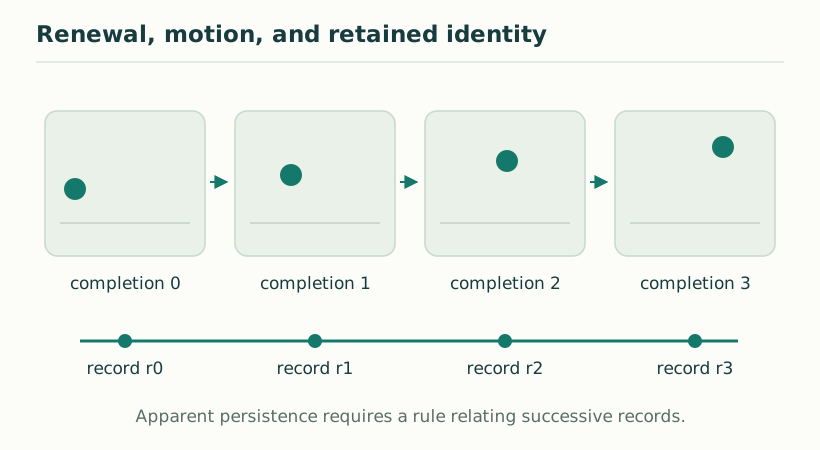
Figure 1. Renewal, motion, and retained identity. A film-frame analogy clarifies successive creation and apparent motion. It does not itself provide an update law, a conserved identity, or a continuum limit. View full size ↗
03Different shadows can reveal more
Several projections can constrain the source more strongly than one projection. But reconstruction depends on knowing the projection geometry and on assumptions about the object. Without those assumptions, adding more images may still leave several possible sources.
This provides a useful lesson for SMM: the claim that observable forms are manifestations must be accompanied by a specified map. Otherwise any source can be declared compatible with any appearance. A restrictive map makes the proposal informative by ruling out some combinations of records.
04DTT as temporal projection
In DTT, the relevant projection is not necessarily from one ordinary spatial dimension to another. It can be a readout from an inner generative history to a completed outer record. Several inner sequences might have the same accessible outcome. The observable description then concerns equivalence classes of histories rather than their every intermediate detail.
A model must state which differences remain detectable through later interference, memory or response. If an apparently discarded distinction can influence future observations, it belongs in the retained state even when it is absent from the current record.
05Dependence without denial of observable reality
Calling a form dependent does not make it useless or nonexistent as an observable structure. A shadow can be measured and predicted even though it depends on a light source and an obstructing object. Similarly, a record-based description can support objective relations when independent observers can reproduce comparisons and agree on invariants.
The SMM question is how those stable relations arise from a common origin. The DTT question is how they become available through completion and remain coherent through subsequent updates. Together they turn the image metaphor into a problem about information, dynamics and reproducible access.
06An observable quotient must respect future evolution
If two source states produce the same current record but different future record distributions, then the current record alone is not a sufficient state description. A complete predictive model must retain the hidden distinction or enlarge the observable history. Formally, the equivalence relation induced by R should be compatible with the update whenever the model claims closed dynamics on records. This gives the projection metaphor a concrete test. It is not enough that an inner history can be mapped to an appearance; the mapping must also support consistent predictions across time. The SMM/DTT interface therefore concerns both present accessibility and the lawful evolution of accessible information.
07Information and manifestation
Several generating states can share one record, while a second measurement distinguishes some of them. Manifestation can therefore reveal structure without revealing everything. The source’s image of dependence gains a precise formal comparison through many-to-one readout maps. A physical account of hidden generation remains constrained by the records it permits and by the correlations it predicts among further observations.
KEEP THE CONNECTION
Key ideas
A projection can preserve form while losing information.
Observable equivalence must be defined through a readout map.
DTT must retain hidden distinctions that affect later records.
Scope of the argument. Source-based conceptual interpretation with original worked examples; physical conclusions are stated with their assumptions.
Original public topic. This edition provides an independently written explanation; article-level references identify the passages and additional sources used.