01The historical study and the later research program
Ibn ‘Arabi — Time and Cosmology belongs to the historical and philosophical foundation of the later Single Monad project. Its role is to reconstruct a difficult cosmological account through texts, terminology, and context. That enterprise has a different immediate goal from proving a physical equation.
The later model can draw inspiration from the historical study while remaining answerable to the standards of mathematical and physical explanation. Keeping this distinction clear strengthens both projects: historical claims do not need to be modern predictions to matter, and modern constructions do not become historically justified merely because a suggestive phrase can be found.
02Why context matters for a technical word
A word such as day may denote an ordinary measured interval, a recurring motion, a qualitative stage, or a relation within a theological cosmology. Translating all occurrences by the same English word does not establish that the underlying meanings are identical. The sentence, chapter, and argumentative purpose determine which sense is active.
The same problem arises in modern physics. Time can mean a coordinate, a proper-time reading, an evolution parameter, or a random operational clock. A comparison becomes precise when each use is defined before its similarities are discussed. Otherwise agreement can be manufactured by an ambiguous translation.
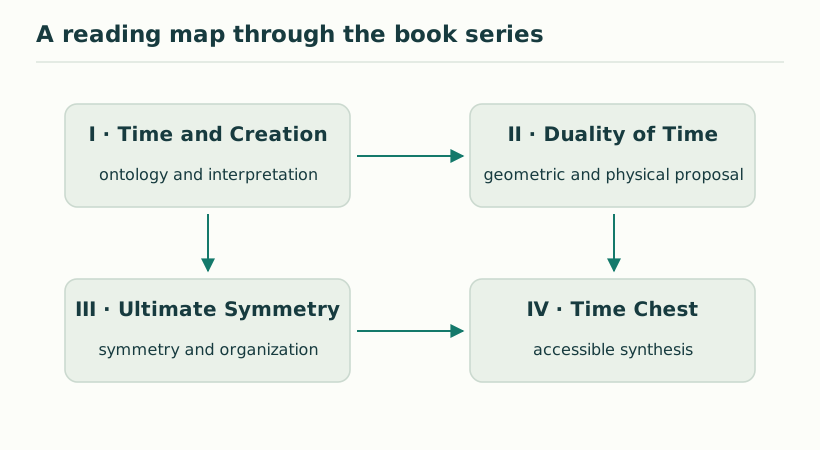
Figure 1. A reading map through the book series. A thematic map, not a claim that the later mathematical results follow automatically from the earlier texts. Readers can move from the ontology of time to physical constructions, then return to the interpretive questions. View full size ↗
03Three kinds of relation to modern physics
A historical idea may anticipate a question later studied scientifically, resemble a modern mathematical structure, or actually provide an independently testable derivation. These are increasingly strong claims. The first two can be illuminating without implying the third.
For example, a discussion of relative temporal experience can motivate interest in observer dependence. It does not by itself supply the Lorentz transformation, the operational procedures for comparing clocks, or a quantitative prediction of time dilation. Those require additional mathematical and empirical content. A careful article explains what is shared and what is newly supplied.
04The origin question as a case study
Asking whether time begins with the world is different from assigning the world a first date on an already existing timeline. The former questions the availability of the temporal relation; the latter assumes it. This distinction can be explained without deciding a particular cosmological model.
In SMM/DTT, the related proposal is that spatial relations and completed record order arise from source generation. A modern construction must therefore avoid assuming the very observational geometry it claims to explain. Historical reflection helps identify that circularity, while mathematical definitions determine whether a proposed model has actually avoided it.
05A useful method of comparison
Build a concept map with four entries for each term: its source-language form, its contextual meaning, the modern quantity proposed as a counterpart, and the extra assumptions needed for the comparison. Add a concrete example where the meanings diverge. This is more informative than a list of verbal resemblances.
For renewal, the modern counterpart might be a sequence of generated states. The extra assumptions would include persistence of records, identity across updates, and coherent dynamics. For unity, the counterpart might be a single-source history category. The additional structure would include its morphisms, composition, and observation tests. Each bridge becomes a research question rather than an automatic equivalence.
06The continuing value of the historical foundation
A foundational theory needs more than new equations; it also needs clarity about which questions its equations answer. Historical cosmology can expose alternatives to familiar assumptions about objects, space, and temporal succession. This is one reason the study remains relevant to the technical program.
Its contribution should be stated positively and accurately. It supplies a conceptual vocabulary and a carefully interpreted set of questions. The newer SMM/DTT work attempts to realize selected ideas through explicit constructions. Readers can evaluate both achievements without requiring every historical statement to function as a scientific theorem.
KEEP THE CONNECTION
Key ideas
Context determines the meaning of historical temporal terms.
Resemblance, motivation, and physical derivation are different levels of connection.
An explicit comparison map turns analogies into research questions.
Scope of the argument. An interpretive-method article based on the public bibliographic and introductory material, not a claim to reproduce the complete monograph.
Thematic reading guide based on the public introduction, available preview or catalogue material identified in the article references. It does not claim to summarize every chapter.