The Arabic treatise on azal challenges the habit of speaking as if eternity were a place or an unlimited duration containing the Divine. Its opening discussion examines different ways people use the term and asks what, if anything, that supposed entity would be. This is a conceptual and theological argument about predication and dependence.
The central lesson for a modern reader is that grammar can suggest an object where an argument has not established one. Saying that something exists in eternity can quietly import the same container picture used for events in ordinary time. The treatise makes that import a subject of examination.
02A distinction between absence of a beginning and endless duration
A sequence can lack a first member while still have temporal relations between its members. The integers, for example, have no least element, yet any two integers can be ordered and their difference computed. Beginninglessness in that mathematical sense does not mean absence of order or duration.
Conversely, a timeless explanatory relation is not a sequence with an extremely remote first event. It is not located earlier or later in the same temporal ordering. These distinctions help prevent eternity, infinite time, and logical priority from being treated as interchangeable notions.
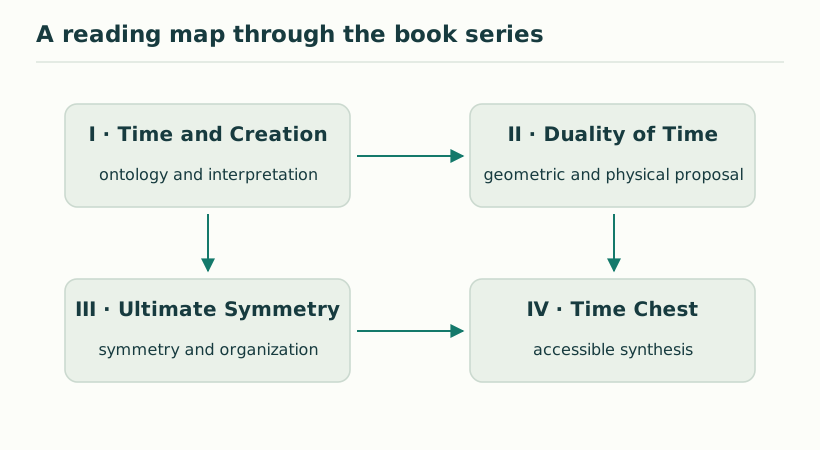
Figure 1. A reading map through the book series. A thematic map, not a claim that the later mathematical results follow automatically from the earlier texts. Readers can move from the ontology of time to physical constructions, then return to the interpretive questions. View full size ↗
03The danger of turning an attribute into another independent being
The treatise’s analysis considers what would follow if eternity were treated as an existent entity distinct from the Divine, or as something dependent on another bearer. The theological concern is that a careless account can introduce a second independent foundation or an explanatory regress.
This argument should be understood in its own conceptual setting. It is not a laboratory claim about the age of the universe. Its value for the SMM discussion is to sharpen the distinction between a source and a background that the source would somehow inhabit. A supposed absolute source placed in an independent temporal container would no longer be absolute in the intended sense.
04A mathematical analogy and its limits
The equation x+y=y+x does not occur earlier than a particular calculation in the way that yesterday occurs earlier than today. It constrains possible calculations without being another moment in their sequence. This is a limited analogy for explanatory priority without chronological priority.
The analogy does not identify a mathematical law with the Divine or establish that all reality is mathematics. It merely shows why not every dependence relation is a temporal relation. A careful conceptual article uses the example for that one point and stops before the analogy is asked to prove more than it can.
05Connecting eternity with the source problem in SMM
The Single Monad program distinguishes a pre-spatial source from the extended world of observations. If the source is also described as prior to ordinary time, that priority needs explanation: does it mean an earlier hidden event, an internal ordering inaccessible to observers, or ontological dependence without an earlier date? These alternatives have different consequences.
DTT’s inner-generative ordering gives one mathematical way to organize histories before completed observation, but it does not by itself settle the theological meaning of eternity. An internal recurrent parameter is still an ordering structure in a model. It should not silently be equated with the absence of all temporal qualification discussed in metaphysical language.
06A productive way to read the translation
Keep a glossary of azal, abad, dahr, duration, beginning, and dependence, and record how each is used in the actual passage. Do not assume an English rendering removes every ambiguity. Where the text argues against a reified notion of eternity, preserve that negative argument before proposing a positive modern counterpart.
The connection to the wider article collection is conceptual discipline. A theory of temporal emergence should explain which ordering relations it assumes and which it derives. The treatise encourages that question at the level of meaning; the technical papers must answer it at the level of explicit state spaces, actions, and observations.
KEEP THE CONNECTION
Key ideas
Beginninglessness and timeless dependence are different concepts.
A temporal container can be an unnoticed assumption in an origin argument.
Inner model order should not be equated automatically with theological eternity.
Scope of the argument. A conceptual reading of the supplied public Arabic text and translation listing; mathematical analogies are explicitly limited.
Thematic reading guide based on the public introduction, available preview or catalogue material identified in the article references. It does not claim to summarize every chapter.