The DoT postulate proposes that the spatial world available at an outer moment is generated through nested inner activity before appearing as a completed observation. Its public short-book introduction presents this as the central bridge from the Single Monad idea to a temporal account of physical multiplicity.
The statement has several parts that should be unpacked: a generative source, an ordering of internal operations, a hierarchy associated with spatial formation, and an interface that yields observable events. Combining these words expresses a research hypothesis. A functional theory must supply objects and rules that make each part definite.
02A minimal mathematical vocabulary
Let H be a set or category of admissible histories, let U describe allowed source updates, and let Π map completed histories to observable records Q. Two histories can share a present record without being physically identical; future tests may distinguish them. The choice of completion and observation therefore determines what the public state retains.
This notation does not derive a theory by itself. Its purpose is to make the explanatory tasks visible. One must define composition in H, the resources required by U, the completion condition, and the tests that make Π meaningful. Once those are supplied, claims about memory, order, or geometry can be stated precisely.
generative history h → completed history → observed record Π(h).
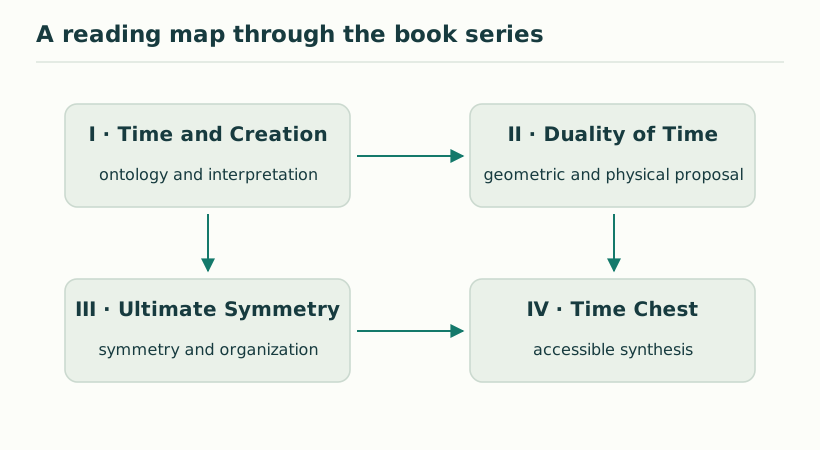
Figure 1. A reading map through the book series. A thematic map, not a claim that the later mathematical results follow automatically from the earlier texts. Readers can move from the ontology of time to physical constructions, then return to the interpretive questions. View full size ↗
03A schedule is a useful example, not yet a cosmology
Imagine a process that constructs relations, checks their consistency, and commits a result to memory. Its internal operations have an order even if the user sees only one completed output. This demonstrates the logical possibility of an inner/outer distinction without giving the user several independent clocks.
But a programmed schedule inherits its state space, update rules, and commitment mechanism from its designer. To explain physical reality, the SMM/DTT source law must account for the relevant agreement among those components. A single controller executing unrelated chosen recipes establishes implementation, not necessity.
04Why the six-stage structure matters
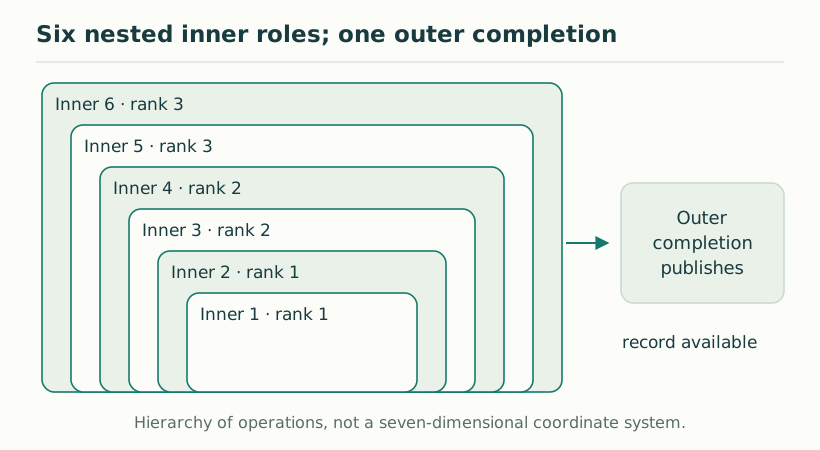
The proposed six inner roles organize three-dimensional formation in nested pairs, with an outer completion role making the result accessible. A useful formulation defines what each stage adds or resolves and what information survives into the next. Later drafts use paired ranks 1,1,2,2,3,3 as one explicit construction.
The number six should not be used as a substitute for that mechanism. A list of six steps can implement many different geometries. The stronger result would show that the source’s admissible operations and stability conditions require the relevant rank progression, rather than selecting it because three-space is the target.
Figure 2. Six nested inner roles; one outer completion. The six inner roles are nested functional stages with readout ranks 1, 1, 2, 2, 3, 3. The outer completion publishes the resulting record. These are not seven independent time axes. View full size ↗
05Relativity puts a constraint on the observation map
A globally ordered hidden construction can coexist with an observer-level relativistic description only if the observable theory has the required covariance and does not expose an incompatible preferred ordering through admitted experiments. That compatibility must be demonstrated, not inferred from the word hidden.
The causal-geometry and physical-clock articles identify the necessary interfaces. They ask how duration, displacement, and propagation are measured independently and why their calibrations agree. A Lorentz-shaped equation is not sufficient if actual detectors or clocks respond to additional source operations in a way that breaks the claimed covariance.
06From postulate to an explanatory research program
The most useful progression is to construct one explicit source model, derive stable records, obtain a relational spatial readout, specify a physical clock, and then test a joint propagation law. The same fixed model should also predict an observable not used to calibrate it. This makes the postulate capable of failure as well as success.
The atlas develops the pieces at different levels of maturity: conceptual motivations, exact finite constructions, conditional representation theorems, and open physical matching questions. Their common purpose is to turn the inner-generation/outer-completion distinction into an auditable theory. The postulate is the organizing starting point; the connected deductions are the work that can make it physically compelling.
KEEP THE CONNECTION
Key ideas
The postulate needs explicit histories, updates, completion, and observation.
One programmed controller does not by itself derive agreement between its rules.
A strong theory must connect source generation to covariant clocks, geometry, and independent predictions.
Scope of the argument. An expanded conceptual and mathematical guide to the postulate; the examples identify what remains to be selected by physical source dynamics.
Thematic reading guide based on the public introduction, available preview or catalogue material identified in the article references. It does not claim to summarize every chapter.