
Split-complex algebra preserves a hyperbolic quadratic form. Turning that identity into relativistic physics requires independently defined duration, displacement, and matter dynamics.
Where the volume sits in the program
Duality of Time: Complex-Time Geometry and Perpetual Creation of Space develops the proposed temporal account of spatial formation. The public introduction connects inner generation, outer observation, and split-complex geometry. This guide builds on that material and A215 without claiming complete coverage of the book.
The key habit is to assign a role to every equation. Does it define a mathematical object, demonstrate a consequence of chosen assumptions, or identify a quantity with an actual measurement? Clear answers prevent the same formula from serving unnoticed as both premise and conclusion.
Work one split-complex example
Let j²=+1 and z=u+jv. Conjugation gives z̄=u−jv, so zz̄=u²−v². For z=5+3j the quadratic norm is 16. Multiplying by coshη−j sinhη with coshη=5/4 and sinhη=3/4 gives z′=4, whose norm is also 16.
The cancellation is exact and illustrates hyperbolic rotation. Nonzero elements such as 1+j have zero norm, showing that this algebra differs from ordinary complex numbers. Its null directions are part of the chosen mathematical geometry.
Do not merge circular and hyperbolic phase
For the ordinary imaginary unit i²=−1, multiplication by cosθ+i sinθ preserves u²+v². The corresponding real operator J obeys J²=−I. These circular phase structures are central to quantum kinematics.
The split-complex j in the preceding calculation obeys the opposite square law. A theory may use both, but must identify their different carriers and maps. The published real-commutant work provides a later route from oriented real dynamics to ordinary complex phase; it is a complementary mathematical development, not a substitution of i for j.
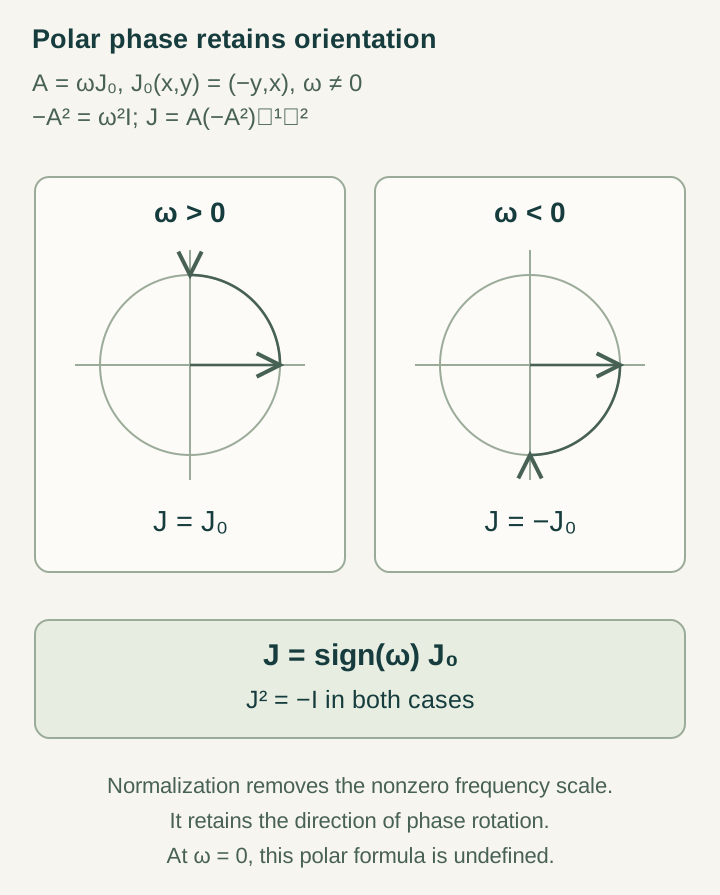
Open the full-size diagram →
Formation roles and completed observation
A nested process can resolve one direction, refine its relations, add a second, and then a third before publishing a record. Repeated rank stages do not add independent axes. The proposed six inner roles should therefore be drawn as dependent operations, with the seventh role marking completed availability.
An ordinary calculation illustrates the logical possibility: intermediate data are meaningful within the process while a reader sees only the committed result. A physical theory must go further by accounting for the source of the operations, the memory holding the data, and the clock used to compare completions.
When a mathematical ratio becomes a speed
Suppose a model assigns one completed displacement a length L and its observed delay T. The speed is L/T. Replacing the readout length by aL and duration by bT changes the numerical speed by a/b while leaving a formal hyperbolic relation available after corresponding normalization.
Thus geometry and calibration are connected but distinct. A universal limiting speed requires different material clocks and propagation channels to share the same operational cone. The SMM ambition is that a common source enforces that agreement, rather than that every independently chosen readout can be given a Lorentz-shaped equation.
Use the volume as a map of construction tasks
Read A215 with A141 on the two algebras and A126 on nested roles. Follow A105–A110 for clock protection and A129–A133 for propagation. Then compare the more general phase-selection result in A202 with the temporal interpretation.
For each proposed consequence, ask what the detector reads and which source invariant fixes it. Can the same construction derive a clock relation previously imposed by calibration? Can matter propagation be changed independently while retaining the proposed geometry? These questions turn the volume’s broad unifying aim into tests of whether its components form one explanatory physical theory.
Continue with the articles
- Reading Volume II: Duality of Time
A guide to the transition from cosmological motivation toward the proposed temporal framework.
- Split-complex time and ordinary quantum phase
Explain why the split-complex pairing used for temporal roles differs from the ordinary complex scalar selected for phase. Avoid treating two algebraic uses of complex language as identical.
- Six inner stages and one publication interface
Explain the hierarchy of readout ranks 1, 1, 2, 2, 3, 3 followed by completion. These are nested functional roles rather than six independently readable temporal coordinates.
- What makes a clock insensitive to branching?
Explain the draft’s criterion for a clock to respond to resolution while ignoring branching. The condition is expressed through the observable algebra accessible to the clock.
- A protected material clock
Describe the model that realizes resolution-only evolution through protected couplings. Explain which interaction restrictions protect the clock and how a controlled perturbation breaks that protection.
- Why one clock model does not prove universality
Use the ungated-clock countermodel to show that a realizable clock law need not be physically universal. Explain the extra selection principle required for all material clocks to agree.
- A finite-update cone
Introduce the bound relating horizontal displacement to temporal projection in the limiting-speed draft. Explain that the finite-update inequality is a stated geometric assumption.
- Invariance of a speed versus its measured value
Distinguish the existence of a shared limiting speed from the calibration of its numerical value. Use this distinction to clarify what a reconstruction has explained.
- Real-commutant phase selection: a paper guide
Introduce the paper’s phase-selection question in real Hilbert representations. Prepare an accessible route from the commutant to compatible complex structures and their physical interpretation.
Sources and reading
Read the original source for its exact formulation and edition. The examples on this page are explanatory reconstructions.