Ten-mode memory, the count 137 and decimal notation
The number ten can arise as a genuine dimension of pair memory rather than an arbitrary numeral base. That improves the structural interpretation of 137, but it does not prove that nature writes numbers in decimal. A symmetric-square calculation and an explicit stopping grammar make the distinction clear.
01The mathematical question behind the decimal appearance
The expression 100+30+7 resembles a decimal decomposition. A stronger structural explanation identifies why a model has ten continuation labels and terminal alphabets of sizes one, three and seven. Then 137 is obtained as a count before any numeral system is chosen.
The current SMM/DTT construction explores precisely this kind of route. It begins with a quaternionic readout under stated algebraic assumptions and adds a unital reconstruction envelope and a selected memory rule. The merit of the construction is that each integer can refer to explicitly described retained distinctions. The remaining issue is why the source must select those distinctions and that grammar. [2][3]
02Why a symmetric square has ten modes
Let V be a complex vector space of dimension four. Its symmetric square has basis vectors labelled by unordered pairs of basis indices, including equal pairs. There are four repeated pairs and six unequal pairs, giving ten independent modes.
The dimension follows from retaining free pair information. It does not follow from multiplying two elements in a four-dimensional algebra and remembering only their product. The free symmetric tensor remembers how an outcome was assembled, even when different pairs produce the same product. This is a meaningful difference between history memory and a compressed present-state value. [2]
V is the four-dimensional complex reconstruction envelope; its scalar channel is not an extra spatial direction.
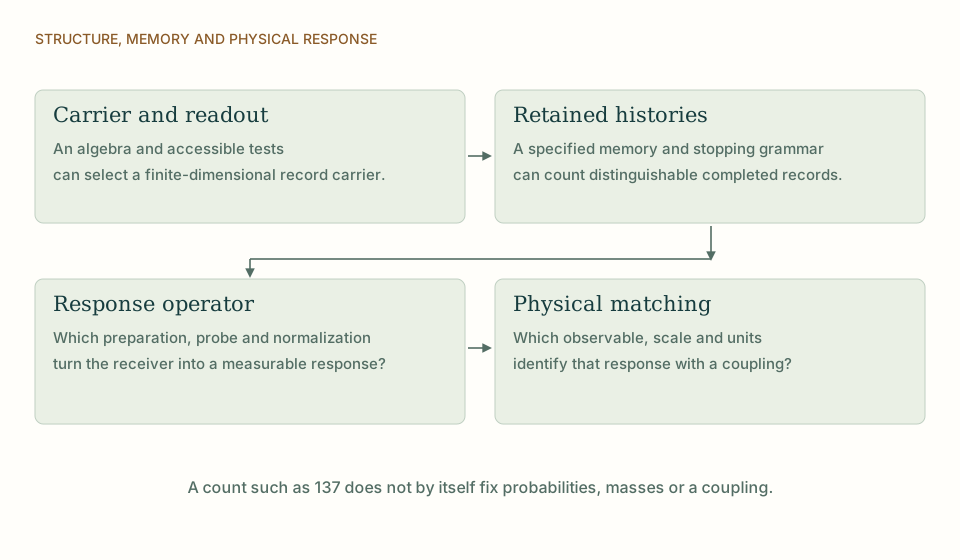
From carrier structure to a measurable response. Representation dimension, a chosen retention grammar, a response operator and physical calibration are separate stages of the constants programme. View full size ↗
03A six-dimensional loss of pair information
In the complexified quaternionic envelope, a symmetrized multiplication map sends Sym²(V) to V. It is onto because products involving the identity recover every basis element. The domain has dimension ten and the image has dimension four, so its kernel has dimension six.
Thus a device that stores only the quaternionic product loses six independent linear combinations of pair data. A model claiming all ten pair modes must provide a physical memory that retains the extra distinctions. That requirement strengthens the construction by replacing an implicit use of information with an explicit resource that a source dynamics can be asked to supply.
μsym: Sym²(V) → V, rank μsym = 4
dim ker μsym = 10−4 = 6
04The stopping grammar gives 137
At depth d, let the terminal alphabet contain the nonempty subsets of d innovations, giving b_d = 2ᵈ−1 labels. Let q = 10 be the number of continuation-memory labels. The grammar either stops with a terminal label at the current depth or appends a continuation label and proceeds to the previous depth, with no words at depth zero.
The resulting count obeys L_d = b_d + qL_{d−1}. It gives L₁ = 1, L₂ = 3+10 = 13 and L₃ = 7+10×13 = 137. The word types are distinct by their terminal depth, so the sum is a genuine count under the chosen grammar. It does not by itself give equal word probabilities or a coupling. [2]
05Why this does not select a universal numeral base
The same cardinality can be written as 137 in decimal, 10001001 in binary or 89 in hexadecimal. The set being counted has not changed. A ten-label physical memory is a model property; the notation chosen to display its cardinality is a representational convention.
This distinction does not weaken a genuine origin for ten modes. It sharpens it. The argument would concern the minimal memory required by a specified physical task, rather than the historical or logical necessity of base ten. If the memory were compressed to four labels while leaving the same formal recursion, the count would be 7+4×3+4² = 35, showing exactly which retained distinctions matter.
137₁₀ = 10001001₂ = 89₁₆
With q=4 in the same formal grammar: L₃=7+12+16=35
06Independent labels and physically available measurements
The statement that ten pair modes are linearly independent belongs to the chosen carrier space. To use all ten as physical records, the receiver must also have access to a suitable family of preparations and discriminating measurements. A representation can contain formal distinctions which every admitted probe treats identically. Conversely, retaining a pair label in an environment can preserve information absent from a compressed local product.
The resulting source question is concrete: which interaction writes the pair distinction, where does it remain stable, and which later operation can read it? If a construction answers these questions, the ten-mode memory has an operational role beyond its algebraic dimension. The stopping grammar can then be evaluated against the records actually available to the observer. This connects the structural integer to the programme’s central distinction between internal generation and completed access, while keeping dimensional counting, memory capacity and measurement availability explicit.
07The selection problem that remains
A fundamental derivation would show why the source retains the full symmetric pair space, excludes the empty terminal subset, chooses the stopping rule and realizes three relevant depths. Those assumptions cannot be justified solely because their combination yields an interesting integer.
The six nested inner levels should also be linked to the grammar through explicit operations; three word depths are not automatically six generative levels. The positive result is already well defined: a specified memory and parser have a minimum receiver size. Connecting the source dynamics to that exact task is the next route toward a noncircular structural explanation.
THE SAME QUESTION, DIFFERENT STARTING POINTS
The comparison at a glance
Question
SMM/DTT
Symmetric tensor powers and combinatorics
Ten
A unital four-mode envelope can support ten free symmetric pair modes.
dim Sym²(C⁴)=10 is a basis-independent dimension count.
137
The selected depth-three stopping grammar yields 137 records.
Changing memory or grammar changes the count.
Decimal
The physical issue is which distinctions the source retains.
The same cardinality can be written in any numeral base.
KEEP THE CONNECTION
Key ideas
Ten free pair modes require retaining more information than an algebra product.
The stated stopping grammar gives 137 exactly and conditionally.
A ten-mode memory does not make decimal notation physically compulsory.
Continue from the structural count to physical response.
Sources and further reading
References support the comparator and the specific mathematical or interpretive claims indicated. SMM/DTT connections are developed in the analysis above.