
In this article
- The question behind this comparison
- The SMM/DTT starting point
- How the comparator works
- The decisive comparison
- Worked benchmark
- What follows for the source programme


Bell correlations challenge a particular local causal factorization while preserving ordinary no signalling. Comparing DTT with objective collapse models, this article calculates the ideal singlet violation and its unchanged local marginals, then asks what a single generative source must explain to reproduce both features through one physical mechanism.
Bell inequalities test restrictions on correlations, not the speed of an observed signal. In the usual local causal model, outcomes at two separated laboratories become independent once the relevant common cause and local settings are specified. Measurement-setting independence is another premise. Quantum states can violate the resulting bounds while preserving the inability to transmit a controllable message by changing a distant measurement choice alone.
A Single Monad is naturally a common origin for records, but a common origin by itself does not evade Bell’s argument: the hidden variable in a Bell model already represents an arbitrarily rich common cause. The decisive issue is the form of the conditional probabilities. A DTT account must specify whether its source violates factorization, changes a setting-independence assumption, or uses a different causal structure. An inaccessible inner ordering is not an automatic explanation of the observed correlation law. [3] [4] [5]
The Single Monad Model begins with one nonspatial generative source. The Duality of Time Theory distinguishes the source’s inner production from the outer order in which completed records become accessible. Its six inner levels are nested functional roles of one process: a higher role organizes lower-level work. The seventh is the completion or observation interface. They are neither six independent clocks nor six additional time coordinates.
This distinction supplies a useful research question: which features of an observed world can follow from the way a source produces, retains and releases information? A concrete answer needs a state space, an autonomous update, retained memory and a rule connecting completion to an accessible measurement. In the constructions discussed here, those mathematical ingredients are stated explicitly. A successful finite example establishes what its specified mechanism can do; further arguments connect it to physical particles, spacetime or universal laws. [1]
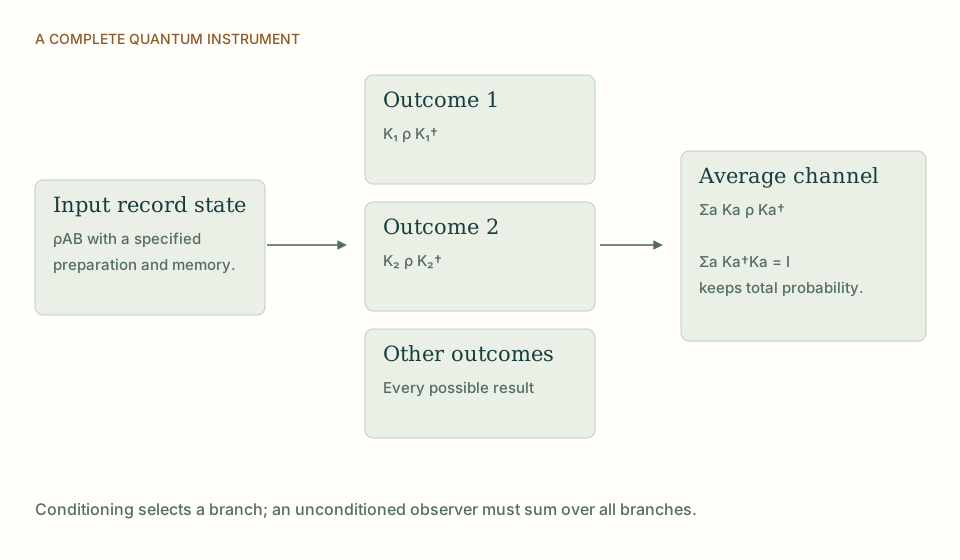
Objective collapse theories modify quantum dynamics so that sufficiently macroscopic alternatives are suppressed by a physical stochastic process. In GRW-type and continuous-spontaneous-localization families, the modification contains a rate and a spatial or mass-related structure. Amplification makes microscopic coherence relatively persistent while reducing macroscopic superpositions. These are dynamical proposals with measurable consequences, rather than interpretations that necessarily preserve every prediction of ordinary unitary quantum theory.
Outer completion in DTT is not automatically an objective collapse. A completion channel may simply expose a decohered record or condition on an ordinary outcome. It becomes a collapse proposal only when the state evolution changes in a specified way, with a probability law, energy accounting and a physical scale. Collapse models consequently provide a demanding comparison: they illustrate how an account of definite records can take quantitative risks. No bound on their parameters directly bounds an unspecified generative process; the two mechanisms must first be translated into comparable observable dynamics. [2]
Relativistic collapse research must reconcile stochastic outcome selection with observable causal consistency. DTT faces a closely related problem if a completed Bell record physically selects outcomes across separated locations. A hidden production order is not itself a violation of relativity at the observational level, but its effect on accessible probabilities has to be calculated. In particular, conditioning on a remote outcome and changing a local unconditional marginal must remain distinct.
Collapse proposals supply explicit stochastic laws that can be checked for ensemble linearity, positivity and unwanted signalling. A DTT alternative needs comparable mathematical control. The singlet calculation gives a demanding pair of targets: the nonlocal CHSH correlation and the remote-setting-independent local state. If completion merely reproduces the ordinary quantum instrument, its outcome statistics are consistent but no collapse modification has been established. If it changes the dynamics, its rate and operator content determine what Bell visibility or other measurements constrain. The positive lesson is that a mechanism of definite records must earn causal compatibility at the ensemble level; neither a single source nor an appeal to unobservable inner time guarantees it. [2] [3] [4] [5]
For a spin singlet, the correlation of ±1 outcomes along unit vectors a and b is E(a,b)=−a·b. Choose a=z, a′=x, b=(z+x)/√2 and b′=(z−x)/√2. In the CHSH combination E(a,b)+E(a,b′)+E(a′,b)−E(a′,b′), the four terms add to −2√2, whose absolute value exceeds the local bound 2.
Each local outcome remains equally likely. Indeed the reduced state at either wing is I/2. A distant trace-preserving operation leaves the local reduced state unchanged when its outcome is not conditioned upon. Correlation beyond the Bell bound and no signalling therefore coexist in the same calculation. This is the benchmark for temporal source proposals: a mechanism must reproduce both facts. Explaining only the strong correlation while allowing the remote setting to change a local marginal would describe a different, experimentally constrained theory. [3] [4] [5]
CHSH outcomes are ±1. The local bound presupposes local factorization and suitable independence of measurement choices from the common cause.
The strongest use of DTT here is to make the hidden production architecture precise enough that its causal assumptions can be inspected. A source update that coordinates records may be nonlocal at the underlying level while yielding a relativistically admissible observable interface. That is a substantive possibility, but a claim of compatibility requires the interface calculation. Existing Bell violations support the quantum correlation structure, not a unique ontology of its origin. [3] [4] [5]
THE SAME QUESTION, DIFFERENT STARTING POINTS
| Question | SMM/DTT | objective collapse models |
|---|---|---|
| Starting structure | One nonspatial source, retained memory and six nested inner functions with an outer completion interface. | Quantum states with a specified stochastic modification of dynamics. |
| Observable connection | The source update and readout must generate the measured records and their calibrated relations. | A physical localization or selection law suppresses alternatives. |
| Bell nonlocality and causal structure | Collapse proposals supply explicit stochastic laws that can be checked for ensemble linearity, positivity and unwanted signalling. | Relativistic collapse research must reconcile stochastic outcome selection with observable causal consistency. |
| Status of the claim | A constructive research programme; a specified finite model establishes only its stated conditional results. | Dynamical proposals with parameters and potentially distinguishable predictions. |
KEEP THE CONNECTION
Connects this comparison with the author’s underlying construction.
Connects this comparison with the author’s underlying construction.
Connects this comparison with the author’s underlying construction.
Connects this comparison with the author’s underlying construction.
Places the comparison alongside the programme’s published results, assumptions and open targets.
References support the comparator and the specific mathematical or interpretive claims indicated. SMM/DTT connections are developed in the analysis above.
How these comparisons distinguish premises, results and physical claims