
In this article
- The question behind this comparison
- The SMM/DTT starting point
- How the comparator works
- The decisive comparison
- Worked benchmark
- What follows for the source programme


Quantum erasure reveals complementary interference patterns when correlated records are sorted; it does not rewrite the unsorted past. This comparison with QBism follows the conditional probabilities explicitly and examines how DTT’s partial and completed archives can clarify the experiment while respecting its causal and informational limits.
Delayed-choice experiments compare different ways of completing an interference experiment. A later choice of measurement can determine which joint correlations are accessible, but it does not license changing an already stored, unconditional earlier detection record. Quantum erasure is clearest when the path becomes correlated with a marker: interference disappears from the unconditioned signal and reappears in suitably sorted coincidence subsets.
DTT’s emphasis on completed records can clarify the difference between a partially available correlation and a final joint archive. The relevant completion is the availability of the required data and measurement context, not a physical revision of the past. A stronger temporal model would calculate why the same local marginal survives all permitted later choices and why the conditional subsets exhibit complementary fringes. [3] [4]
The Single Monad Model begins with one nonspatial generative source. The Duality of Time Theory distinguishes the source’s inner production from the outer order in which completed records become accessible. Its six inner levels are nested functional roles of one process: a higher role organizes lower-level work. The seventh is the completion or observation interface. They are neither six independent clocks nor six additional time coordinates.
This distinction supplies a useful research question: which features of an observed world can follow from the way a source produces, retains and releases information? A concrete answer needs a state space, an autonomous update, retained memory and a rule connecting completion to an accessible measurement. In the constructions discussed here, those mathematical ingredients are stated explicitly. A successful finite example establishes what its specified mechanism can do; further arguments connect it to physical particles, spacetime or universal laws. [1]
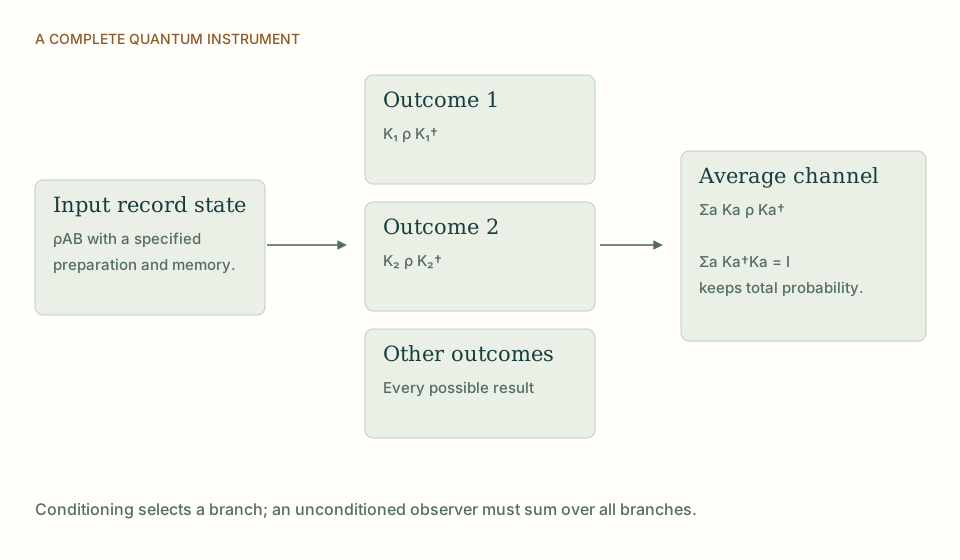
QBism interprets quantum probabilities as an agent’s personal expectations for the consequences of actions on the world. The quantum state belongs to that probability assignment rather than serving as a complete observer-independent description of the system. The Born rule acts as an additional normative constraint among an agent’s probability judgments. QBism does not deny an external world; it rejects an interpretation in which the state is simply a catalogue of its intrinsic properties.
The Single Monad Model has a much stronger ontological ambition: one source is intended to explain the production of physical multiplicity. A mathematical DTT model can still use an operational probability interface, but equating that interface with QBism would obscure this difference. The informative question is whether a proposed generative law imposes new, testable restrictions on the probabilities an agent should assign. If it does not, the two views can organize the same data while offering substantially different accounts of what the formalism means. [2]
QBism treats delayed-choice alternatives as different actions to which an agent assigns different probabilities. Once a marker result is learned, conditioning changes expectations about a correlated record. It does not entail that the agent’s knowledge physically changes the past. DTT can offer a source-level explanation of why the correlations are there, but it must preserve the same distinction between new information and a new earlier event.
The quantum-eraser arithmetic is useful because it sharply separates those roles. The plus subset has fringes, the minus subset has opposite fringes, and the unsorted sample remains flat. A DTT model gains no extra empirical support merely by describing the full coincidence archive as a completed world; that archive is already encoded in the standard joint state. It could gain substance by deriving a constrained law for when marker information becomes accessible or how much coherent memory a delayed eraser requires. An agent could then use that law in probability assignments regardless of whether the source ontology is accepted. Interpretational disagreement alone does not turn the familiar eraser pattern into a new prediction. [2] [3] [4]
Let signal paths and marker states be in (|0⟩|m₀⟩+e^{iφ}|1⟩|m₁⟩)/√2, with orthogonal marker states. Ignoring the marker leaves the signal in an equal path mixture. Its balanced-recombiner output probability is 1/2, independent of φ. Measure the marker instead in the basis |m±⟩=(|m₀⟩±|m₁⟩)/√2. Each marker outcome occurs with probability 1/2.
Conditioned on the plus marker, the first signal output has probability cos²(φ/2); conditioned on the minus marker, it has sin²(φ/2). Averaging the two gives 1/2 again. At φ=0, the two sorted subsets are completely different, but the unsorted earlier data remain evenly distributed. A later selection can reveal this organization only when the marker result is communicated and the records are compared. The arithmetic explains why the effect offers no channel for controllable messaging into the past. [3] [4]
Ideal orthogonal path markers and balanced recombination are assumed. Conditioning requires access to the marker outcome.
The contribution of a completion vocabulary is strongest when it distinguishes local detection, remote marking and the later comparison of their records. A source account can attach its hidden stages to that operational structure without claiming that a human decision recreates an earlier event. Any further prediction must survive the same unconditioned-versus-conditioned distinction; apparent retrocausal effects caused solely by sorting are already expected in ordinary quantum theory. [3] [4]
THE SAME QUESTION, DIFFERENT STARTING POINTS
| Question | SMM/DTT | QBism |
|---|---|---|
| Starting structure | One nonspatial source, retained memory and six nested inner functions with an outer completion interface. | An agent’s probability assignments for actions and experiences. |
| Observable connection | The source update and readout must generate the measured records and their calibrated relations. | An outcome informs that agent’s subsequent expectations. |
| Delayed choice and quantum erasure | The quantum-eraser arithmetic is useful because it sharply separates those roles. | QBism treats delayed-choice alternatives as different actions to which an agent assigns different probabilities. |
| Status of the claim | A constructive research programme; a specified finite model establishes only its stated conditional results. | Interpretation of quantum probabilities rather than a unique hidden source dynamics. |
KEEP THE CONNECTION
Connects this comparison with the author’s underlying construction.
Connects this comparison with the author’s underlying construction.
Connects this comparison with the author’s underlying construction.
Connects this comparison with the author’s underlying construction.
Places the comparison alongside the programme’s published results, assumptions and open targets.
References support the comparator and the specific mathematical or interpretive claims indicated. SMM/DTT connections are developed in the analysis above.
How these comparisons distinguish premises, results and physical claims
SMONAD
Share this page, or keep a clear reference to the work you are reading.
Use this reference for the explanation on this page. “n.d.” means its first publication date is not specified; the update date is recorded separately.