
In this article
- The question behind this comparison
- The SMM/DTT starting point
- How the comparator works
- The decisive comparison
- Worked benchmark
- What follows for the source programme


A physical vacuum already contains a state, observables and dynamical structure. Comparing SMM/DTT with inflationary cosmology, this article asks how one nonspatial source might generate those ingredients, uses a ground-state oscillator as a precise benchmark, and identifies the extra map required to turn source records into a spatial field vacuum.
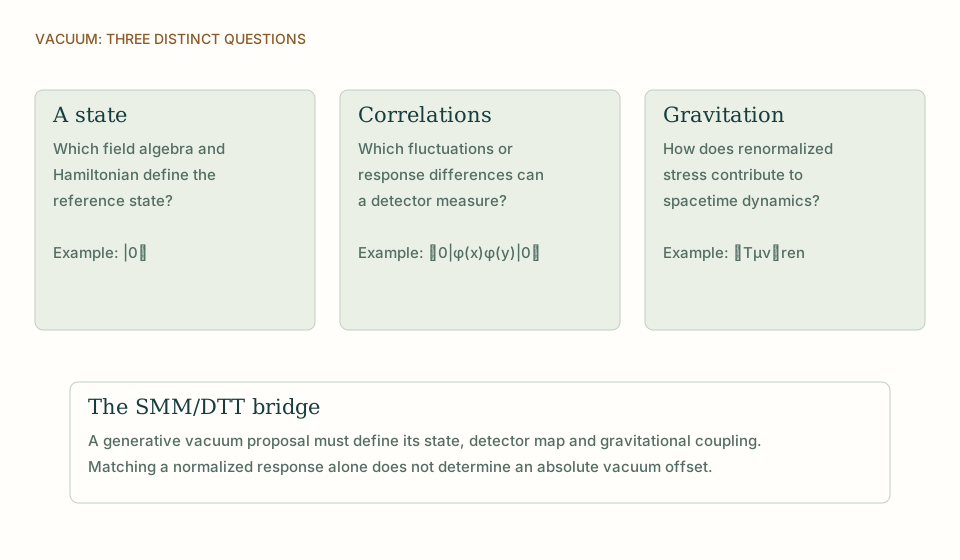
The quantum vacuum is not the absence of every physical structure. It presupposes an algebra of fields, a state and a rule for their dynamics. The Single Monad proposal asks why those structures exist and how the vacuum geometry is produced. This gives its use of vacuum a generative meaning, while the metaphysical source remains distinct from a physical medium already occupying space.
The central comparison therefore concerns an explanatory map: source dynamics produces retained relations, and an effective description turns those relations into field observables and geometry. The existence of a finite readout model is a useful first step. A continuum vacuum requires more, including a stable state, physically meaningful correlators and the appropriate notion of locality. Without these ingredients, calling the source a vacuum substrate states an ontology but does not yet identify the measured vacuum of a field theory. [3] [1]
The Single Monad Model begins with one nonspatial generative source. The Duality of Time Theory distinguishes the source’s inner production from the outer order in which completed records become accessible. Its six inner levels are nested functional roles of one process: a higher role organizes lower-level work. The seventh is the completion or observation interface. They are neither six independent clocks nor six additional time coordinates.
This distinction supplies a useful research question: which features of an observed world can follow from the way a source produces, retains and releases information? A concrete answer needs a state space, an autonomous update, retained memory and a rule connecting completion to an accessible measurement. In the constructions discussed here, those mathematical ingredients are stated explicitly. A successful finite example establishes what its specified mechanism can do; further arguments connect it to physical particles, spacetime or universal laws. [1]
Inflationary models describe a period of accelerated expansion, commonly generated by a scalar field whose potential energy dominates its kinetic energy. Their strongest quantitative content concerns the production and evolution of primordial scalar and tensor perturbations, together with the transition to the subsequent hot cosmological history. Inflation is a family of dynamical models rather than one unique potential or a complete explanation of the universe’s initial state.
The temporal-generation idea can be compared with inflation at two levels. It may seek an origin for the effective field, its clock and its geometry, or it may propose a different mechanism for the nearly homogeneous background and observed perturbations. A rapid sequence of source updates is not by itself accelerated metric expansion: the scale factor is defined through physical distances and its rate through a calibrated clock. The useful bridge therefore requires an effective stress-energy and a perturbation equation. An account that reproduces only the growth of a symbolic record count has not yet reproduced inflation’s observational predictions. [2]
Inflationary cosmology normally supplies a spacetime and a field state, then studies a regime in which the field’s stress drives accelerated expansion. SMM/DTT seeks the prior construction of both state and spatial arena. Their point of contact is a source-generated state that can behave as an effective homogeneous field with potential-dominated stress, but that behaviour requires more than nonzero vacuum fluctuations.
The oscillator example is useful precisely because its ground state has a positive energy without automatically defining a cosmological negative pressure. Pressure follows from how the full action depends on geometry and how the state changes with volume. A DTT vacuum model must derive that dependence if it is to explain inflationary dynamics. It must also identify the fluctuation variable that becomes the primordial curvature perturbation and explain how the inflationary phase ends. This comparison therefore separates a possible generative foundation from a claim to replace inflation. The positive route is one source solution yielding a stable vacuum regime, its stress-energy and its perturbations together. A picture of rapid re-creation is an intuition for the programme, not yet the accelerated solution. [2] [3] [1]
For a harmonic mode with Hamiltonian H=ℏω(a†a+1/2), the vacuum satisfies a|0⟩=0 and has energy ℏω/2. Its mean displacement is zero, but the variance is ⟨x²⟩=ℏ/(2mω). Doubling the mode frequency halves that variance and doubles its zero-point energy. A zero mean therefore does not mean that every measurement outcome is zero.
This elementary mode distinguishes three questions that a generative model must keep separate: which state is prepared, which observable is measured, and what energy reference is used. A source can produce the same variance while differing in unobserved internal states. To become a field vacuum, many such modes must have consistent correlations and dynamics across the spatial readout. To become a gravitational vacuum, their renormalized stress-energy must also couple to the effective metric. The oscillator calculation supplies a target for one mode; it does not prove that an infinite collection of independent source oscillators produces space or resolves the cosmological constant problem. [3] [1]
m is the oscillator mass, ω its angular frequency in s⁻¹, and x a displacement. This is a mode benchmark, not a cosmic parameter fit.
The positive SMM contribution is to ask for a common origin of vacuum correlations and their observable arena. The next mathematical link is an effective-state construction whose readout preserves positive probabilities and has a controlled long-distance limit. Different source implementations can yield the same vacuum, so a claim of unique physical explanation needs a principle selecting the source dynamics or a measurable restriction on the resulting correlators. [3] [1]
THE SAME QUESTION, DIFFERENT STARTING POINTS
| Question | SMM/DTT | inflationary cosmology |
|---|---|---|
| Starting structure | One nonspatial source, retained memory and six nested inner functions with an outer completion interface. | Accelerated background and specified quantum perturbation state. |
| Observable connection | The source update and readout must generate the measured records and their calibrated relations. | Scale-factor evolution, primordial spectra and the transition to a hot phase. |
| Vacuum as generative substrate | The oscillator example is useful precisely because its ground state has a positive energy without automatically defining a cosmological negative pressure. | Inflationary cosmology normally supplies a spacetime and a field state, then studies a regime in which the field’s stress drives accelerated expansion. |
| Status of the claim | A constructive research programme; a specified finite model establishes only its stated conditional results. | A research family with different fields, potentials and observational predictions. |
KEEP THE CONNECTION
Connects this comparison with the author’s underlying construction.
Connects this comparison with the author’s underlying construction.
Connects this comparison with the author’s underlying construction.
Connects this comparison with the author’s underlying construction.
Places the comparison alongside the programme’s published results, assumptions and open targets.
References support the comparator and the specific mathematical or interpretive claims indicated. SMM/DTT connections are developed in the analysis above.
How these comparisons distinguish premises, results and physical claims
SMONAD
Share this page, or keep a clear reference to the work you are reading.
Use this reference for the explanation on this page. “n.d.” means its first publication date is not specified; the update date is recorded separately.