
In this article
- The question behind this comparison
- The SMM/DTT starting point
- How the comparator works
- The decisive comparison
- Worked benchmark
- What follows for the source programme


A primordial spectrum reaches the observed microwave sky through cosmological evolution and transfer. Comparing DTT with semiclassical gravity, this article calculates the effect of a small spectral tilt and explains how source-memory correlations could become a restricted prediction for temperature, polarization and structure under one calibrated physical model.
The cosmic microwave background encodes primordial perturbations after their propagation through an evolving plasma, gravitational potentials and photon transport. A primordial power law is only the starting input; temperature, polarization and lensing spectra require transfer functions and cosmological parameters. An underlying theory must therefore connect its source fluctuations to the gauge-invariant perturbations used in those calculations.
DTT can ask whether coherent or correlated generation produces a restricted primordial spectrum. This is more specific than connecting the universe’s visual uniformity with the unity of its source. One source can generate either highly irregular or highly symmetric outputs depending on its law and memory. The explanatory content lies in a probability distribution and correlation structure selected by the dynamics, together with the clock and length calibration needed to identify a physical wavelength. [3] [4] [5]
The Single Monad Model begins with one nonspatial generative source. The Duality of Time Theory distinguishes the source’s inner production from the outer order in which completed records become accessible. Its six inner levels are nested functional roles of one process: a higher role organizes lower-level work. The seventh is the completion or observation interface. They are neither six independent clocks nor six additional time coordinates.
This distinction supplies a useful research question: which features of an observed world can follow from the way a source produces, retains and releases information? A concrete answer needs a state space, an autonomous update, retained memory and a rule connecting completion to an accessible measurement. In the constructions discussed here, those mathematical ingredients are stated explicitly. A successful finite example establishes what its specified mechanism can do; further arguments connect it to physical particles, spacetime or universal laws. [1]
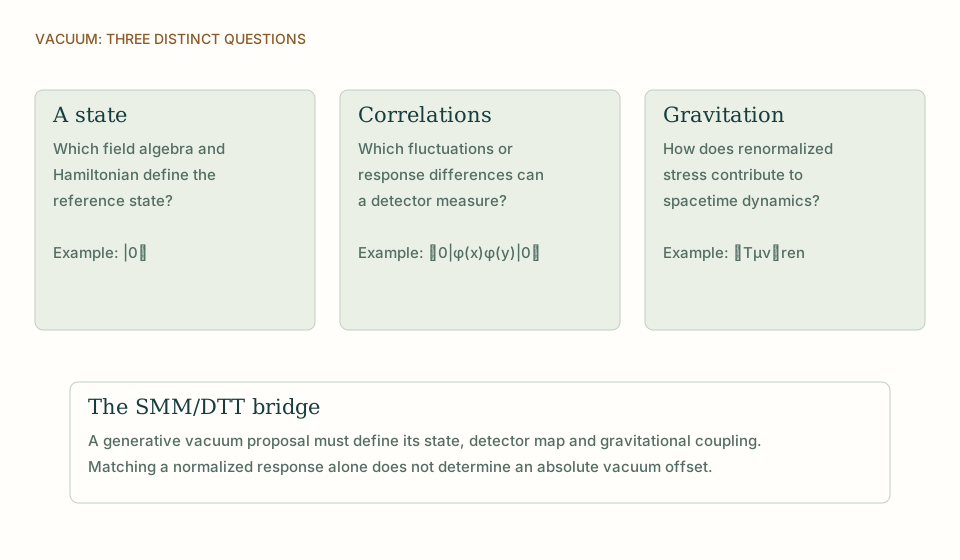
Semiclassical gravity couples a classical metric to the renormalized expectation value of quantum stress-energy. Quantum fields propagate on that metric, and their averaged energy and pressure contribute to its dynamics. The approximation is useful in regimes where a mean field description is adequate; it need not remain reliable when metric fluctuations or stress-energy fluctuations become essential. Renormalization also introduces allowed local gravitational terms, whose parameters require specification.
This is a natural intermediate target for DTT because a source-generated field state and an effective geometry must eventually influence one another consistently. Recovering a field equation on a prescribed background is weaker than deriving that feedback. Covariant stress-energy conservation is particularly important: arbitrary time dependence assigned to vacuum energy cannot be inserted into Einstein’s equation without a consistent pressure or exchange law. A valid source contribution would derive a conserved effective stress tensor from the same dynamics that generates records. A microscopic temporal interpretation alone does not fix the finite vacuum term or the domain of the semiclassical approximation. [2]
Semiclassical cosmology connects quantum fluctuations to an evolving metric and then to observable structure. DTT’s one-source aim would be stronger if it generated both the mean expansion and the fluctuation state with the same conserved dynamics. Otherwise a source model can fit the background and primordial spectrum independently, leaving their apparent agreement unexplained.
The tilt calculation demonstrates how even a small exponent affects power across scales, while the transfer integral shows why the effective geometry matters to the final CMB prediction. A source time parameter needs calibration against the clock in the perturbation equation, and a readout scale needs calibration against physical wave number. Those maps cannot be chosen separately for each mode without destroying predictive content. A useful DTT construction could impose a relation between a source-memory correlation time and a spectral feature, then determine its angular consequence under a fixed cosmology. The semiclassical comparison makes the target precise: a jointly consistent background, stress-energy and perturbation process, with a stated regime of validity and no hidden freedom to retune the source spectrum after transfer. [2] [3] [4] [5]
Write the dimensionless primordial curvature spectrum as Pℛ(k)=As(k/k*)^{ns−1}. For an illustrative ns=0.965, a factor of ten increase in wave number changes the spectrum by 10^{−0.035}≈0.923, a reduction of about 7.7 percent. The tilt is small but it changes the relative strength of modes across a wide range of scales.
This is not yet an angular CMB spectrum. In a standard linear calculation, Cℓ=4π∫d ln k Pℛ(k)|Δℓ(k)|², where the transfer function includes the cosmological evolution and the chosen observable. A source model predicting a modulation of Pℛ must propagate it through the same transfer calculation before comparing with data. It also needs the normalization As; obtaining a plausible slope alone leaves the amplitude unexplained. The numerical tilt used here is the familiar Planck-era benchmark, not a claim to quote the newest combined constraint. [3] [4] [5]
k and k* are comoving inverse lengths in the same units. Pℛ is dimensionless; temperature conventions determine the units of Cℓ.
A useful DTT prediction would be an overconstrained relationship between amplitude, tilt, running or higher-order correlations derived from one source mechanism. An arbitrary function of scale can fit many spectra but explains little. The programme becomes sharper when the model is fixed before inspecting residuals, and when the same parameters also produce an acceptable background expansion. Historical anomalies should remain hypotheses to analyze with their statistical and foreground limitations, not be advertised as signatures of the Single Monad. [3] [4] [5]
THE SAME QUESTION, DIFFERENT STARTING POINTS
| Question | SMM/DTT | semiclassical gravity |
|---|---|---|
| Starting structure | One nonspatial source, retained memory and six nested inner functions with an outer completion interface. | Classical metric coupled to renormalized quantum stress-energy. |
| Observable connection | The source update and readout must generate the measured records and their calibrated relations. | A conserved effective stress and a controlled mean-field regime. |
| Cosmic microwave background and primordial structure | The tilt calculation demonstrates how even a small exponent affects power across scales, while the transfer integral shows why the effective geometry matters to the final CMB prediction. | Semiclassical cosmology connects quantum fluctuations to an evolving metric and then to observable structure. |
| Status of the claim | A constructive research programme; a specified finite model establishes only its stated conditional results. | An approximation; it does not supply complete quantum metric dynamics. |
KEEP THE CONNECTION
Connects this comparison with the author’s underlying construction.
Connects this comparison with the author’s underlying construction.
Connects this comparison with the author’s underlying construction.
Connects this comparison with the author’s underlying construction.
Places the comparison alongside the programme’s published results, assumptions and open targets.
References support the comparator and the specific mathematical or interpretive claims indicated. SMM/DTT connections are developed in the analysis above.
How these comparisons distinguish premises, results and physical claims
SMONAD
Share this page, or keep a clear reference to the work you are reading.
Use this reference for the explanation on this page. “n.d.” means its first publication date is not specified; the update date is recorded separately.