
In this article
- The question behind this comparison
- The SMM/DTT starting point
- How the comparator works
- The decisive comparison
- Worked benchmark
- What follows for the source programme


A primordial spectrum reaches the observed microwave sky through cosmological evolution and transfer. Comparing DTT with unimodular gravity, this article calculates the effect of a small spectral tilt and explains how source-memory correlations could become a restricted prediction for temperature, polarization and structure under one calibrated physical model.
The cosmic microwave background encodes primordial perturbations after their propagation through an evolving plasma, gravitational potentials and photon transport. A primordial power law is only the starting input; temperature, polarization and lensing spectra require transfer functions and cosmological parameters. An underlying theory must therefore connect its source fluctuations to the gauge-invariant perturbations used in those calculations.
DTT can ask whether coherent or correlated generation produces a restricted primordial spectrum. This is more specific than connecting the universe’s visual uniformity with the unity of its source. One source can generate either highly irregular or highly symmetric outputs depending on its law and memory. The explanatory content lies in a probability distribution and correlation structure selected by the dynamics, together with the clock and length calibration needed to identify a physical wavelength. [3] [4] [5]
The Single Monad Model begins with one nonspatial generative source. The Duality of Time Theory distinguishes the source’s inner production from the outer order in which completed records become accessible. Its six inner levels are nested functional roles of one process: a higher role organizes lower-level work. The seventh is the completion or observation interface. They are neither six independent clocks nor six additional time coordinates.
This distinction supplies a useful research question: which features of an observed world can follow from the way a source produces, retains and releases information? A concrete answer needs a state space, an autonomous update, retained memory and a rule connecting completion to an accessible measurement. In the constructions discussed here, those mathematical ingredients are stated explicitly. A successful finite example establishes what its specified mechanism can do; further arguments connect it to physical particles, spacetime or universal laws. [1]
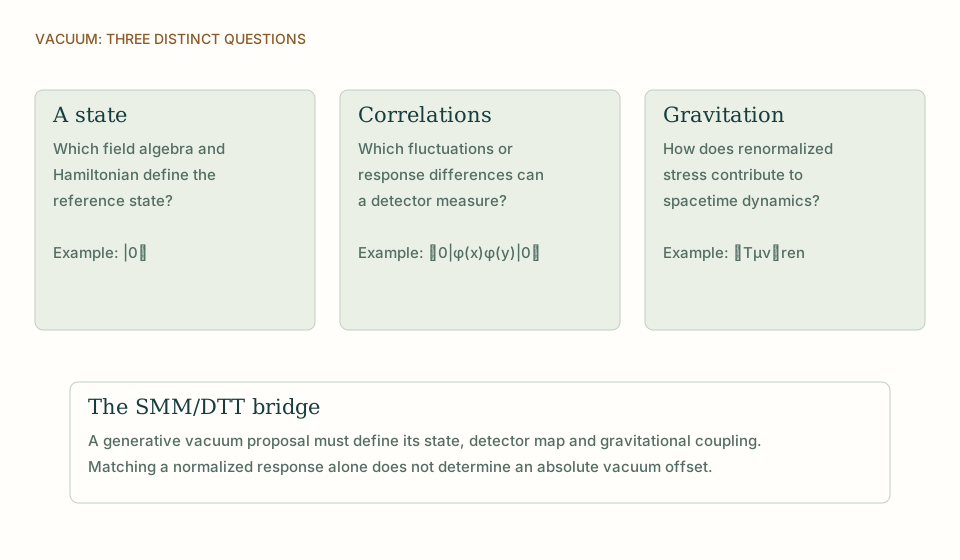
Unimodular formulations reorganize the gravitational equations so that the cosmological constant can arise as an integration constant rather than as a conventional fixed coupling in the action. In a common classical presentation, the metric equation is trace-free. With covariant conservation of matter, integration restores an Einstein equation with a constant term. Different covariant and constrained formulations can differ in their quantization and treatment of global variables.
This is relevant to SMM/DTT because a completion or normalized-response rule may remove sensitivity to an additive offset in a particular observable. But mathematical insensitivity to a constant and prediction of the constant’s measured value are different results. Unimodular gravity does not automatically select that value or explain every radiative contribution. A DTT link would need a dynamical reason that its generated geometry obeys the trace-free equation or its covariant equivalent, together with a rule fixing the global integration data. Calling the source vacuum offset unobservable in a local response is insufficient to establish its gravitational absence. [2]
Unimodular gravity can share the usual classical perturbation predictions in formulations and regimes equivalent to general relativity, while other quantization choices may differ. DTT cannot infer a novel CMB spectrum merely from treating Λ as an integration constant. The source’s state, perturbation dynamics and physical clock still have to determine the initial correlations.
The transfer calculation makes the required comparison explicit. A modified primordial spectrum must be evolved through the actual gravitational equations of the chosen formulation, and a changed background must be used consistently in that transfer. If DTT proposes a global completion constraint, it could in principle restrict large-scale modes or their correlations, but the effect needs a derived formula and a specified ensemble. Simply suppressing an inconvenient mode by hand does not show that the source selected it. The useful connection is a possible link between global source data and cosmological initial conditions. To establish it, the theory must state whether it changes a boundary condition, a dynamical equation or a quantum measure, since those changes have different observational implications. [2] [3] [4] [5]
Write the dimensionless primordial curvature spectrum as Pℛ(k)=As(k/k*)^{ns−1}. For an illustrative ns=0.965, a factor of ten increase in wave number changes the spectrum by 10^{−0.035}≈0.923, a reduction of about 7.7 percent. The tilt is small but it changes the relative strength of modes across a wide range of scales.
This is not yet an angular CMB spectrum. In a standard linear calculation, Cℓ=4π∫d ln k Pℛ(k)|Δℓ(k)|², where the transfer function includes the cosmological evolution and the chosen observable. A source model predicting a modulation of Pℛ must propagate it through the same transfer calculation before comparing with data. It also needs the normalization As; obtaining a plausible slope alone leaves the amplitude unexplained. The numerical tilt used here is the familiar Planck-era benchmark, not a claim to quote the newest combined constraint. [3] [4] [5]
k and k* are comoving inverse lengths in the same units. Pℛ is dimensionless; temperature conventions determine the units of Cℓ.
A useful DTT prediction would be an overconstrained relationship between amplitude, tilt, running or higher-order correlations derived from one source mechanism. An arbitrary function of scale can fit many spectra but explains little. The programme becomes sharper when the model is fixed before inspecting residuals, and when the same parameters also produce an acceptable background expansion. Historical anomalies should remain hypotheses to analyze with their statistical and foreground limitations, not be advertised as signatures of the Single Monad. [3] [4] [5]
THE SAME QUESTION, DIFFERENT STARTING POINTS
| Question | SMM/DTT | unimodular gravity |
|---|---|---|
| Starting structure | One nonspatial source, retained memory and six nested inner functions with an outer completion interface. | Trace-free or covariant constrained gravitational formulation. |
| Observable connection | The source update and readout must generate the measured records and their calibrated relations. | Local metric equations plus global integration data. |
| Cosmic microwave background and primordial structure | The transfer calculation makes the required comparison explicit. | Unimodular gravity can share the usual classical perturbation predictions in formulations and regimes equivalent to general relativity, while other quantization choices may differ. |
| Status of the claim | A constructive research programme; a specified finite model establishes only its stated conditional results. | A family of formulations; local offset cancellation does not select the constant. |
KEEP THE CONNECTION
Connects this comparison with the author’s underlying construction.
Connects this comparison with the author’s underlying construction.
Connects this comparison with the author’s underlying construction.
Connects this comparison with the author’s underlying construction.
Places the comparison alongside the programme’s published results, assumptions and open targets.
References support the comparator and the specific mathematical or interpretive claims indicated. SMM/DTT connections are developed in the analysis above.
How these comparisons distinguish premises, results and physical claims