


Expansion rate and acceleration are different observables
The expansion rate H=ȧ/a measures fractional growth of the scale factor. Acceleration concerns ä, the rate of change of ȧ. An expanding universe can have H decreasing while ä is positive. Confusing these quantities can make a perfectly consistent model appear contradictory.
The laboratory supplies flat Einstein gravity with separately conserved pressureless matter and a constant vacuum component. Radiation, spatial curvature, interactions between components, and changing dark-energy equations of state are omitted. The input Ωm is the matter fraction at the reference epoch a=1, and ΩΛ=1−Ωm. It is an illustrative slider, not a fitted measurement. [C08] [C09]
A constant positive vacuum energy density has negative pressure in this baseline. That response influences the acceleration equation. The calculation describes what a chosen vacuum term does; it does not explain why the source selects its magnitude.
Track the transition with one set of inputs
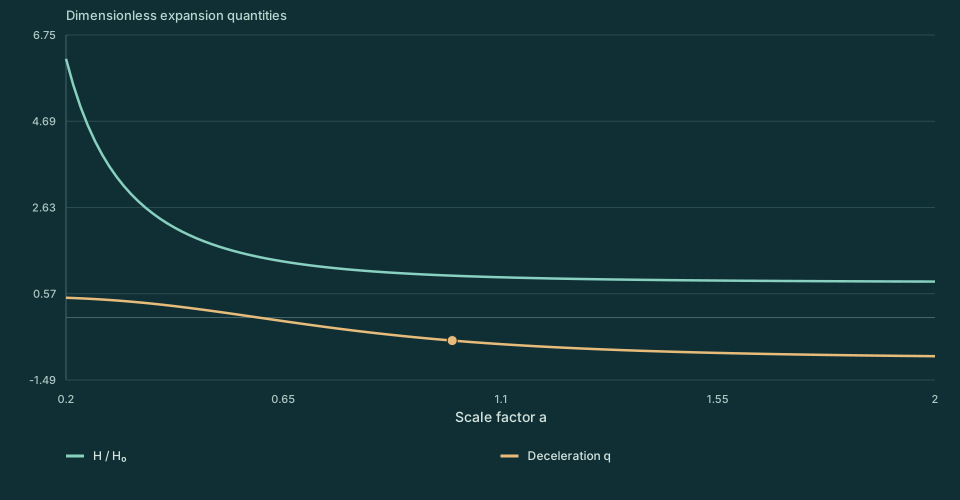
Change the reference matter fraction and select a scale factor. The graph displays H/H₀ and the deceleration parameter q. The readout also shows the matter and vacuum shares at the selected epoch. Those shares change with a even though the reference parameter Ωm stays fixed.
Interactive calculation
Play scans Scale factor a. Step advances it. No animation starts automatically.
Enable JavaScript for adjustable values. The static figure and worked calculation remain available.
For the illustrative choice Ωm=0.3, H/H₀=1 and q=−0.55 at a=1. At a=1/2, H²/H₀²=3.1 and q≈0.1613, so the earlier model is decelerating. At large a, its matter contribution becomes small and q approaches −1.
Set Ωm=1 to recover pressureless matter with q=1/2. Set Ωm=0 to obtain the pure constant-vacuum limit with H/H₀=1 and q=−1. These endpoint checks verify the normalization independently of the intermediate curves.
The component shares sum to one at every displayed epoch. For Ωm=0.3 and a=1/2, the matter share is 2.4/3.1≈0.7742 and the vacuum share is 0.7/3.1≈0.2258. Those fractions differ from the reference values 0.3 and 0.7 because the conserved matter density changes with the physical volume.
Derive the mixture and its acceleration threshold
The matter term follows from conservation of pressureless matter in an expanding comoving volume. The constant term follows from a separately conserved component with pressure minus its energy density. In units c=1, the fluid equation ρ̇+3H(ρ+P)=0 then gives ρ̇=0.
The acceleration equation ä/a=−4πG(ρ+3P)/3 weights matter and vacuum differently. Matter contributes positively to the deceleration numerator, while the vacuum contributes negatively. A positive vacuum density therefore does not need to be negative energy in order to drive acceleration.
Acceleration begins when the matter density falls below twice the vacuum density. For Ωm=0.3, this occurs at a≈0.5984. Equality of the two densities instead occurs at a≈0.7539. Equal densities and the acceleration transition are therefore distinct events.
The identity Ḣ=ä/a−H² explains how H can decline during accelerated expansion. In this mixture, Ḣ is negative whenever matter is present, while H approaches a positive constant in the vacuum-dominated future. The scale factor eventually grows approximately exponentially even as its fractional growth rate settles.
A geometric effect is not a source-level value
The final conversion distinguishes energy density, mass density, and the cosmological constant. Their units differ. A source expression for an energy per volume must not be inserted directly where an inverse-length-squared coefficient is required. Gravitational and matter conventions must be matched together. [C02] [C03]
The offset experiment earlier in this sequence showed why normalized populations can miss a common energy shift. That obstruction does not mean gravity is insensitive to vacuum stress; it means those normalized records do not supply the absolute geometric response. The present baseline assumes the response through Einstein's equations and asks what follows.
Temporal averaging can smooth fluctuations but cannot, by itself, select a small mean vacuum contribution. A successful SMM/DTT model would derive a protected relation, cancellation, or other explicit mechanism in the metric-sensitive action and show its behavior under matter-sector changes. Replacing an unexplained coefficient with an unexplained completion count would leave the same question open. [C03] [C10]
Continue to structure growth to test a different aspect of cosmology. The original vacuum-curvature guide develops matching and averaging, and the constants explorer records dependencies among scales.