


Begin by specifying what the word vacuum means
A physical vacuum is a state within a defined theory: it has observables, correlations, and a rule for responding to disturbances. The metaphysical absence of a pre-existing spatial arena is a different idea. SMM/DTT investigates how a common source might generate the former without presupposing the latter. The distinction prevents a picture of emptiness from silently supplying a quantum field theory. [C03]
The first laboratory is deliberately smaller. It is a three-level canonical probability model with supplied energies and an inverse-temperature parameter. It contains no quantum field, spacetime dynamics, pressure, or gravitational equation. Its purpose is to isolate an exact information question: which changes in energy can normalized populations detect?
This question matters because a reconstruction based entirely on relative or normalized records can leave an absolute parameter undetermined. Identifying that freedom is useful: it tells a source theory which additional physical response must be supplied rather than hidden inside a normalization convention.
Move the levels without changing their spacing
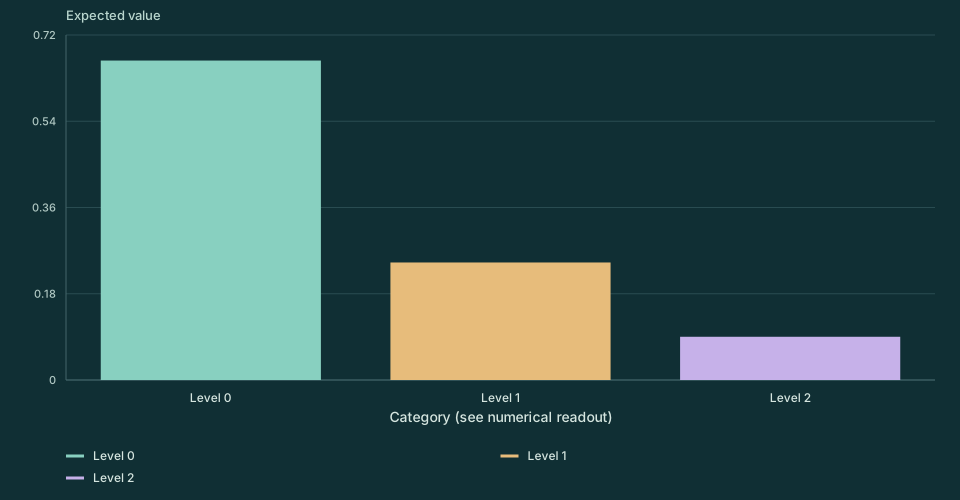
The unshifted dimensionless levels are 0, 1, and 2. Change the common offset C and compare the probability bars. Then change the inverse-temperature parameter β. The first operation leaves the bars unchanged; the second changes their relative heights.
Interactive calculation
Play scans Common energy offset C. Step advances it. No animation starts automatically.
Enable JavaScript for adjustable values. The static figure and worked calculation remain available.
At β=1 the populations are approximately 0.66524, 0.24473, and 0.09003. With C=0 the mean dimensionless energy is about 0.42479. With C=2 it becomes about 2.42479, although every population is exactly the same. The probability experiment alone cannot identify C.
Collecting more population measurements at other temperatures does not resolve that ambiguity. For every positive β, two models with different common offsets still predict exactly the same normalized distribution. The obstruction is therefore structural, not a consequence of too few samples. An additional observable sensitive to the absolute offset would have to enter the specification before the inverse problem could have a unique answer.
In the limit β→0, all three populations are 1/3 regardless of their distinct energies. As positive β increases, the lowest level dominates. Adding a common offset does not change which level is lowest, any transition gap, or the approach to that limiting distribution.
See exactly where the offset cancels
The common factor e−βC cancels between numerator and denominator. Here β represents E*/(kBT), so the exponent is dimensionless. The finite model can equally be studied as a chosen exponential weighting rule without identifying a laboratory temperature.
Normalization gives Σpi=1. All pairwise ratios satisfy pi/pj=e−β(i−j), which depends only on a gap. The mean shifts by C, while the variance and entropy −Σpiln pi remain unchanged. These provide separate checks on the numerical implementation.
The analogous isolated quantum identity is e−i(H+CI)T/ℏ=e−iCT/ℏe−iHT/ℏ: a common scalar offset adds a global phase. This establishes invariance of ordinary density-matrix evolution. It does not establish that every physical coupling is insensitive to a vacuum-energy density.
The missing response is a gravitational question
In a metric theory, a term proportional to physical spacetime volume contributes when the metric is varied. Whether an offset is merely a convention or belongs to the gravitating action depends on that full specification. The normalized three-level model has no such geometric variation and therefore cannot settle the cosmological-constant problem. [C02] [C03]
A source calculation would need an absolute, metric-sensitive functional, a state, a regulator or controlled limiting prescription, and a common normalization for curvature and matter. Repeating inner cycles does not automatically divide an energy sum by the number of cycles. Likewise, averaging independent fluctuations reduces their variance while leaving their mean intact.
The published completion and phase papers constrain aspects of retained structure and dynamics. They do not make this finite thermal illustration into a physical vacuum. Its SMM/DTT use is diagnostic: it exposes the information a completion map can discard and identifies an additional response that must be reconstructed. [P01] [P02]
Continue to isotropy. The original generated-vacuum guide develops the source-to-geometry question, and vacuum curvature treats the absolute normalization explicitly.