
A common source can support multiplicity through histories and retained records. Its explanatory strength depends on which observable structures its dynamics selects together.
What would count as explaining multiplicity?
SMM proposes unity at the level of generative origin. This does not assert that every observed object has the same state, nor that a source is a tiny object already located inside space. A pre-spatial source is described through allowed states and operations before locations are assigned. Its unity concerns the origin of distinctions; their number concerns the records those operations can produce.
The strongest objection asks whether this simply hides the whole universe inside an unspecified source. The constructive answer is to constrain the source: give its state, autonomous update, memory budget, completion criterion and permitted tests. Then show that several independently measured features follow from those restrictions. A single label for an unrestricted simulator explains little; a common law that excludes alternatives has substantive content.
One operational system, eight histories
Take two allowed operations A and B, a blank three-place register and three successive choices. The eight histories are AAA, AAB, ABA, ABB, BAA, BAB, BBA and BBB. An archive retaining the complete word distinguishes eight records. A detector retaining only the parity of the number of B operations distinguishes two: four words have even parity and four have odd parity.
The inputs are the two operations, three places of memory and a specified detector. No multiplication of fundamental sources was required to obtain either count. Yet memory has not appeared for free: distinguishing eight alternatives requires capacity for eight labels, or three classical bits in this finite example. Choosing parity discards information. The example establishes a mechanism for multiplicity while making its resource and readout assumptions inspectable.
When are two histories really the same record?
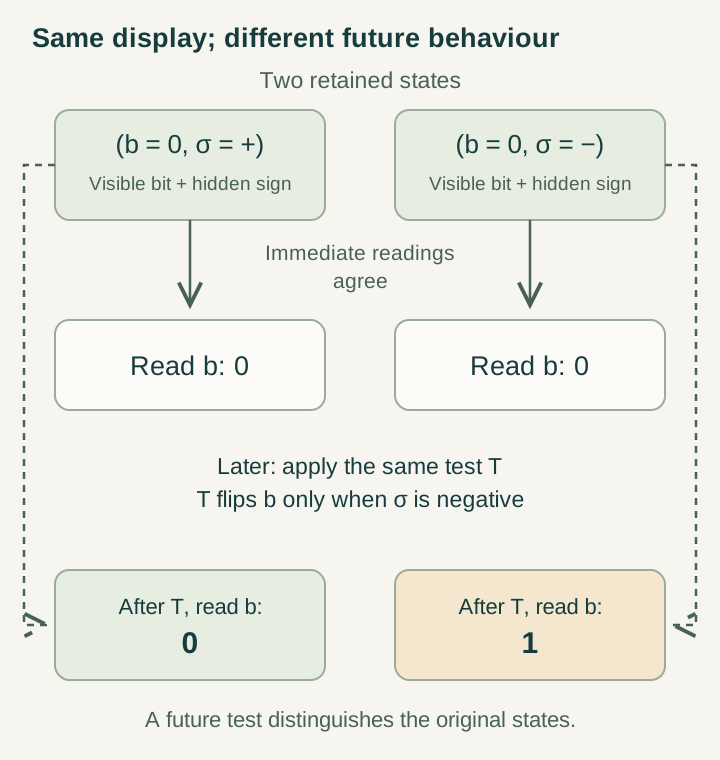
Present agreement is insufficient if a later allowed control can reveal a difference. Let a complete state be (b,m), with visible bit b and hidden bit m. The states (0,0) and (0,1) currently display zero. Apply the admitted control b→b XOR m. Their next outputs are zero and one, so a predictor using b alone cannot describe both preparations.
This implication is exactly the condition for defining a deterministic record update V by V(Π(h))=Π(Uh). It is sufficient because all representatives yield the same answer; it is necessary because a function cannot assign two futures to one input. Including every admitted continuation gives the appropriate predictive equivalence. A richer test language can therefore reveal multiplicity hidden by a simpler detector.
Open the full-size diagram →
How can renewed generation preserve an object?
Persistence can be a stable relationship between successive records rather than the survival of an unchanging microscopic token. A pattern can move through different registers while retaining charge, correlations and a reproducible response to intervention. To call it the same object, the model must specify a transport rule connecting those records and predict when that identification fails.
A useful comparison is a copied classical label versus a bound excitation. Both may recur, but only the latter claim requires a dynamics that restores or confines disturbances and yields an excitation spectrum. A source model should perturb the pattern and calculate its lifetime, not merely replay its description. DTT contributes the distinction between the work that generates the next configuration and the completion that makes its persistent relationships available.
Why source unity does not already determine geometry
An explicit short argument locates the missing geometric input. Suppose a nonzero real vector space has no selected operations or metric, and a bilinear form B is required to be invariant under every active linear automorphism. Scaling every vector by two is allowed. Invariance demands B(2v,2w)=B(v,w), while bilinearity gives B(2v,2w)=4B(v,w). Consequently B vanishes.
This concerns active symmetry of otherwise unstructured data, not a change of coordinates for a given metric. Nonzero geometry becomes possible when source operations, a norm, a state or a restricted observation family break that freedom. For example, declaring elementary transitions defines graph adjacency. The scientific question then becomes why those transitions form and preserve the particular local relationships encountered by observers.
What makes a single law stronger than a shared controller?
A controller can execute one programme for positions, another for clocks and a third for matter. This is a valid implementation of multiple rules, but their compatibility remains separately supplied. The stronger SMM objective is a restriction tying the outputs together: a change in the source that modifies geometry should impose a calculable change in clock or propagation response.
The six inner roles can organize dependent stages of that work, with the seventh role certifying an available outer record. They are not six independently adjustable clocks. Their usefulness is demonstrated when the retained outputs of lower stages constrain higher ones, and when all relevant memory and completion duration enter the model. Shared scheduling becomes explanatory only where it removes an independent physical choice.
A constructive answer to the objection
One source can explain how multiplicity is generated once operations, memory and tests are specified. The finite history example and predictive-quotient criterion establish this precisely. Explaining the observed kind of multiplicity requires more: stable objects, local geometry, calibrated clocks and interactions constrained by the same selected dynamics.
A productive next test holds the source law fixed while changing preparations. Reconstruct the records through future tests, measure retention and transport, and ask whether one parameter choice predicts every interface. Compare an alternative controller that reproduces one output while changing another. If the source principles exclude that alternative, their explanatory content has increased. The ambition is a unified account of observable distinctions, with each bridge expressed as a result that can be checked.
Continue with the articles
- One action, two temporal roles
Explain the draft’s same-cycle foundation: inner action is primitive, while outer record order comes from completed observable returns. Neither role automatically supplies a second readable laboratory clock.
- When two histories count as the same observation
Introduce completion and observational equivalence as distinct ways of identifying histories. Explain why the tests available to an observer determine which differences survive.
- Test languages and observable quotients
Explore how richer tests alter the distinctions retained by a record model. Introduce the draft’s correspondence between test languages and observational congruences.
- A record that carries its own completion certificate
Introduce autonomous generation of a record and a flag certifying completion. Explain why the certificate must arise from the specified dynamics rather than an external declaration.
- Programmed geometry and spontaneous selection
Compare the draft’s explicit torus preparation with a mechanism that would naturally select geometry. A constructive example proves feasibility while leaving the physical origin of its program open.
- What spatial readout forgets
Investigate information lost when a full generative state is reduced to spatial records. Explain why an apparently complete geometry may still be insufficient for autonomous prediction.
- Why a bare source does not imply spacetime
Introduce the obstruction showing that source order alone lacks enough structure to fix Lorentzian geometry. Use it to explain the role of the reconstruction’s additional assumptions.