


The answer in brief
A meaningful relation between 137 and 128 needs a map between their readout tasks and a shared, independently normalized response law.
Go to the research challengeBegin with the physical meaning of each construction
In the proposed SMM/DTT interpretation, 137 and 128 belong to selected vacuum and readout constructions. Their difference should therefore be investigated through the records, completion rules and probes that define those constructions. Assigning them to two experimental energy scales would add a different physical interpretation and would require its own matching calculation.
The detailed 137 discussion starts with a specific continuation receiver and stopping grammar. A comparison with 128 needs equally explicit data: a state space, the retained alternatives, the permitted tests and the reason that its rank is minimal for that task. Merely placing the two integers beside each other leaves their relationship undetermined. They could describe two sectors of one receiver, a quotient and its parent, or genuinely different response tasks. Each possibility has different consequences.
The six nested inner generative levels organize dependencies before outer completion. Counting levels is not the same as counting independent binary variables. As a mathematical example, seven freely chosen bits have 128 strings, but identifying those bits with the nested levels requires an additional argument about admissible states and their dependencies.
What would a map between the two receivers establish?
Let R have dimension 137 and S dimension 128. A surjective linear map P:R→S has a nine-dimensional kernel. This exact rank statement says that nine independent directions are removed. It does not select which directions or explain why the source should remove them. If the source evolution is U and the completed evolution is V, predictive descent additionally requires PU=VP.
A small example makes the extra requirement visible. Take R=ℝ³, S=ℝ² and P(x,y,z)=(x,y). If U(x,y,z)=(x+z,y,z), the same completed record can evolve differently depending on hidden z. No map V on S can satisfy PU=VP. If U instead acts as U(x,y,z)=(x+y,y,z), the quotient evolves autonomously by V(x,y)=(x+y,y). The dimension reduction is identical in both cases; the dynamics decides whether it is a valid predictive quotient.
A proposed relation between 137 and 128 should therefore supply the kernel and verify descent for every admitted future operation, not only for one static projection.
What ratio follows if both sectors share one response law?
Assume, as a declared model hypothesis, that a normalized coupling for a rank-N receiver is gN=ζ/N. If the same source fixes the same ζ for both constructions, then the ratio is independent of that common factor:
This is a conditional structural comparison. If the sectors instead have independent factors ζ128 and ζ137, the ratio acquires their quotient and is no longer fixed by the integers. The research task is to prove the shared normalization, identify what is measured in each sector and explain how both are prepared.
Even a valid common-factor ratio would not identify either quantity with a running electromagnetic coupling. That identification requires a current, a momentum or energy convention and a physical response calculation. A vacuum-sector comparison can be valuable on its own terms, provided those terms are specified consistently.
Why removing modes can change the remaining response
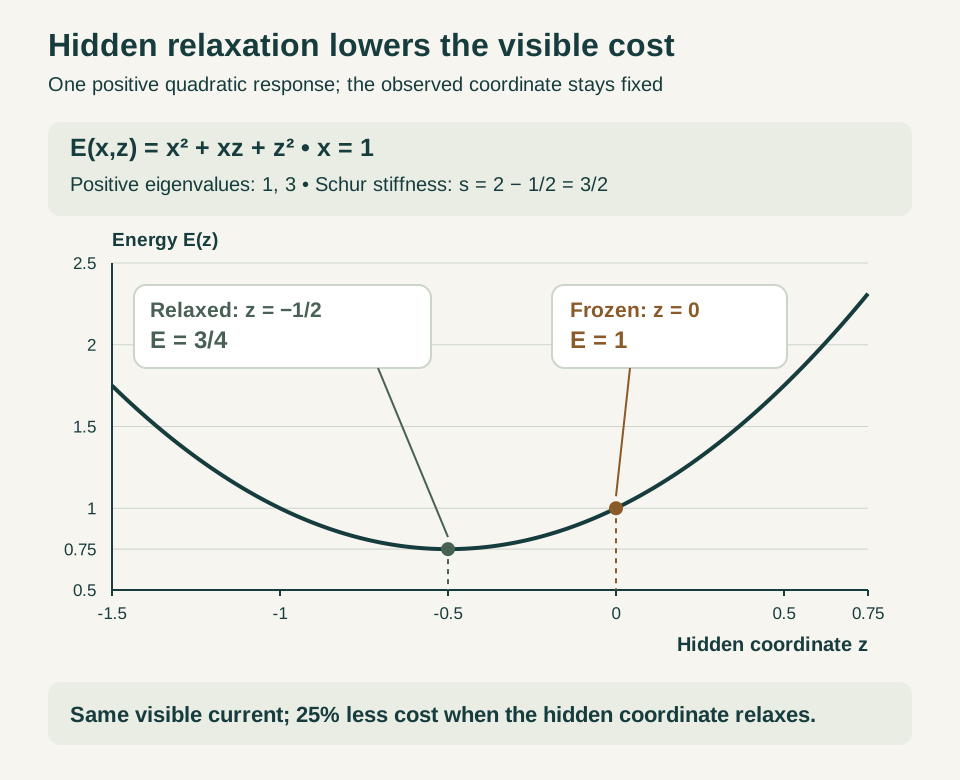
Consider a visible coordinate x and an unobserved coordinate z with energy E(x,z)=x²+xz+z². Holding x fixed and letting z relax gives z=−x/2 and Eeff(x)=3x²/4. Setting z to zero instead gives E=x². Both descriptions retain one visible coordinate, but their stiffnesses differ because one allows hidden relaxation and the other freezes it.
For a larger positive block matrix, this is the Schur-complement mechanism: Keff=Kvv−KvhKhh−1Khv. A proposed nine-mode reduction must specify whether removed modes are forbidden, unprepared, dynamically decoupled or allowed to relax. These choices can alter the response even when the visible rank remains 128. The response construction provides the natural place to test this question.
How could holonomy or matter modify an ideal value?
A useful correction programme defines a physical parameter before choosing a fitting formula. Suppose an independently identified loop has a phase θ, and an observable inverse response is invariant under θ→−θ and θ→θ+2π. A smooth even periodic correction may begin as δ(θ)=a(1−cosθ), giving δ(θ)=aθ²/2+O(θ⁴) near zero. Symmetry explains the absence of a linear term in this illustrative family; it does not determine a, the preparation of θ or the observable being corrected.
A source derivation would calculate the loop response and its coefficient from the same frozen dynamics used for the ideal construction. Matching a small fractional discrepancy by choosing θ afterward is a fit. A stronger result would use an independently measured phase or mass parameter to predict a second response, including a range where the approximation fails.
A rank reduction can also change the success probability
Prepare the maximally mixed state ρ=I/137 on the larger receiver and let P be an orthogonal projector of rank 128. A two-outcome completion test with effects P and I−P succeeds with probability Tr(Pρ)=128/137. The discarded outcome has probability 9/137. Conditioning on success produces P/128.
This gives an exact operational meaning to a possible rank-128 selection. It also shows why the success rate must remain visible in the comparison. Renormalizing the accepted state does not make the rejected preparations disappear from the resource budget. Another initial state generally gives a different acceptance probability, even for the same projector.
A physical proposal should therefore specify whether the smaller receiver arises through deterministic restriction, dynamical descent or probabilistic selection. Each option has a distinct preparation cost and response interpretation. This finite test supplies a concrete question that the source construction can answer.
A concrete programme for comparing the two integers
Construct the two receivers in a common finite source and state their vacuum/readout meanings. List the distinctions each completion retains, calculate both ranks and provide any intertwining map. Couple the same normalized probe to the two sectors and minimize the actual energy, including every allowed hidden relaxation. Finally determine whether the ratio is fixed across all remaining admissible source parameters.
This would decide whether the pair expresses a protected structural relation, two separately normalized tasks, or a promising numerical pattern still awaiting a mechanism. Mathematicians can contribute the quotient and representation analysis; physicists can identify a probe and calibration; philosophers can clarify why two completion descriptions count as two aspects of the same source. The resulting deliverable should make those contributions meet in one explicitly defined calculation.
Develop the argument
Questions to take further
- Which source-selected map relates the 137 and 128 receivers?
- Does the same probe and calibration fix their response ratio after hidden modes relax?
A concrete next step
Compare two vacuum receivers
Specify the two receiver tasks, an intertwining map if available, and their positive response operators under one calibration.
What to share
Exact ranks, a descent check, and either a protected response ratio or an explicit surviving normalization freedom.
I welcome collaboration with experts in physics, mathematics and philosophy. Get in touch with a question or proposal.