
The constructive result is a faithful 137-dimensional receiver for a declared family of histories. Its minimality follows from perfect discrimination. Sampling probabilities, phase weights and physical response require additional, separately defined operations.
1. Specify what the source must preserve
Start with a three-dimensional real readout space W. This is the output of the preceding spatial-reconstruction chapter; here it is a supplied linear space, not a proof of a metric, a clock or a propagation law. Restore an identity channel to obtain Vℝ=ℝ⊕W. A vector has four components because the identity is an operation channel in addition to three displacement components. It is not a fourth spatial direction.
Choose a positive inner product and orthonormal basis e0,…,e3. If coherent complex amplitudes are available, use V=ℂ⊗Vℝ. Its complex dimension is four, whereas its real dimension is eight. Every dimension below is over ℂ unless explicitly stated. The ordinary complex structure used here belongs to the phase reconstruction; it must not be silently replaced by a split-complex unit with square +1.
The retention task is exact: preserve every symmetric bilinear function of two prepared input vectors. Symmetric means interchanging the inputs changes nothing; bilinear means linearity in each input separately. This task is broader than remembering only the product of two source operations. A receiver meeting it stores enough information to answer every test in this declared class. SMM provides the motivation of unity beneath multiplicity; DTT asks which nested operations create and retain these distinctions before outer completion.
2. Construct the ten-mode receiver and prove its minimality
Let S exchange the two factors of V⊗V. The operator P+=(I+S)/2 is an orthogonal projector because S†=S and S²=I. Its range Q=Sym²V has basis saa=ea⊗ea and sab=(ea⊗eb+eb⊗ea)/√2 for a<b. The four diagonal and six mixed vectors are orthonormal: unequal pairs have disjoint tensor support, and the two terms in a mixed vector have total squared norm two before division.
For any symmetric bilinear test b:V×V→X, define L(saa)=b(ea,ea) and L(sab)=√2b(ea,eb). Expanding coordinates proves L(P+(u⊗v))=b(u,v). The basis also proves uniqueness. Thus Q supports the whole test class. A linear compression with a nonzero kernel loses a linear functional detecting that kernel, and consequently loses a symmetric bilinear test. Ten is therefore the minimum dimension for faithful linear retention of this task.
This result is stronger than merely listing ten symbols. It identifies the exact information requirement that makes those symbols necessary. For example, ordinary quaternionic multiplication compresses the symmetric pair space to rank four and erases six independent directions. A physical realization must preserve the extra pair memory somewhere. Writing u⊗u is not permission to clone an unknown quantum state: preparation of the two inputs remains an explicit operation.
3. Derive the binary branch counts
At depth d introduce an innovation space Id with d independent basis vectors. Choose the nonempty exterior receiver Bd=⊕k=1dΛkId. Its rules forbid repeated use of the same basis innovation in a monomial and identify order changes up to the exterior sign. A basis monomial is therefore specified by a nonempty subset of the d basis labels.
There are binom(d,k) subsets containing exactly k labels: arrange d positions, select the occupied k positions, and list their indices increasingly. Their union over k is disjoint. The binomial theorem then gives bd=Σk=1dbinom(d,k)=2d−1. At the three required depths this yields one singleton; two singletons and one pair; then three singletons, three pairs and one triple.
Binary membership is a basis-counting rule, not a restriction to binary amplitudes. A coherent state can have arbitrary complex coefficients over these basis records. Excluding the empty subset is also substantive: it means that a terminal event must record at least one innovation. Including it would replace every increment by 2d and change the final result. In a source construction the admissible test family must justify exterior retention and this stopping rule, just as it must justify symmetric retention for the continuation register.
4. Build the grammar and prove the count
Set R0=0 and define Rd=(Q⊗Rd−1)⊕Bd. The tensor product means that every continuation label remains distinguishable together with every earlier record. The direct sum means that stopping at the present depth remains distinguishable from continuing. These are free-memory rules: no further identities collapse two declared records.
Taking dimensions gives rd=10rd−1+bd. Substitution produces r1=1, r2=13 and r3=137. More explicitly:
r3=10²·1+10·3+7=137
To check that this is not double counting, tag each terminal symbol with its depth and distinguish terminal symbols from continuation symbols. A complete word is q₁q₂b₁, q₁b₂ or b₃. Its first terminal symbol ends the word, so its form is uniquely recoverable. Within a form, tensor-basis independence distinguishes every allowed label choice. Across forms, the direct-sum tag keeps the records distinct.
The same proof works for an arbitrary continuation rank q: r3=q²+3q+7. For q=4, as in a product-only compression, it gives 35; for q=10 it gives 137. That comparison isolates why retained pair memory matters. The output follows from a specific compositional task rather than from a numerological preference for a familiar integer.
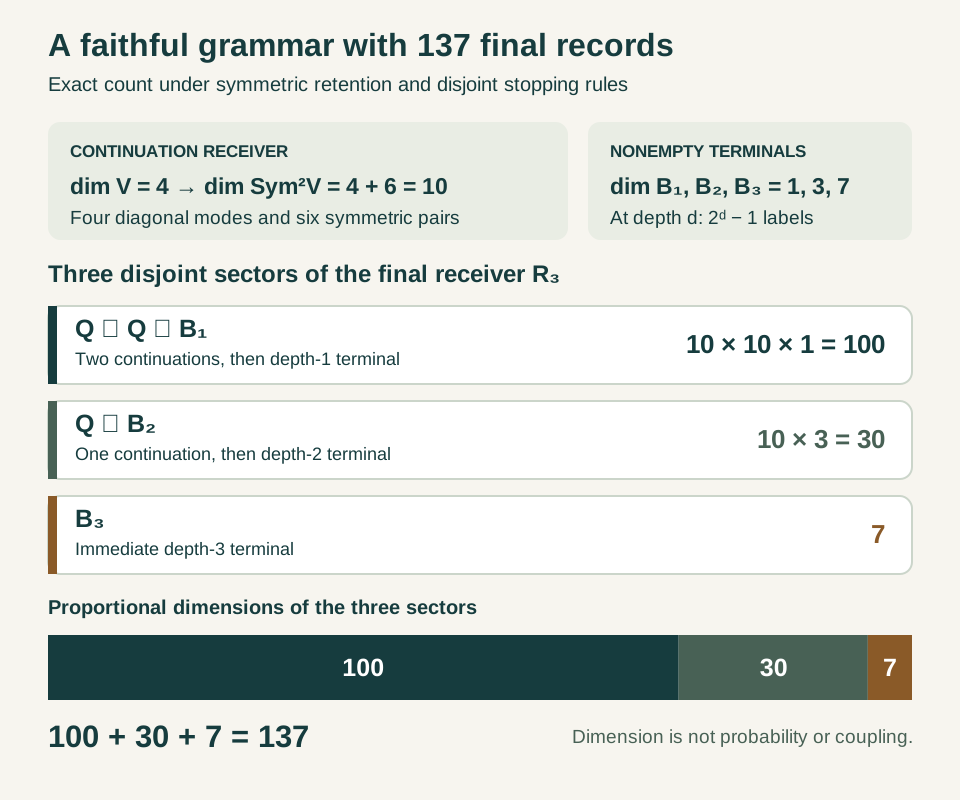
Open the full-size diagram →
5. Turn the count into an operational memory bound
Suppose the 137 possible records are encoded as normalized states ψi, and one measurement identifies every record without error. Let Ei be the positive effect reporting i, with ΣEi=I. Correct identification requires expectation one on ψi and zero on every ψj with j≠i.
Since 0≤Ei≤I, expectation one implies Eiψi=ψi; positivity makes zero expectation imply Eiψj=0. Self-adjointness now gives ⟨ψi,ψj⟩=⟨Eiψi,ψj⟩=0. The encoding space needs at least 137 orthogonal dimensions. The free basis of R3 attains the bound.
A binary register implementing this exact one-shot task needs at least eight two-level factors, because 2⁷=128<137≤256=2⁸. This does not turn eight into a new temporal level count. It describes one implementation's storage capacity, with unused states, and differs from the six nested generative roles. Likewise, log₂137≈7.098 bits is the Shannon entropy only for a uniform distribution over complete records. A biased preparation has smaller entropy while preserving the worst-case requirement to distinguish all records perfectly.
Allowing errors, permitting a sequence of external queries, or restricting the legal test family changes the operational problem. Such alternatives may be physically interesting, but their memory bounds must be proved for their own tasks.
6. Calculate what two samplers actually observe
A dimension count does not choose a probability law. To prepare a uniformly sampled final word at depth d, assign each immediate terminal symbol probability 1/rd. Assign each continuation symbol probability rd−1/rd, then recursively sample the earlier record uniformly. Summing the immediate choices gives [bd+10rd−1]/rd=1. Multiplying conditional probabilities proves that every final word has probability 1/rd.
At depth three this gives sector probabilities 100/137, 30/137 and 7/137. Let L count continuation symbols. Its generating polynomial is F(t)=100t²+30t+7, and its uniform-final-record mean is F′(1)/F(1)=230/137. The second moment is [400+30]/137, so its variance is 430/137−(230/137)²=6010/18769.
Compare a sampler that chooses uniformly among available immediate options. At depth three it has ten continuation symbols and seven terminal symbols; at depth two it has ten plus three. Each immediate terminal record then has probability 1/17, while each longer complete word has probability 1/(17·13)=1/221. Its sector probabilities are 100/221, 30/221 and 91/221, and its mean continuation count is 230/221. Both samplers are normalized and use the same receiver.
This explicit comparison prevents a count from quietly becoming a time delay. To turn L into a duration, the model needs a cost per continuation, costs for terminal operations, parallelism rules and a clock calibration. The six inner roles organize dependencies; the outer completion record must identify the observable sampling and timing protocol.
7. Keep phase degree distinct from receiver dimension
Suppose each original envelope vector and each innovation carries phase weight one. A symmetric pair has weight two. The three exterior branch weight polynomials are z, 2z+z² and 3z+3z²+z³. Tensor continuation multiplies the character by 10z², rather than merely multiplying its dimension by ten.
Expanding the graded receiver therefore gives P(z)=100z⁵+10z⁴+21z³+3z²+3z. The dimension is P(1)=137, but the total phase weight is P′(1)=500+40+63+6+3=612. For phase z on the unit circle, the determinant of this inherited action is z612. The result follows because determinants multiply eigenvalues, whereas a dimension simply counts them.
Selected uniform output action: Uout(z)=zI137, det Uout(z)=z137
If completion instead supplies the uniform output action, imposing determinant one allows phase fractions k/137 modulo one. The smallest positive fraction is then 1/137. That is an exact statement about the added action and closure condition. It is not obtained by erasing the inherited weights from a calculation while keeping their physical interpretation.
For SMM/DTT this is a useful design question: which retained instrument establishes the public phase, and how is it related to the phase carried by internal generation? An explicit intertwining or completion law can answer it. Similar numerical labels attached to dimension and phase do not provide that law automatically.
8. Quantify the consequences of imperfect retention
The free grammar gives a benchmark against which a more economical realization can be compared. Suppose the realization identifies δd independent combinations at depth d, after previously imposed relations have already been propagated. If its current rank is xd, then xd=10xd−1+bd−δd, with nonnegative integer deficits compatible with the available rank.
Expanding this recurrence gives x3=137−100δ1−10δ2−δ3. Losing one dimension at the second stage leaves 127, while losing one only at the final stage leaves 136. An early distinction is reused by many later continuations, which is why its loss is amplified. The formula is exact for linear quotient relations and the stated propagation rule; approximate distinguishability needs an error analysis rather than subtraction of a fractional dimension.
A coherent implementation also needs a positive inner product, initialized memory, legal pair preparation and an instrument that exposes the retained result. If it stores merely an accumulated product, the six pair distinctions already identified as a kernel cannot be reconstructed by relabeling the final product. Additional memory or a restricted task is necessary. This is where a mathematically free grammar becomes a concrete resource obligation.
One source remains compatible with this multiplicity because source identity and record capacity answer different questions. What matters dynamically is whether a single specified autonomous update can generate the registers, carry their dependencies and deliver the declared tests without importing independent mechanisms at each stage.
9. State the achieved result and the next theorem
The chapter has constructed the receiver, proved the count, established its perfect-discrimination minimum and calculated two incompatible sampling laws on the same state space. It has also separated inherited phase degree from a selected uniform output phase and measured the effect of lost distinctions. These are positive mathematical results for the chosen architecture.
The next chapter supplies a response operator and an independently normalized source. Its central object is a capacity, involving the inverse response operator, rather than a bare dimension. In an isotropic trace-response model an inverse-rank factor can survive, but the overall stiffness and physical action–clock dictionary still enter. Neither 137 nor a phase fraction is already the electromagnetic coupling.
A complete source theorem would explain why the same nested update selects the rank-three readout, preserves the symmetric and exterior tests, implements the terminal grammar and fixes the public response. The ideal structural count is then an upstream input to an atomic calculation. It should retain that role without being renamed a measured low-energy constant or an energy-running prediction.
Use the receiver and response workbench to vary the declared continuation rule and response weights separately. Use the research claim map to follow the assumptions attached to each step. The constructive objective is a shared source law that removes specific remaining freedoms, with each newly fixed relation visible in the calculation.
Continue with the articles
- From three-dimensional readout to retained records
A quaternionic readout, ten-mode pair memory, and a selected stopping grammar produce 137 distinguishable records. The construction makes its retention assumptions explicit and leaves physical coupling as a separate problem.
- Why a record count is not yet a coupling
A receiver's static response depends on its source and inverse stiffness, as well as its size. Exact minimization shows why counting 137 records does not by itself determine an electromagnetic coupling.
- Trace-sector response and the Schur complement
Allowing hidden traceless modes to relax changes the stiffness seen by a trace source. The Schur complement gives the exact reduced capacity and exposes the normalization still needed for an inverse-rank coupling.
- The conditional ideal value one over 137
The ideal model value 1/137 requires a selected record count, a trace-response law, and an additional absolute normalization. A hydrogen-like calculation checks their consistency without deriving the measured fine-structure constant.
- Why the symmetric receiver has ten modes
The symmetric square of a four-component envelope contains four diagonal and six off-diagonal pair modes. Retaining all ten requires genuine pair memory, beyond the information in a quaternionic product.