
The selected free grammar has 137 distinguishable receiver modes. Probability, phase closure and normalized electromagnetic response remain separate constructions whose assumptions can be tested.
Why begin with ten continuation modes?
Let a three-dimensional readout module be enlarged by an identity channel, giving a four-dimensional envelope V. The identity is an operational component, not a fourth spatial direction. If the task is to retain every symmetric bilinear input distinction without extra relations, its receiver is Q=Sym²V. Four diagonal pairs and six unordered mixed pairs give dimension ten.
For an orthonormal input basis, mixed modes are (eₐ⊗eᵦ+eᵦ⊗eₐ)/√2. Their normalization matters when the receiver is used for probabilities or response. Quaternionic multiplication supplies a useful comparator: its symmetric product maps this ten-dimensional space onto four dimensions and loses six independent distinctions. Thus the larger receiver means retained pair information. Its physical preparation and continued accessibility are substantive memory assumptions.
How the grammar produces 137
At depth d use a d-dimensional innovation space and retain its nonempty exterior branches. The basis count is bd=Σk=1dbinom(d,k)=2d−1, giving one, three and seven branches. Declare R₀=0 and Rd=(Q⊗Rd−1)⊕Bd. A continuation preserves all ten labels, while a terminal branch is kept in a distinct direct-sum sector.
The three final forms are two continuation symbols followed by a depth-one terminal, one continuation followed by a depth-two terminal, and an immediate depth-three terminal. Typed symbols and the stopping rule make their parsing unique. These are free retention assumptions, not consequences of decimal notation or of merely observing three spatial directions.
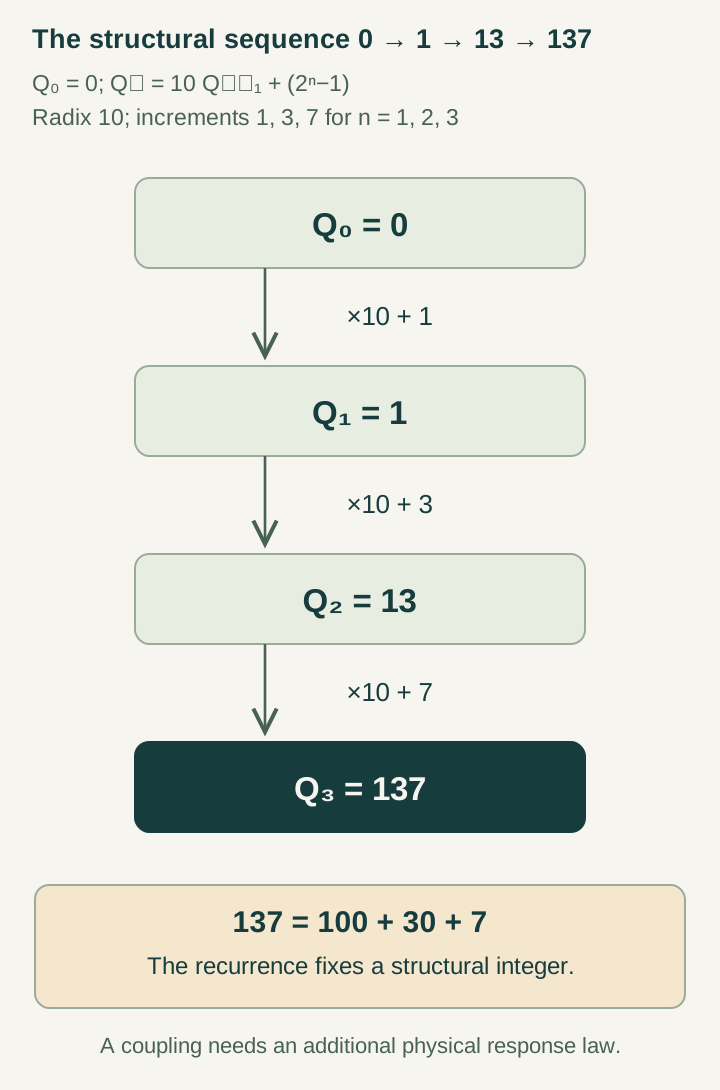
Open the full-size diagram →
What operational minimum does that count imply?
Suppose every legal word must be identified without error in one readout from an encoded pure state ψᵢ. Measurement effects Eᵢ are positive and sum to identity. Perfect discrimination requires Eᵢψᵢ=ψᵢ and Eᵢψⱼ=0 for j≠i. Consequently ⟨ψᵢ,ψⱼ⟩=⟨ψᵢ,Eᵢψⱼ⟩=0. All 137 states must be orthogonal.
A receiver of dimension at least 137 is therefore necessary for this declared one-shot task, and the free basis attains the bound. This establishes a concrete informational meaning. A task allowing errors, sequential interrogation or fewer questions can require different resources. Conversely, additional physical relations identifying words reduce the free rank. The source model must establish that all counted distinctions survive completion and the future tests actually used.
The stopping rule also matters physically. Including an empty exterior branch would change the increments from one, three and seven to two, four and eight. With the same ten-mode continuation and zero initial receiver, the successive dimensions become two, twenty-four and 248. This calculation does not propose a competing value for alpha; it identifies exactly which record convention the source must select to make 137 necessary within the grammar.
Does a count make every outcome equally likely?
No: an explicit comparison shows the remaining choice. A uniform final-word sampler assigns each word probability 1/137. Another sampler chooses uniformly among local available terminals and continuations. At the final depth there are seventeen choices; at the preceding depth thirteen. It gives each of seven immediate terminal words probability 1/17 and each of the 130 longer words probability 1/221.
Both samplers use the same receiver and normalize exactly. Only the first makes each word equally likely. An inverse rank can therefore arise as a probability under one preparation without being forced by the dimension itself. In DTT language, generating a receiver, selecting its state and exposing a completed outcome are related but different operations. Their connection must be specified dynamically.
How can the same count yield different response?
For a positive stiffness operator K and source vector f, the quadratic capacity is C=⟨f,K⁻¹f⟩. The inverse weights each accessible mode by its response, not merely by its existence. Give the 100-, 30- and 7-dimensional sectors isotropic stiffnesses κ₁,κ₂,κ₃ with ordinary trace coupling. Then C=100/κ₁+30/κ₂+7/κ₃.
Equal stiffnesses κ give C=137/κ. Doubling only the first sector gives C=87/κ, because fifty plus thirty plus seven is eighty-seven. The record grammar is unchanged, and both choices preserve symmetry within each sector. Even a stronger symmetry enforcing equal stiffnesses leaves the common overall scale free. This countermodel identifies the required source theorem: select the response weights and normalize them against independently identified action, speed and unit current.
Why a 137-fold phase closure needs its own action
A phase can act with different weights on different grammar sectors. In the inherited polynomial action, an envelope vector has weight one, a symmetric pair weight two and an exterior k-product weight k. The resulting weight polynomial is P(z)=3z+3z²+21z³+10z⁴+100z⁵. Its dimension is P(1)=137, but its total phase weight is P′(1)=612.
The inherited determinant is therefore z⁶¹². Selecting instead a common output action zI gives determinant z¹³⁷ and a 137-fold determinant-one condition. Both calculations are exact for their stated actions. Removing labels from a description does not physically change one action into the other. The completion mechanism must explain why its observable phase uses the common output action if that closure is part of the coupling argument.
What would convert the integer into a prediction?
A conditional continuum response gives gN=scont/(4πacN). With N=137, the ideal value 1/137 additionally requires scont=4πac and an electromagnetic identification of the source and matter sector. This dimensionless equality cannot be obtained by changing measurement units. It is the physical normalization target.
The structural integer is not measured inverse alpha and is not a running-coupling calculation. A stronger SMM/DTT model would derive its grammar, response and common action–clock dictionary from one law, freeze independent calibrations and predict another observable. The exact count then becomes one constraining part of a joint explanation. Keeping these stages explicit makes the 137 programme both more ambitious and more readily assessable.
Continue with the articles
- From three-dimensional readout to retained records
Trace the latest draft’s route from quaternionic readout to a selected grammar with 137 distinguishable records. Keep each structural choice visible in the explanation.
- Why a record count is not yet a coupling
Explain why the static response depends on the source and inverse response operator, not simply on the number of records. This is the central bridge required by the coupling proposal.
- Trace-sector response and the Schur complement
Introduce the reduction that gives capacity N/s under ordinary trace coupling. Show how hidden response sectors can affect an apparently simple scalar observable.
- The conditional ideal value one over 137
Summarize the extra normalization and electromagnetic matching needed for the ideal model coupling. Explain why the draft’s alpha-zero notation does not denote the measured low-energy constant.
- Why the symmetric receiver has ten modes
Count the independent symmetric quadratic combinations of a four-component envelope. Explain the receiver interpretation and why selecting that construction is a substantive modeling choice.
- Alternating branches and the ranks one, three, seven
Explain how positive-degree exterior sectors produce the branch counts used by the reconstruction. Keep the counting argument separate from any identification with particle families.
- Two phase actions and determinant closure
Compare the inherited polynomial phase with the selected coherent-output phase. Explain why determinant closure can produce a 137-fold condition only after the stated phase identifications.
- Prediction after calibration
Present the calibration-fiber criterion for a conditional prediction. An additional observable must be fixed across the allowed calibrated models to avoid merely reusing its target value.