


What is being generated?
The Single Monad Model asks how a world of distinct, related forms can be understood through a common source. In this account, the source is not a small object moving around inside a space that already exists. Spatial relations belong to what the generative activity makes available. The question is therefore prior to ordinary motion: what allows there to be distinguishable positions and persistent relations at all? [B01] [B13]
Duality of Time separates two jobs. Inner generation constitutes a configuration. Outer observation compares completed configurations. The books use successive frames and a screen to make the distinction intelligible. A moving picture can arise from a sequence of records, even though the preparation of each record is different from the motion depicted within it. The analogy provides a question to investigate; it does not yet specify a physical update law. [B02] [B14]
This journey gives that question a concrete setting. We supply six binary roles, combine them through a readout map, connect the resulting sites, and evolve a nonnegative weight on that graph. Each chapter adds one definition and retains the earlier ones. By the final chapter, you can calculate a prediction by hand and compare it with the running model.
Watch distinctions accumulate
Use Step to generate one address, or Play to enumerate the entire set. The address count measures how many inputs have been visited; the distinct-site count measures how many different outputs have appeared. They do not grow at the same rate because several inputs can produce the same output.
Explore · teaching model v1
Teal: generated values. Gold: highlighted readout or reference.
Enable JavaScript to explore this model. The figure, worked values, and equations explain the same construction.
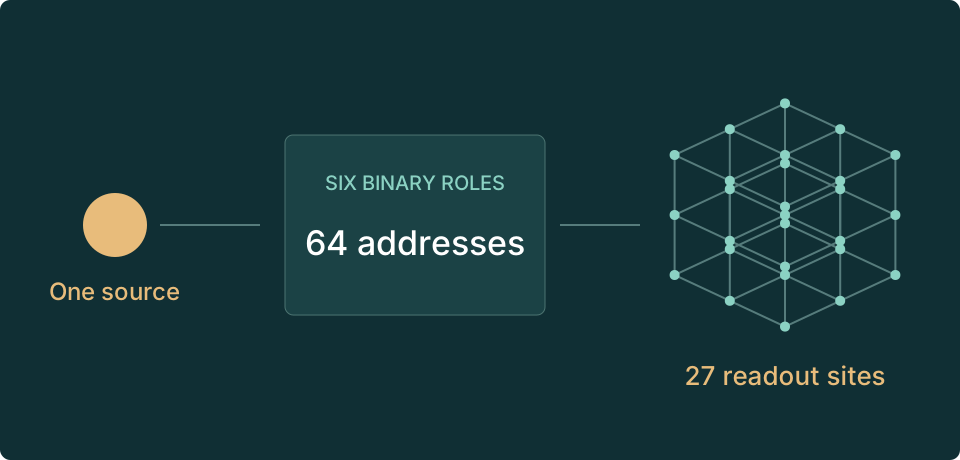
The drawing is a view of the completed coordinate convention. It is not an animation of the Monad travelling between pre-existing places. A point lights up when an address with that readout is encountered. Once all inputs have been visited, the display contains 64 visits distributed over 27 sites.
The model contract
A binary role has two allowed values. Six independent roles give 2⁶ = 64 addresses. Each paired difference has three possible values: −1, 0, and +1. Because the three pairs are independent in this construction, every triple in {−1,0,1}³ is attained, giving 3³ = 27 distinct sites.
| We supply | We calculate | We have not identified |
|---|---|---|
| Six binary roles and the pairing rule | 64 addresses and 27 readouts | A physical mechanism selecting those roles |
| A local graph and a weight-update rule | Conserved total weight and spreading | Matter, quantum amplitudes, or physical energy |
| A completion boundary and later calibration | A record count and a chosen duration scale | A universal physical clock |
The paired construction is discussed in the book material; the diffusion rule used later is an additional teaching choice made for this section. Its simplicity lets us inspect conservation, scheduling, and prediction directly. It should not be attributed to the published papers as their fundamental microscopic law. [B06] [B16]
From philosophical proposal to calculation
Three questions remain distinct throughout the journey. Why propose one source? What follows from a particular set of mathematical rules? Which of those rules describe measured physical systems? The first concerns the interpretation of the theory, the second can be settled within an explicit construction, and the third requires evidence and calibration.
The historical account of renewal motivates thinking of persistence as a maintained relation rather than an independently enduring substance. The later reconstruction programme asks for precise completion maps and accessible records. An animated model can make their relationship visible while preserving the difference between motivation and proof. [B17] [P01] [A02]
Continue to relations to see why a collection of sites is still insufficient to define locality. For the broader conceptual introduction, return to inner generation in Duality.