
Plato’s cosmological account and Aristotle’s analysis of numbered change offer distinct questions. Modern SMM/DTT can develop related construction problems without treating either account as an early physics proof.
Two primary texts and different explanatory tasks
In the Timaeus, Plato places temporal order within an account of the formation of the cosmos. The familiar cycles of days, months, and years belong to that ordered world. Aristotle’s Physics IV instead analyzes time through change, before and after, and counting.
The contrast is useful: one text asks how temporal order belongs to a cosmos, while the other examines what time measures and how it relates to movement. These are selected arguments, not a complete description of ancient thought. Reading them together reveals distinctions that remain important when a modern theory proposes to derive time rather than assume it.
Plato: order and its recurring measures
Plato relates time to a numerical moving counterpart of an eternal model and connects its measures with celestial motions. The passage gives cosmic regularity an explanatory and metaphysical role. It does not provide the operational clock theory or dynamical equations of modern astronomy.
A modern conceptual example helps isolate the issue. A sequence of repeated configurations can supply recognizable cycles, while the order in which those cycles occur supports a larger history. Neither one circular motion nor a calendar alone determines the complete temporal structure. The important question is which regular process provides a measure and what establishes its relation to other changes.
Aristotle: time and counted change
Aristotle distinguishes time from motion itself and analyzes it through the numbering of movement with respect to earlier and later. He also considers how motion measures time and time measures motion. This is not a simple identification of time with a moving object.
Imagine two wheels, one completing two revolutions for every revolution of the other. Either can provide a count, but their counts use different units. If one wheel changes rate, their ratio changes. The example is a modern aid to the problem of measure: a repeatable process and a comparison rule are needed before changes can function as a shared clock.
Infinite subdivision and finite travel
Aristotle’s discussion of continuity and the arguments associated with Zeno makes divisibility a central issue. A modern calculation separates infinitely many analytical subdivisions from an infinite elapsed duration. Divide a path of length L into L/2, L/4, L/8, and so on. The first n portions sum to L(1−2−n), approaching L.
At fixed speed v, their travel times sum to L/v. The calculation does not decide whether nature has fundamental discrete updates. It shows that listing infinitely many subdivisions is not itself an obstruction to finite motion in a continuous model. A physical discrete account needs its own transition law and a controlled relation to the successful continuous description.
A present boundary and a retained history
Aristotle’s treatment of the now raises a problem about how an interval can have temporal reality when its past and future do not exist in the same way as the present. In modern mathematics, endpoints can delimit an interval without adding finite length to it.
A record model adds another distinction: the currently available state can contain information about earlier events without those events occurring again. A rotating phase and an increasing cycle counter therefore describe different aspects of one process. The phase can recur while the retained history grows. This example helps compare cyclic imagery with temporal direction without claiming that recurrence of one variable repeats the entire world.
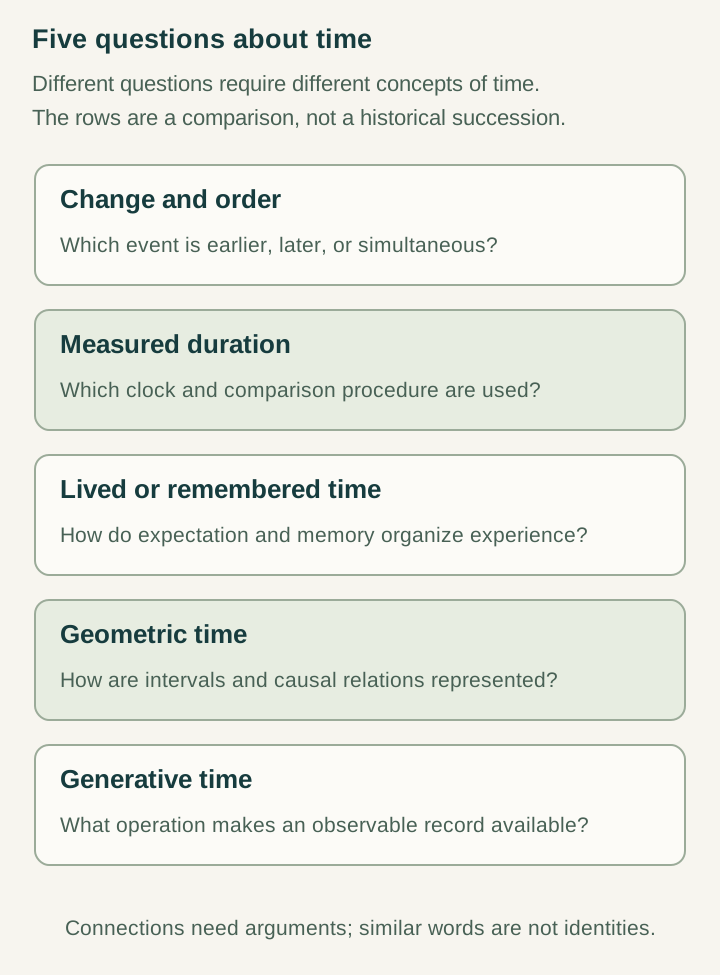
Open the full-size diagram →
What SMM/DTT can learn from the comparison
SMM asks about the dependence of multiplicity on a source; DTT distinguishes nested generation from completed observation. These questions echo concerns about cosmic order and measured change while requiring different mathematical tools. Six nested inner roles specify a proposed organization of formation, not six ancient celestial cycles converted directly into laboratory clocks.
Read A6 with A14, A25, A66, and A86. The constructive questions are whether the source derives only succession or also equal durations, whether recurrence preserves predictive memory, and how a physical clock emerges among generated processes. Historical comparison is valuable when it sharpens these questions while leaving each author’s original argument and evidence in its own setting.
Continue with the articles
- A Brief Overview of Early Cosmological Models
A historical reading guide to early cosmological pictures and the questions they tried to answer. Use their different ideas of order, motion, and origin to frame later discussions.
- Time in Greek Philosophy
Explore Greek discussions of time through the relation between cosmos, motion, and number. Prepare a careful comparison with later Islamic and modern accounts.
- The Origin of Time
Investigate how time might originate with an ordered world rather than inside an already existing chronology. Present the cosmological and philosophical meanings of this question.
- Circular Time and Cyclical Time
Distinguish circular temporal structure from repeated events in a cycle. Use that distinction to prevent recurrence, periodicity, and return from being treated as interchangeable.
- Zeno's Paradoxes
A proposed article revisiting Zeno’s paradoxes through motion, divisibility, and completed description. Use the paradoxes to motivate precise distinctions between mathematical limits and physical updates.
- When an additive clock is unique
Explain the conditional uniqueness of a scalar clock up to positive rescaling for ordered rank-one returns. Distinguish additive delays from a globally defined event time.