
Avicenna’s analysis of temporal measure and al-Ghazali’s challenge to necessary causal connections address different problems. A modern renewal model must state its own lawful update and retained relations.
A debate with several methods
The historical field includes philosophical analysis, theology, astronomy, and scriptural interpretation. This guide focuses on two identifiable primary discussions rather than treating the tradition as one theory: Avicenna’s analysis of time in The Physics of The Healing and al-Ghazali’s treatment of causal necessity in the seventeenth discussion of The Incoherence of the Philosophers.
Their questions involve explanation and dependence as well as measurement. A useful comparison with SMM/DTT should preserve that range. It should not sort thinkers into those who supposedly anticipated modern physics and those who did not, since their argumentative goals and available mathematical structures were different.
Avicenna: movement and its measure
Avicenna examines the relation between time and motion, including the different senses in which motion indicates temporal measure and time gives motion a measurable magnitude. The translated text distinguishes these roles rather than treating duration as the distance a moving body covers.
A modern illustration makes the distinction concrete. Two travelers can cover different distances during the same interval, while one traveler can cover the same distance on trips of different duration. An account of time must therefore distinguish the extent of a route, the rate of travel, and the measure used to compare processes. Naming all three change leaves the explanatory problem unresolved.
Al-Ghazali: association and necessity
Al-Ghazali uses the contact of fire and cotton to challenge the claim that familiar conjunction establishes an absolutely necessary connection between the observed events. His argument is embedded in theological concerns about divine power and the possibility of exceptional events.
The modern lesson drawn here is narrower than a direct identification with his theology: observation of one event alongside another does not by itself determine every possible causal explanation. It does not follow that ordinary regularity is useless or that contemporary physical mechanisms have been refuted. The philosophical question concerns what kind of necessity or dependence the evidence supports.
Beginning and continuing dependence
A history can have a first indexed state without explaining why its transition rule exists. A history with no first state can still be regarded as dependent on a ground. Thus a temporal beginning and an explanation of existence are distinct claims.
For a modern source model, write the allowed domain explicitly: perhaps updates are indexed by nonnegative integers, or by all integers, or by a partial order of operations. None of these mathematical choices alone decides a theological creation question. Their significance lies in what records, boundary conditions, and physical consequences they permit. The conceptual distinction prevents a supposed origin from being placed unnoticed inside an unexplained earlier time.
Lawful renewal needs preserved relations
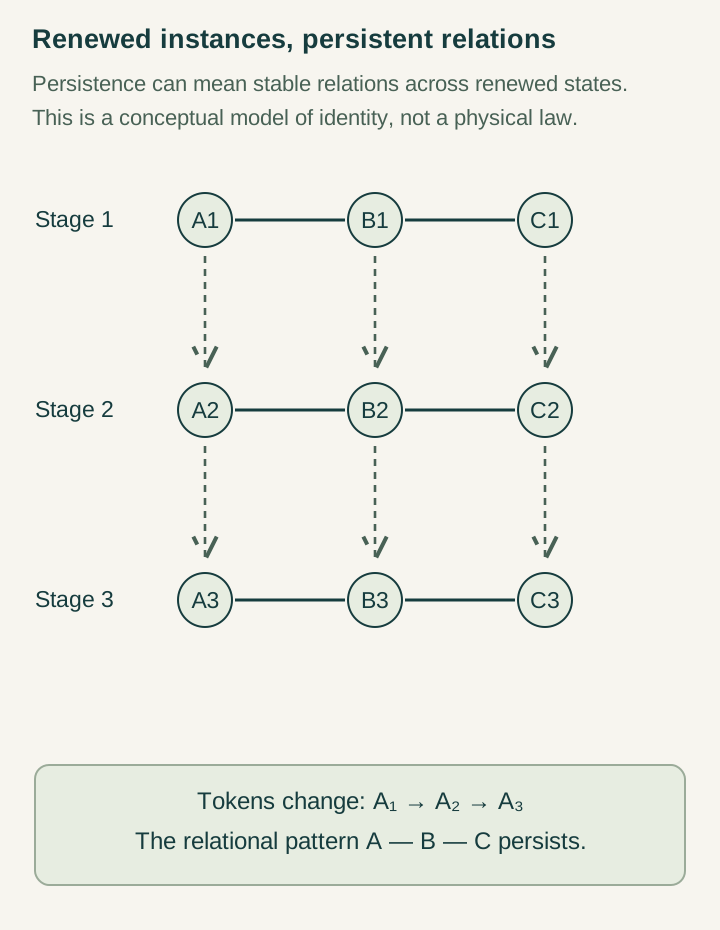
Let sn+1=F(sn) and let rn=R(sn) be a completed record. A predicate P identifies a persistent feature when P(rn) remains true along the permitted updates. Different microscopic states can then retain one operational identity.
This is a modern construction, not a translation of a medieval atom into a quantum state. It makes the persistence question explicit: which relations survive and why? Arbitrary independent replacement would not explain stable memory. A renewal interpretation gains physical content when the update law constrains later records and can calculate how interventions affect them.
Open the full-size diagram →
A precise contemporary connection
SMM seeks a common source of the regularities that different objects exhibit. DTT separates their nested formation from the completed order available to observers. Its six inner roles are dependencies in that modern proposal; they should not be equated with every historical account of temporal atomism or renewal.
Read A7 with A13, A54, A69, and A85. Ask what makes an interval measurable, what grounds a persistent object, and which source rule enforces stable causal relations across renewal. The historical arguments contribute distinctions and alternatives. A contemporary theory contributes by supplying explicit states, updates, physical clocks, and consequences that those earlier questions did not themselves determine.
Continue with the articles
- Time in Earlier Islamic Philosophy
Introduce selected Islamic philosophical debates about time, motion, and creation. Place Ibn al-Arabi’s approach alongside these debates while retaining differences between philosophical and theological methods.
- The Origin of the World
Explore why asking about the origin of the world differs from asking for an earlier event. Introduce the distinction between explanatory priority and temporal priority.
- The Principle of Ever-renewed Creation
Introduce ever-renewed creation as a central motivation of the Single Monad Model. Ask how the idea might be expressed through histories, completed records, and observable persistence.
- Causality and Induction
Examine causality and induction as separate questions about explanation and inference. Relate them to a framework in which repeated records support laws inferred by observers.
- From available records to a temporal arrow
Introduce record-positive returns as the steps that preserve or advance accessible records. Explain the conditions under which they define an effective forward action.
- Reading Volume I: time and creation
A reading route through the historical vocabulary that motivates the Single Monad framework.