
A relational account of manifestation motivates a source-to-record construction. The modern mathematical model must independently supply memory, duration, and the spatial relations that historical vocabulary inspires.
Identify the reading being presented
This guide follows Mohamed Haj Yousef’s documented interpretation in the public articles and book guides. His reconstruction presents Ibn al-Arabi’s time as relational rather than an independently existing container, and links temporal vocabulary with manifestation, days, and renewal.
That attribution matters because a historical cosmology is not exhausted by one modern summary. The articles organize passages and themes for the later SMM program. Readers should keep the original textual question, the scholar’s interpretation, and the proposed physical realization distinct. Their connection can be intellectually substantial without making every historical expression a modern scientific equation.
Relational does not mean unconstrained
In the interpretation developed here, calling time imagined concerns its status as a separately existing entity, not the denial that events can be ordered or measured. A relation can be indispensable and objectively constrained without being another object beside its terms.
Consider three markers and a fixed procedure for comparing separation. Their distances are relational, yet changing one marker changes the measured values. Likewise, an ordering can matter physically even if no independent temporal substance is postulated. The SMM question is how a single source produces such stable relational distinctions and enables different observers to compare them consistently.
An unmarked cycle cannot display its own count
The public account of time’s origin uses the problem of identifying motion. A modern idealization is a perfectly featureless rotating object observed only through its unchanged appearance. That restricted receiver cannot infer its phase or count revolutions. Adding a visible mark and a counter changes the available information.
The example does not establish that all time depends on human attention. It establishes a requirement for that measurement interface: the relevant states must be distinguishable. DTT can use this insight constructively by asking which source dynamics generates a readable phase, a completion signal, and retained information about earlier returns.
New manifestation and enduring identity
Yousef’s presentation gives ever-renewed creation a central role. The continuing appearance of a form need not mean that every aspect of its realization is numerically unchanged. This raises the question of what makes later appearance the continuation of an earlier one.
Let a memory state m be transformed by a known reversible map V. Although its visible encoding changes, decoding with V−1 recovers the same information. That is a precise example of persistence through transformation. A physical account must additionally explain the encoding, interactions, and resources. Mere similarity between two independently generated forms does not supply the same historical relation.
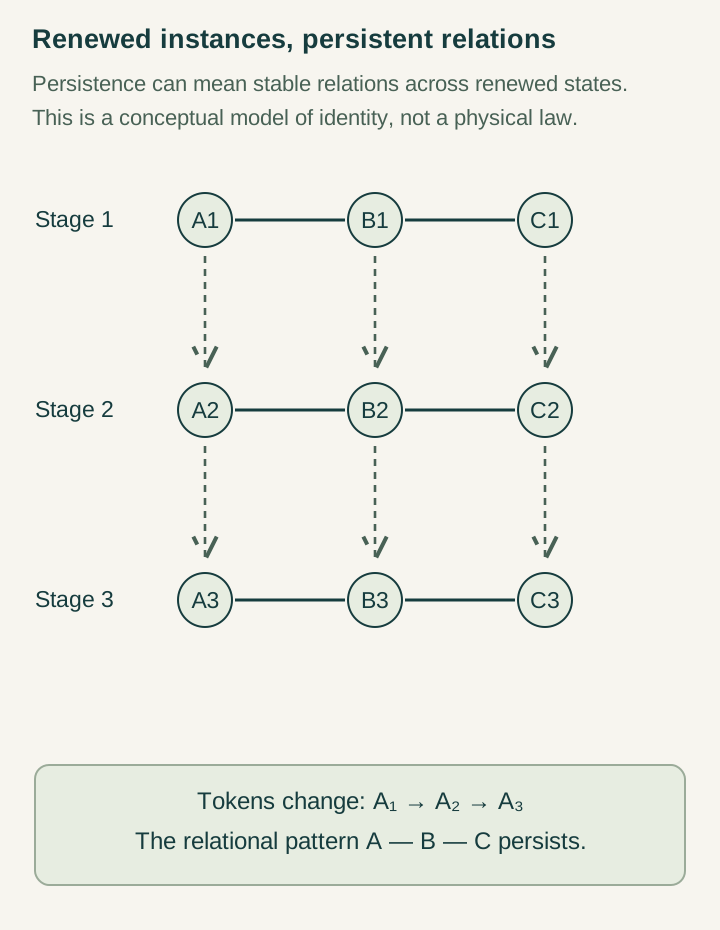
Open the full-size diagram →
Reading cycles and levels carefully
Terms such as day, moment, and age can perform different roles in a cosmological argument. The site’s historical articles discuss a wider vocabulary than an ordinary count of terrestrial days. A good reading records the intended meaning before proposing a physical counterpart.
The modern DTT formulation organizes six nested inner roles and a seventh completion role. These dependencies should not be drawn as seven independent laboratory axes or identified directly with fixed durations. The rank sequence 1,1,2,2,3,3 belongs to a particular modern readout construction. Its validity depends on the defined operations, not on a shared number or an evocative historical analogy.
From a motivating ontology to a source model
A useful bridge specifies histories, their composition, a completion condition, and an observation map. It then asks whether records retain enough information for future prediction, whether their relations define a stable spatial geometry, and whether material clocks obtain compatible durations.
Read A10, A13–A14, A27–A35, A54, and A214–A220. The historical inquiry clarifies what dependence and manifestation mean; the physical construction tests which structures follow from explicit assumptions. The next SMM/DTT advance would derive a relation among records, clocks, and matter that is not inserted independently. This preserves the historical motivation while giving the modern theory an identifiable standard of progress.
A useful reading notebook can therefore keep three columns: the historical term, its meaning within the cited interpretation, and the proposed mathematical replacement. An empty third column identifies work still required. It prevents an evocative resemblance from silently becoming a derivation.
Continue with the articles
- Introducing Ibn al-Arabi's View of Time
Introduce Ibn al-Arabi’s treatment of time as a relation associated with change and manifestation. Provide a bridge from the historical terminology to the later Single Monad interpretation.
- The Origin of the World
Explore why asking about the origin of the world differs from asking for an earlier event. Introduce the distinction between explanatory priority and temporal priority.
- The Origin of Time
Investigate how time might originate with an ordered world rather than inside an already existing chronology. Present the cosmological and philosophical meanings of this question.
- Days
Introduce the different meanings of a day in Ibn al-Arabi’s temporal cosmology. Establish why a cosmological day need not mean an ordinary rotation-based interval.
- The Moment
Explore the moment as the smallest meaningful unit of presence in the historical discussion. Ask how a moment relates to change, observation, and the apparent continuity of experience.
- Eternity
Introduce eternity without treating it as merely a very long duration. Compare timeless dependence, endless succession, and the language of beginning and end.
- The Age: a guide to the term
A glossary article on the Age and its place among the source’s expressions for time. Explain how its encompassing role differs from the repeated cycles described as days.
- The Principle of Ever-renewed Creation
Introduce ever-renewed creation as a central motivation of the Single Monad Model. Ask how the idea might be expressed through histories, completed records, and observable persistence.
- Reading Volume I: time and creation
A reading route through the historical vocabulary that motivates the Single Monad framework.
- Reading Ibn ‘Arabi — Time and Cosmology
A source-oriented entry point for the historical study underlying the later research program.