
Newton distinguishes an independent temporal framework from its sensible measures; Leibniz questions an empty temporal displacement with no relational difference. Modern reconstruction must still explain clock dynamics.
Newton’s distinction between time and its measures
In the Scholium following the definitions of the Principia, Newton distinguishes absolute mathematical time from the sensible measures commonly used in practice. Hours and days serve as measures through motion, while the underlying temporal framework is conceived independently of external changes.
This is more subtle than saying that Newton thought every actual clock was perfectly uniform. The distinction permits corrections to particular measures. The modern question it exposes is how physical dynamics identifies a useful time parameter when no instrument can simply be declared exact by definition. A temporal theory needs both mathematical organization and a model of its measuring processes.
Leibniz’s relational challenge
In his third paper to Clarke, Leibniz presents time through the order of successions. He asks what difference would be made if the whole created history occurred earlier while all its internal relations remained the same. The argument challenges a temporal distinction lacking a distinguishing relation among events.
His reasoning belongs to a broader metaphysical exchange, including questions about sufficient reason. It should not be reduced to the claim that time is whatever a particular clock displays. The enduring analytical issue is whether a proposed change represents a different physical situation or only another way of assigning labels to the same relationships.
A harmless shift and a different clock
Suppose events receive readings 2,5,9. Replacing them by 12,15,19 changes the origin while preserving intervals of three and four. Replacing them by their squares gives 4,25,81 and changes those intervals to twenty-one and fifty-six.
Both assignments preserve order, but only the first leaves duration differences unchanged. If the second is a coordinate transformation, the dynamical equations must be transformed with it. If it is the output of another physical device, its changing rate requires a mechanism. This modern example separates an unobservable choice of zero from a measurable change in the comparison between clocks.
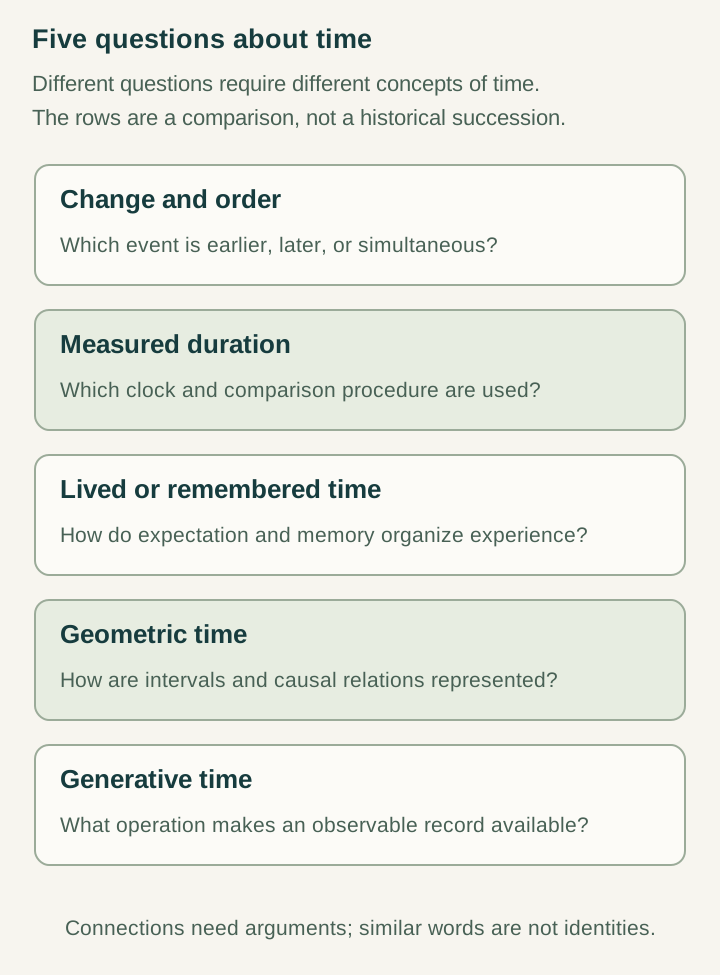
Open the full-size diagram →
Why uniform motion introduces structure
A law x(t)=x₀+vt describes constant coordinate velocity. Under s=t² for t>0, the same path becomes x(s)=x₀+v sqrt(s), whose derivative varies with s. Nothing happened to the trajectory; its parameter changed.
Thus a choice of temporal parameter can simplify dynamics, but the simplicity alone does not explain how an actual clock realizes that parameter. A material clock must have a reproducible process and coupling. In a self-contained source model, the clock’s stability cannot be supplied indefinitely by reference to another unexplained clock. The relations among several independently prepared devices become part of the physical target.
This example also explains why a coordinate description needs transformation rules. A changed numerical acceleration need not represent a changed physical experiment if the equations and measuring procedures change consistently. The real question is which relations between trajectories and clock readings remain invariant.
What the historical contrast does not settle
The absolute–relational debate does not by itself derive relativistic clock comparisons, quantum probabilities, or a thermodynamic arrow. Those questions introduce additional physical structures and evidence. A useful historical reading identifies the underlying issue without treating a broad position as a complete modern theory.
Likewise, a single hidden ordering does not automatically imply Newtonian observable time. A generative model could have internal dependencies while its completed records obey another effective geometry. The compatibility must be demonstrated through its observation maps and clocks. An inaccessible variable is neither automatically measurable time nor automatically irrelevant to every later experiment.
The SMM/DTT question after the debate
SMM shifts attention from independent temporal and spatial containers toward a common source of observable relations. DTT distinguishes nested inner generation from outer completion. The six inner roles organize dependencies, while a physical clock remains an independently defined readout of that process.
Read A8 with A11, A86, and A105–A110. Ask which temporal changes preserve all observations, which alter clock response, and what source law enforces agreement among material clocks. A successful reconstruction would contribute a dynamical answer to a question sharpened by the older debate, rather than claim that choosing the relational side has already provided the missing physical mechanism.
Continue with the articles
- Time in Western Philosophy
Compare absolute, relational, and experiential approaches to time in Western philosophy. Use the comparison to clarify what a theory must mean when it calls time fundamental or emergent.
- What is Time?
Ask what a definition of time must explain: succession, duration, change, and observation. Use the question to distinguish temporal experience from the mathematical variables used to describe it.
- When an additive clock is unique
Explain the conditional uniqueness of a scalar clock up to positive rescaling for ordered rank-one returns. Distinguish additive delays from a globally defined event time.
- What makes a clock insensitive to branching?
Explain the draft’s criterion for a clock to respond to resolution while ignoring branching. The condition is expressed through the observable algebra accessible to the clock.
- A protected material clock
Describe the model that realizes resolution-only evolution through protected couplings. Explain which interaction restrictions protect the clock and how a controlled perturbation breaks that protection.
- Why one clock model does not prove universality
Use the ungated-clock countermodel to show that a realizable clock law need not be physically universal. Explain the extra selection principle required for all material clocks to agree.
- Why a bare source does not imply spacetime
Introduce the obstruction showing that source order alone lacks enough structure to fix Lorentzian geometry. Use it to explain the role of the reconstruction’s additional assumptions.